How Does a Pile Cage Machine Improve Rebar Cage Accuracy?
Sep 30, 2026
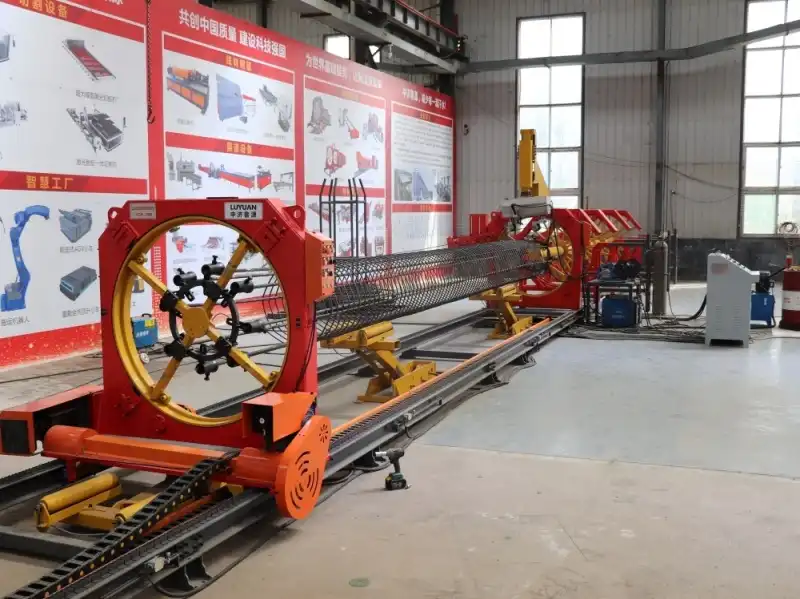
A pile cage machine improves rebar cage accuracy by replacing manual assembly with fully automated, PLC-controlled fabrication. The machine synchronizes main bar placement with spiral bar winding at programmable pitch intervals, eliminating the human error that causes dimensional drift in manual work. Gas-shielded welding locks every intersection with consistent fusion strength, while servo-driven rotation maintains cage roundness within tight tolerances. The result is a geometrically uniform reinforcement cage that meets structural load-bearing requirements on every production run—critical for pile foundations, bridges, and large-scale infrastructure projects.
Why Rebar Cage Accuracy Matters in Modern Construction
In deep foundation engineering, the shape of the cage directly affects how well the structure holds up. If the diameter, pitch, or length of a reinforcement cage doesn't match what was stated, it can lower a pile's load-bearing capacity, fail inspections, and require costly repair.
A study in the Journal of Construction Engineering and Management says that one of the top five reasons why civil infrastructure projects need to redo structures is because the reinforcement parts don't match the dimensions. When it comes to big projects like high-speed rail, highway bridges, and metro lines, this rework means delays and extra costs that procurement managers can't handle.
This is taken care of by automated cage fabrication equipment during the production stage, before the cages even get to the installation site.
Understanding the Challenges in Manual Rebar Cage Fabrication
Manual fabrication of rebar cages depends heavily on worker experience. Welders and assemblers must maintain consistent spiral pitch, keep bars evenly spaced around the cage circumference, and hold cage diameter within specification—all by hand, shift after shift.
Dimensional Inconsistency
Even skilled workers produce pitch variation when positioning stirrups manually. Studies in construction quality management show that hand-tied cages can exhibit pitch errors of ±20–30 mm compared to specified spacing, which accumulates across a 12-meter section into significant geometric deviation.
Labor Skill Dependency
Manual cage fabrication typically requires four to six workers per production line. Turnover, fatigue, and varying skill levels all introduce variability. Large infrastructure contractors in the U.S. and Europe report increasing difficulty retaining certified rebar workers, which directly affects production consistency.
Material Waste and Rework Costs
When cages fail dimensional inspection, the steel cannot be recovered efficiently. Rejected cages consume material, labor, and crane time. For procurement managers tracking cost-per-unit, manual fabrication losses represent a measurable drag on project budgets.
These pain points are well-documented across the industry and form the core reason contractors evaluate automated reinforcement cage welding systems.
How Pile Cage Machines Enhance Rebar Cage Accuracy
Automated cage production equipment integrates mechanical, electrical, and hydraulic systems to control every fabrication variable simultaneously.
PLC and Touchscreen Control
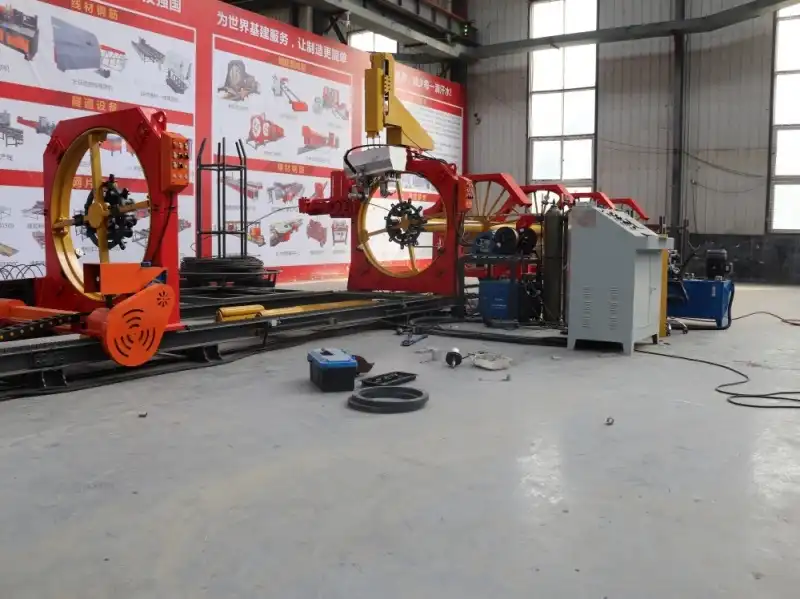
The Zhongji Luyuan LYZD-GJL2500 operates on a PLC-plus-touchscreen control system. Operators program cage diameter, spiral pitch, main bar count, and cage length before production begins. The pile cage machinethen executes each parameter repeatably, removing reliance on manual judgment. Cage diameter range spans φ700–φ2500 mm, and cage length reaches 12 meters per section.
Gas Shielded Welding Technology
Every weld joint uses CO₂ gas-shielded welding, which produces consistent fusion depth and bond strength at each spiral-to-main-bar intersection. This eliminates the false welds and missed joints that are common in manual tack welding. Top-mounted automatic welding arms maintain a fixed angle relative to the cage surface, producing straighter, more stable weld points regardless of cage diameter.
Synchronized Rotation and Wire Feed
The machine's drive system rotates the cage assembly while the spiral bar feeds at a programmed advance rate. This synchronization controls pitch spacing to within engineering specification across the full cage length. Main bar diameters from φ18 to φ40 mm and spiral bar diameters from φ8 to φ16 mm are handled within the same machine configuration, supporting diverse project requirements without retooling.
Comparative Analysis: Automated vs. Manual Fabrication
The performance gap between automated and manual production becomes clear when measured against shared benchmarks.
Production Output
The LYZD-GJL2500 produces 13 cages per 10-hour shift for 12-meter sections. A comparable manual team typically produces 3–5 cages per shift under favorable conditions. That output differential directly affects project schedules on time-critical infrastructure contracts.
Dimensional Conformance Rate
Automated equipment maintains spiral pitch at ≤300 mm spacing consistently across full cage length. Manual fabrication routinely shows pitch variation exceeding acceptable tolerances, requiring inspection correction or rejection.
Labor Requirements
Here is a direct comparison of operational staffing:
- Manual production line: 4–6 workers per shift, with additional supervision for quality checks.
- LYZD-GJL2500 automated workstation: 1 operator per shift, managing the touchscreen control system and material loading.
This labor reduction is not simply a cost-saving measure. Fewer personnel on the production floor also reduces the number of human decision points where error can enter the fabrication process, directly supporting accuracy.
These figures represent a strong procurement argument for contractors managing labor budgets alongside quality standards.
Best Practices for Maximizing Rebar Cage Accuracy With Pile Cage Machines
The first step is to buy automated equipment. To keep its accuracy over time, it needs to be operated in a systematic way.
Daily Maintenance Routines
To keep them from moving, drive chains and guide bars need to be oiled every day. The hydraulic system works at -16 MPa. If the pressure readings are outside this range, it means that the seals are wearing out and need to be fixed before production can resume.
Calibration Schedules
The encoder and welding electrodes are calibrated once a month to keep the geometric accuracy at the millimeter level. The tablet interface keeps records of calibrations, which gives production managers written proof of how well pile cage machines work for quality checks.
Operator Training
There is only one operator for the LYZD-GJL2500. As part of its after-sales service, Zhongji Luyuan helps with installation and trains operators so that teams can use the equipment to its full potential right away.
By following these steps regularly, the machine will keep working as planned, protecting both the initial investment and the project's quality promises.
Procurement Considerations for B2B Clients in the U.S. and Europe
For big building projects, choosing the right reinforcement cage welding tools means looking at it from a number of different angles.
Technical Specification Alignment
Match the machine's range of cage diameters, maximum bar diameters, and production rate to the size of your project. The LYZD-GJL2500 can handle cage widths between φ700 and φ2500 mm and main bars up to φ40 mm. This is a wide enough range of specifications to handle most pile foundation and bridge building jobs in North America and Europe.
Supplier Reliability and Project References
Zhongji Luyuan was formed in 2016 with 50 million yuan in listed capital. It works with China Railway, China State Construction, and China Communications Construction. Almost 100 countries and regions have bought equipment, such as South Korea, Malaysia, Thailand, Kazakhstan, and Israel. That track record shows buying managers that the seller can do what they say they can do.
After-Sales Support
For international buyers, how the machine is serviced after the sale is just as important as the machine itself. Zhongji Luyuan helps with installations, trains operators, provides extra parts, and gives expert advice. For long-term working efficiency, this support layer needs to be available for as long as the equipment is in use.
Conclusion
Making reinforcement cages automatically fills in the gaps in accuracy that can't be accurately filled by hand. A pile cage machine always makes the same product that meets engineering standards because it uses PLC-driven systems to control the spiral pitch, cage width, and weld quality. The figures here on production efficiency, labor savings, and dimensional accuracy make it easy for procurement managers and project engineers to decide whether to buy capital equipment for a pile foundation, bridge, or tunnel. The LYZD-GJL2500 from Zhongji Luyuan is a mature, field-proven solution for contractors who need both scale and accuracy.
FAQ
1. What cage diameters can a pile cage welding machine handle?
Cages with widths between φ700 and φ2500 mm can be used with the LYZD-GJL2500. For jobs that need cages in the φ300–φ800 mm range, there are also machines with smaller diameter sizes. The configuration depends on the requirements for the pile base.
2. How many operators does the machine require?
The PLC tablet display is used by a trained person to control the whole production process. One of the main ways that the automated desk saves time and effort is by only needing one person.
3. Can the machine produce cages with variable spiral pitch?
Yes. Programming multiple pitch zones within a single cage is possible through the CNC interface. This meets structural needs where pitch spacing changes at certain depths.
4. What is the recommended maintenance interval?
The machine stays within its tolerances by lubricating the drive chains and guide rails every day and calibrating the encoders and welding electrodes once a month.
5. Is the equipment suitable for on-site construction environments?
The heavy-duty steel frame is reinforced, and the design is modular, so it's easy to move and set up on busy construction sites. Electrical boxes are protected against dust and water up to an industrial level.
Discover the LYZD-GJL2500 From Zhongji Luyuan
Zhongji Luyuan makes rebar cage welding gear for companies who can't have big building projects go wrong because of poor accuracy. The LYZD-GJL2500 pile cage machine for sale can make 13 cages in a 10-hour shift and can handle cage diameters between φ700 and φ2500 mm. It only needs one operator to run. You can get specifications, prices, and a consultation that fits the needs of your project by going to emailing our team at sales2@shandongluyuan.com.
References
1. Journal of Construction Engineering and Management – American Society of Civil Engineers, 2021.
2. Automation in Construction – Elsevier, 2022.
3. International Journal of Advanced Manufacturing Technology – Springer, 2020.
4. ACI Structural Journal – American Concrete Institute, 2019.
5. Construction and Building Materials – Elsevier, 2023.
6. Proceedings of the Institution of Civil Engineers – Structures and Buildings – ICE Publishing, 2021.