Automatic Pile Wire Cage Welding Machine Enables Faster Cage Production
Sep 24, 2026
When large-scale infrastructure projects demand thousands of reinforcement cages within tight schedules, production speed and structural accuracy become non-negotiable. An automatic pile wire cage welding machine addresses both challenges simultaneously. By replacing manual wire tying and spot welding with a fully automated, PLC-controlled production workstation, contractors can fabricate 12-meter cages at a consistent rate while deploying only one operator per shift. This article walks you through how the technology works, how it compares to manual methods, how to choose the right unit, and what the future holds for rebar cage automation.
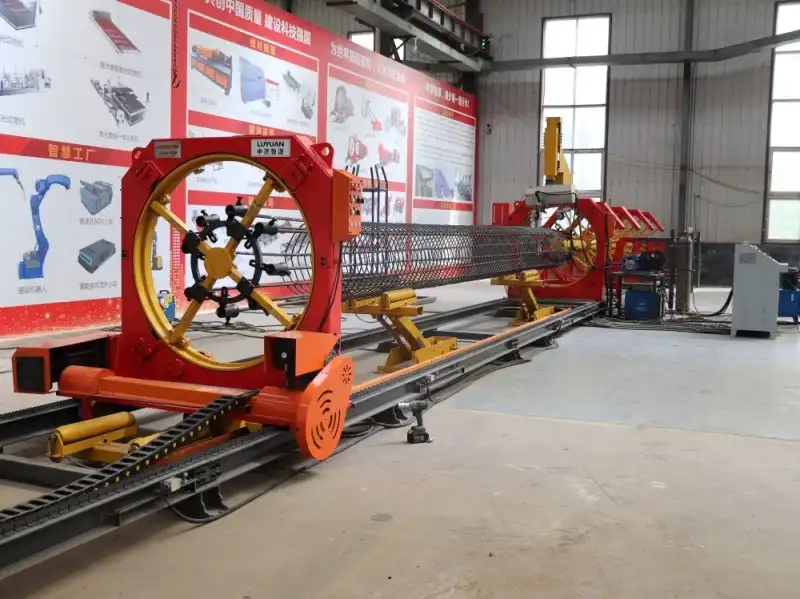
How Automatic Rebar Cage Welding Systems Accelerate Production
Modern rebar cage welding workstations combine gas-protected welding heads, automated wire feeding, and synchronized mechanical rotation into a single process that runs all the time. The main disk that spins keeps the longitudinal bars in exact radial positions, and a powered carriage moves the spiral bar forward at a set pitch. An overhead automatic welding torch fires at each weld point in milliseconds, so there is no dwell time like there is with manual welding.
Key Operational Parameters That Drive Throughput
When it comes to cage diameters, the Zhongji Luyuan LYZD-GJL2500 workstation can handle them. It can also handle cage lengths of up to 12 meters per section. Sizes of main bars range from ±18 mm to Ά40 mm, and sizes of spiral bars range from Ά8 mm to Ά16 mm. The space between spiral bars can be set to any value between 0 and 300 mm. The system can weld 100 kW of steel and has a total installed power of 30 kW. It can make 13 cages in a 10-hour shift, which is more than any manual team with plenty of workers could do. The machine has a 30 m × 8.5 m footprint, which means it can be used in both fixed manufacturing yards and big on-site precast areas.
PLC Touch-Panel Control for Precision and Flexibility
The PLC-plus-touch-panel interface on an automatic pile wire cage welding machine lets workers save different cage settings and quickly access them between production runs. The hydraulic pressure stays at or below 16 MPa, and the air supply pressure stays at or below 0.8 MPa. This keeps the mechanical stress on the building's parts within the limits that were planned for. Together, these choices keep the pitch accuracy well within the tolerance limits needed by ASTM A615 and other similar reinforcement standards used in U.S. building projects.
Comparing Automatic and Manual Cage Fabrication Methods
Teams of four to eight welders usually put together a cage by hand. They work around a moving jig, setting and checking each weld point by hand. Quality audits of bridge foundation projects have shown that defects can happen in 3–5% of all weld joints when the work is done by hand. One 12-meter cage that needs to be fixed can add two to four hours to the schedule of a project. Some of that work is done automatically by semi-automatic systems, but skilled workers still need to keep an eye on the wire tension and weld current throughout the run.
Those factors are not present at all in a fully automatic workplace. The gas-shielded welding method makes sure that every crossing has the same level of fusion, so it doesn't depend on the operator being consistent. The use of labor drops sharply because the machine only needs one person to load the main bars and keep an eye on the touch panel. Contractors who switched from making cages by hand to using machines say that the cost of labor has gone down by 40–60% just for making the cages, and the quality of the measurements has also gone up, which cuts down on review time on site.
Selecting the Right Cage Welding Workstation for Your Project
When buying an automatic pile wire cage welding machine as such a large piece of capital equipment, it's not enough to just compare the main specs. When figuring out the total cost of ownership, you need to look at things like the amount of production, the range of cage shapes, the availability of power on-site, and how long the machine will last.
Before you decide on a supplier, here are some important things you should think about:
- Diameter and length flexibility: Confirm that the machine covers your full project specification range. The LYZD-GJL2500 supports φ700–φ2500 mm diameters, accommodating pile foundation work, bridge pier cages, and metro shaft linings within a single platform.
- Welding method compatibility: Gas-protection welding produces cleaner weld zones with lower porosity than open-arc methods, which matters for projects governed by strict structural codes.
- Power supply alignment: The standard configuration runs on 380V / 50Hz / 3-phase, with optional customization available for site-specific electrical infrastructure.
- Operator training commitment: While the system is fully automated, operators need three to five days of structured training covering PLC programming, rebar loading sequences, and safety protocols.
- After-sales service network: Equipment downtime on a foundation project translates directly to schedule delay. A supplier with a documented rapid-response service team and stocked spare parts inventory protects your project timeline.
When you add these factors together, the comparison stops being about prices and starts being about values. China Railroad, China Communications Construction, and China Nuclear Power Construction Corporation are all long-term partners of Zhongji Luyuan. The company also sends equipment to almost 100 countries and regions. That track record gives procurement managers something they can use to back up their own justifications for capital expenditures.
Maintaining Peak Performance: Practical Maintenance Guidance
Routine Inspection Priorities
Three parts of an automatic pile wire cage welding machine workbench need to be serviced every day: the welding electrodes, the hydraulic circuit, and the drive adjustment. Welding electrodes pick up slag and oxidation waste every time they are used. Cleaning them at the beginning and end of each shift keeps weld flaws from happening without notice. Every week, you should check the hydraulic fluid levels and the stability of the seals. This is because changes in pressure have a direct effect on the clamp force on the main bars.
Troubleshooting Common Faults
When automatic cage systems go wrong, spiral pitch deviation is the most common problem that is recorded. Most of the time, it's caused by a change in tension in the wire feed or a wrong setting for the carriage speed in the PLC program. To fix it, you have to re-zero the encoder reference and check the tension on the wire spool. This usually only takes about 20 minutes for trained professionals. The LYZD-GJL2500's modular structure means that most subassemblies can be changed without taking apart nearby parts. This makes the average fix time a lot shorter.
Future Directions in Rebar Cage Welding Technology
The next version of cage welding systems will have online diagnostics that are allowed by the Internet of Things. Sensor data from welding current, spinning speed, and hydraulic pressure will constantly stream to a cloud display. Predictive maintenance algorithms can find worn parts before they stop working, which is especially helpful for projects that are far away. Vision systems check each weld joint in real time with AI-driven weld quality inspection, which is already being used on advanced production lines in the prefabricated construction industry.
Energy efficiency is also getting more attention. Variable-frequency drives and regenerative brakes on spinning motors are lowering the amount of energy used per cage without slowing down production. These changes are in line with the Infrastructure Investment and Jobs Act's growing standards for sustainability in U.S. government infrastructure procurement rules.
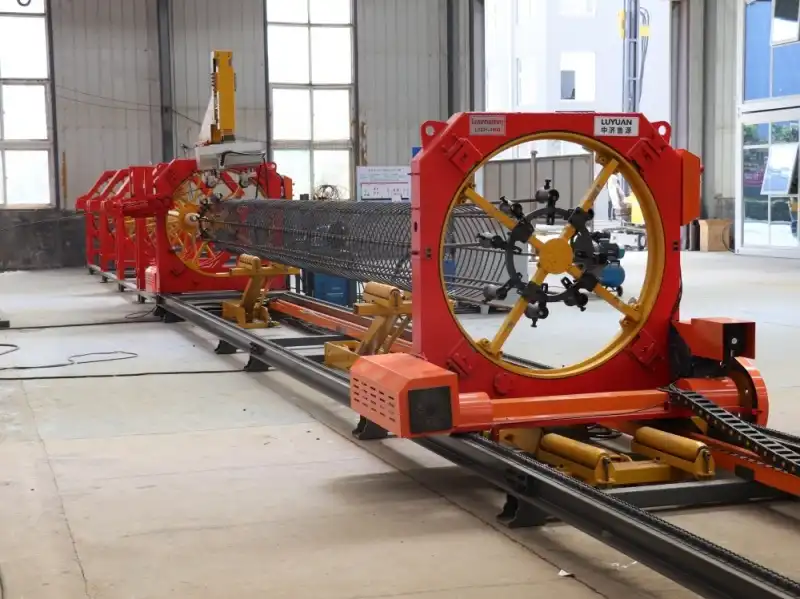
Conclusion
Making rebar cages automatically with an automatic pile wire cage welding machine is now well past the "proof of concept" stage. There is now a big enough difference in productivity between fully automated and fully manual production that most big infrastructure contractors can't ignore it. When you choose the right rebar cage welding workstation, you can be sure of consistent weld quality, lower labor costs, and a production rate that keeps up with tight project schedules. The best way to ensure long-term operating efficiency is to buy the right tools from a company with a history of strong engineering and quick customer service after the sale.
FAQ
What cage diameters can an automatic pile wire cage welding machine handle?
The Zhongji Luyuan LYZD-GJL2500 can work with holes from φ700 mm to φ2500 mm, so it can be used for pile foundations, bridge piers, and metro shafts without having to switch machines.
How many operators does the system require?
The workstation is designed for production by a single person.
How long does it take to switch between cage specifications?
The PLC keeps track of more than one cage program. Using the touch-panel interface, changing specs like girth, spiral pitch, and cage length usually only takes about 10 minutes. This cuts down on the time needed between production runs.
What welding method does the machine use?
It employs a gas-protection welding method that creates low-porosity weld joints with consistent fusion quality at all intersection points. This is a key factor for ensuring structural compliance on certified infrastructure projects.
What power supply does the machine require?
380V, 50Hz, three-phase power is used in the standard configuration. Custom power configurations can be made to fit the needs of each site's electricity system.
Partner With Zhongji Luyuan for Your Next Automatic Pile Wire Cage Welding Machine Project
Zhongji Luyuan makes automatic pile wire cage welding machines that are accepted by large infrastructure builders in almost 100 countries. To protect your investment, as a committed maker, we offer full technical support, operator training, and quick after-sales service after the sale. To get a specification consultation and project quote, please email our engineering team at sales2@shandongluyuan.com or visit shandongluyuan.com right now.
References
1. American Concrete Institute. ACI 318-19: Building Code Requirements for Structural Concrete. American Concrete Institute, 2019.
2. American Welding Society. AWS D1.4/D1.4M: Structural Welding Code — Reinforcing Steel. American Welding Society, 2018.
3. ASTM International. ASTM A615/A615M: Standard Specification for Deformed and Plain Steel Bars for Concrete Reinforcement. ASTM International, 2022.
4. Federal Highway Administration. Drilled Shafts: Construction Procedures and LRFD Design Methods (FHWA-NHI-10-016). U.S. Department of Transportation, 2010.
5. Transportation Research Board. NCHRP Report 697: Acceptance Criteria for Momentary Exceedance of Design Loads During Construction. National Academies Press, 2012.
6. International Federation for Structural Concrete (fib). fib Bulletin 72: Shear and Punching Shear in RC and FRC Elements. fib, 2014.