How Does an Automatic Steel Cage Welding Machine Improve Efficiency?
Sep 23, 2026
An automatic steel cage welding machine improves efficiency by replacing labor-intensive manual fabrication with fully automated, PLC-controlled production cycles. Rather than relying on multiple workers to position, wrap, and weld rebar by hand, these systems integrate servo-driven rotation, real-time sensor feedback, and gas-shielded arc welding to produce structurally consistent reinforcement cages at measurable speed. The result is a dramatic reduction in cycle time, near-elimination of weld defects, and continuous output that manual processes simply cannot match — making automated cage welding a cornerstone of modern infrastructure construction.
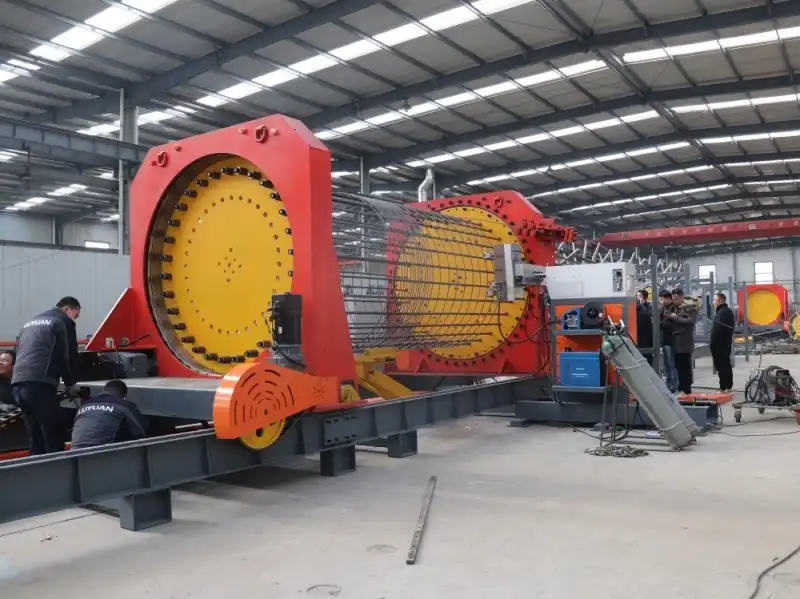
Understanding Automatic Steel Cage Welding Machines
At their heart, rebar cage welding systems automate the three most important steps in making a cage: placing the longitudinal bars, winding the spiral stirrups, and joining the bars together with welds. All three can be done at the same time by a fully automated station like the Zhongji Luyuan LYZD-GJL2500, which is controlled by a PLC and only needs one operator to watch over the touchscreen HMI.
How Automation Differs from Semi-Automatic and Manual Methods?
To join stirrups to main bars by hand, you have to tie wires together or use small welding, which is a hard, slow, and inconsistent process. Winding is done automatically by semi-automatic equipment, but welding alignment still needs to be done by a person. Both of these problems are solved by a fully automated rebar cage welding station, which keeps diameter tolerances within ±5 mm and pitch consistency within ±10 mm during a continuous production run. In bridge and pile foundation work, where structural accuracy is essential, this level of repeatability is not a nice-to-have; it's a must.
Where Do These Machines Operate?
Automated cage welding stations are now commonplace in projects like high-speed rail pile foundations, expressway bridge precast yards, and subway diaphragm walls in cities. They are just as comfortable working in their own steel fabrication shops, where they handle large orders with a variety of cage specs.
Key Efficiency Challenges in Traditional Steel Cage Welding
Traditional welding methods have a lot of problems that make projects take longer than planned and cost more than planned, which is why an automatic steel cage welding machine is increasingly specified. These problems are often not seen when the plans are being made.
For cages to be made by hand, four to six workers are needed at each station. Each weld point is different based on the worker's skill, amount of tiredness, and the conditions of the job. Weld integrity changes between shifts, and quality problems like missing welds, wrong stirrup spacing, and cages that aren't round cause repair processes that take time and materials. When there are tight deadlines for big infrastructure projects, a single production slowdown in the manufacturing yard can cause delays in the structural pour that cost a lot more than the equipment itself.
In addition to repair, moving heavy rebar by hand puts you at serious risk of injury. When working under tight deadlines, workers who handle φ18–φ40 mm main bars and spiral wire are more likely to get hurt. This is a risk that responsible project directors can no longer accept because of current safety standards.
How Automatic Steel Cage Welding Machines Enhance Efficiency?
All of these problems can be solved by automated reinforcement cage production, which uses combined mechanical, electrical, and hydraulic systems that work together in a planned way.
Zhongji Luyuan's automatic steel cage welding machine, the LYZD-GJL2500, can make 13 cages in a 10-hour shift, with 12 meters of space between each section. It can handle main bar diameters from φ18 mm to φ40 mm and spiral bars from φ8 mm to φ16 mm. The cage diameters can range from φ700 mm to φ2500 mm. Gas-shielded arc welding ensures that each joint node has full penetration without the need for adjustments by a person between rounds.
Here are the main performance benefits that procurement professionals always point out:
- Single-operator productivity: The station is run by a PLC with a tablet HMI, so it only needs one person. A trained technician instead of a six-person manual team is all that is needed for labor. This directly cuts down on pay costs and the difficulty of managing shifts on busy project sites.
- Consistent weld quality across the full run: The automatic welding head on top keeps the contact pressure and arc position the same as it rotates. This gets rid of the angle changes that happen when welding by hand and lead to missed or weak welds. There should be no fake joints. No nodes were skipped. Every box leaves the station with the same level of structure.
- Wide specification range without lengthy changeovers: Cage sizes can be changed between φ700 and φ2500 mm, and the spacing between spiral bars can be programmed in 300 mm steps. To change specifications, parameters must be entered at the HMI instead of having to be reconfigured mechanically. This keeps the time between production runs as short as possible.
- Durable, stable mechanical design: The structural frame is made of reinforced steel, the hydraulic system works at ≤16 MPa, and the layout of the flexible parts is designed to handle heavy-duty work all the time. A low failure rate means that uptime can be predicted over long project campaigns.
All of these benefits solve the main production problem that big building companies have: making a lot of precise cages without having to hire more workers or pay more for quality control.
Purchasing Considerations for B2B Clients
To choose the correct reinforced cage welding tools, you need to do more than just look at the unit price. Before committing money, procurement managers at building companies and processing centers should look at the following factors:
Specification coverage vs. project pipeline. An automatic steel cage welding machine that works with cage diameters between φ700 and φ2500 mm can handle pile foundations, bridge piers, and utility corridor structures all on the same platform. Make sure that the main bar and spiral bar diameter sizes of the machine match the needs of your present and future projects.
Automation depth and software capability. PLC systems with touchscreen HMI interfaces cut down on the time needed to train operators and let them save parameters for future orders. Make sure that the control system can handle the production reports you need and works with any plant management tools that you already have.
After-sales infrastructure. The speed with which a part needs to be replaced is more important than how reliable the equipment is. Give more weight to providers who offer on-site commissioning, written user training, and a clear supply chain for spare parts. Zhongji Luyuan has a special after-sales service team whose members have worked as exporters to more than 100 countries.
Total cost of ownership. With 100 kW of welding power, a 30 kW operating power draw on a 380V/50Hz/3-phase supply is doable with the electrical infrastructure that is already in place on a building site. Along with the purchase price, you should also think about how much power it uses, how much it costs to replace parts, and how often it needs to be serviced.
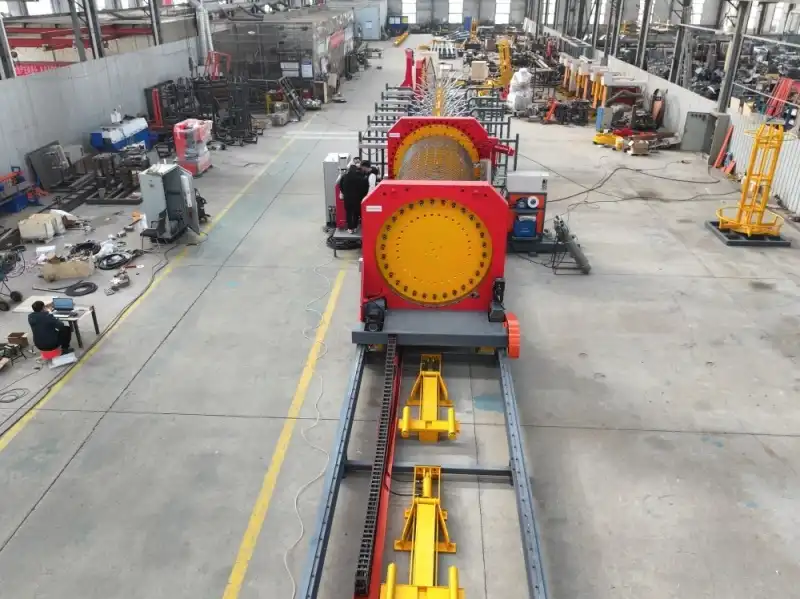
Maintaining and Troubleshooting for Optimal Machine Efficiency
A disciplined repair plan is needed for steady output. The PLC system stops positioning drift by cleaning the sensors and lubricating the lead screws once a month. Checking and replacing welding tips should be done at the manufacturer's suggested times, which are based on arc-on hours instead of just date time.
Uneven weld penetration, which is usually caused by dirty contact tips or an unstable shielding gas supply, and variations in cage diameter, which is usually caused by changes in hydraulic pressure, are two common problems that need to be fixed. When workers get the right training at the start, both can be found and fixed at the machine level without the need for an expert.
Getting certified as an operator through the supplier's organized training program pays off in a clear way. A trained technician can fix small problems in minutes, but an untrained technician can make the same problem worse and lose half of the shift's production.
Conclusion
Automated rebar cage fabrication used to be a competitive edge, but now it's just how things work for real building companies. An automatic steel cage welding machine like the LYZD-GJL2500 solves the problems of labor, quality, and throughput that come up with manual production. They do this by having PLC-driven precision, single-operator efficiency, and a wide range of specifications that can be met. When purchasing reinforcement processing equipment, procurement workers should not only look at unit price, but also automation depth, standard range, and after-sales capability.
FAQ
How much faster is automated cage welding compared to manual production?
At 12-meter lengths, a fully automatic station can make 13 cages in 10 hours, which is a lot faster than a human team that can only make 3–5 cages in the same conditions. When the cage diameter or bar count changes, the difference in efficiency gets even bigger because automatic systems can switch by entering new parameters, while human teams have to physically rearrange the cage.
Can the machine handle both single and double main bar configurations?
The LYZD-GJL2500 can handle both single and double main bar setups, and double main bar layouts can also be made to order. Spiral bar winding can be set up in both single and double spirals to meet different structural needs.
What quality standards does automated cage welding meet?
Weld penetration depth and pitch uniformity on automatic stations that have been properly set meet the standards for JT/T 736-2009 reinforcement cage construction. Under normal conditions, the error in diameter is kept to within ±5 mm, and the error in pitch is kept to within ±10 mm.
What does installation and commissioning involve?
Part of the delivery package from Zhongji Luyuan includes on-site installation help, training for operators, and starting up the machine. The LYZD-GJL2500 has a 30 m × 8.5 m footprint, so the site needs to be prepared ahead of time. A production approval run is usually done at the end of commissioning to make sure that the output meets the agreed-upon standards.
Partner with Zhongji Luyuan for Your Next Project
Since 2016, Zhongji Luyuan has been a reliable maker of automatic steel cage welding machines. They have sold precise rebar processing equipment to companies in China, Southeast Asia, Central Asia, and other places. For example, they have worked with China Railway and China Communications Construction. A dedicated global after-sales team backs up our LYZD-GJL2500, which has been tested and proven to work well on a large scale. For specifications, custom configurations, and competitive quotes, please contact our engineering team right away at sales2@shandongluyuan.com or visit shandongluyuan.com.
References
1. Construction Mechanization Journal — "Advances in Automated Reinforcement Cage Fabrication for Infrastructure Projects," 2022.
2. Journal of Construction Engineering and Management (ASCE) — "Labor Productivity and Automation in Rebar Processing Operations," 2021.
3. Chinese Standard JT/T 736-2009 — "Steel Reinforcement Cage Fabrication Requirements for Highway Bridge Construction," 2009.
4. Engineering Structures (Elsevier) — "Weld Integrity and Structural Performance of Fabricated Rebar Cages in Pile Foundations," 2020.
5. International Journal of Advanced Manufacturing Technology — "PLC-Based Control Systems for High-Precision Welding in Construction Equipment," 2023.
6. Construction and Building Materials (Elsevier) — "Quality Control Protocols for Automated Reinforcement Processing in Large-Scale Civil Works," 2022.