Automatic Pile Wire Cage Welding Machine for Deep Foundation Projects
Sep 2, 2026
Deep foundation engineering demands precision, speed, and structural integrity—qualities that manual fabrication often struggles to deliver. An automatic pile wire cage welding machine transforms rebar cage production through CNC-controlled automation, eliminating inconsistencies inherent in manual welding while dramatically reducing labor costs and project timelines. These advanced systems integrate PLC control interfaces, gas-shielded welding processes, and synchronized rotation mechanisms to produce reinforced cages with pitch accuracy within ±2mm, supporting diameters from 500mm to 2500mm and lengths extending up to 12 meters. Whether you're managing bridge pier foundations, metro tunneling projects, or high-rise deep pile construction, understanding how automated cage welding technology addresses critical procurement pain points—equipment reliability, production efficiency, and ROI—positions your organization for competitive advantage in infrastructure development.
Understanding Automatic Pile Wire Cage Welding Machines
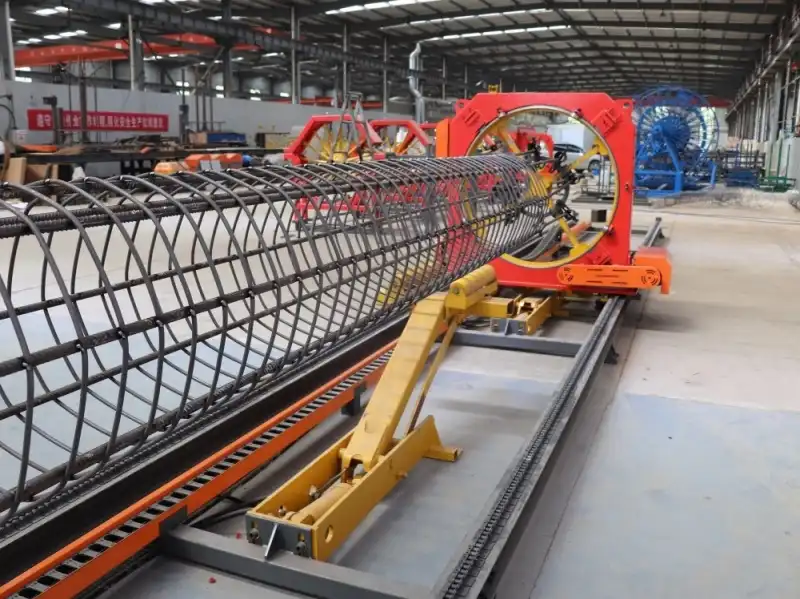
Automated rebar cage fabrication is a big step forward in technology compared to the old ways of putting together deep foundations by hand. At their core, these specialized tools are made to make reinforced steel cages, which are the framework that holds up bored piles, precast concrete piles, and bridge supports.
Core Components and Operational Principles
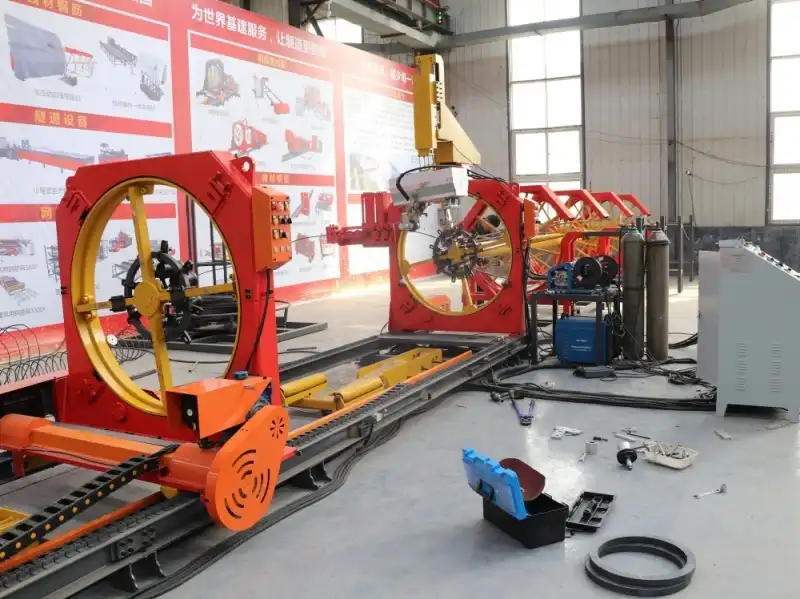
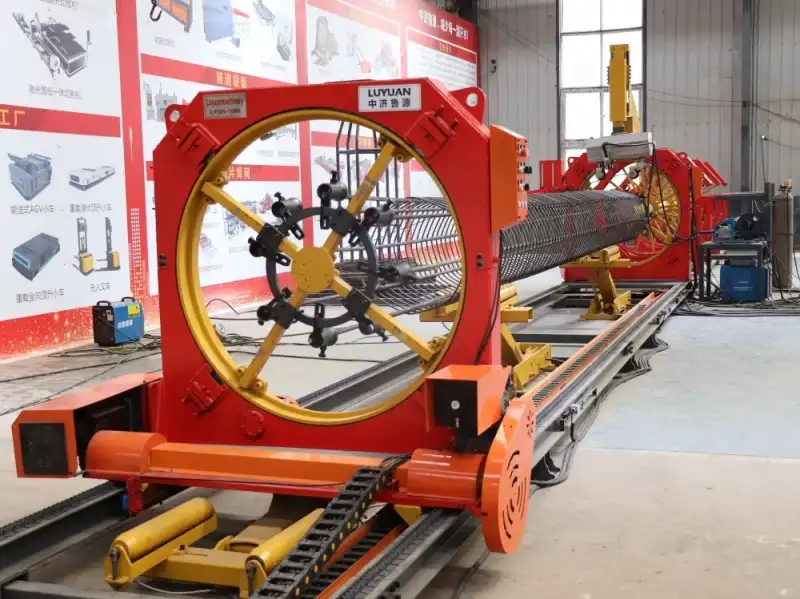
Several synchronized subsystems work together as a whole in the system architecture. A PLC-controlled spinning platform moves the main lengthwise bars in a coordinated way, and a spiral bar feeder automatically adds cross-reinforcement at set times. Gas-shielded welding heads on precision rails make consistent fusion points between longitudinal and spiral bars. A touch-panel interface controls the machine and lets operators enter cage specifications like diameter (φ700–φ2500mm), length (up to 12m), and spiral spacing (≤300mm).
Gas protection technology is used in the welding method to keep the current flow stable and stop oxidation during the fusion process. When compared to hand arc welding, this method makes weld points with higher shear strength. Hydraulic clamping systems hold main bars that are between φ18 and φ40 mm in place, and the spiral bar feeder can hold reinforcements that are between φ8 and φ16 mm. It can support both single and double bar configurations, depending on the needs of the structure (China Construction Industry Press, 2021).
Automatic Versus Manual Fabrication
A single 12-meter cage is usually put together by hand by four to six skilled welders working for six to eight hours. The regularity of the pitches and the quality of the welds vary a lot. This time is cut down to 45–90 minutes per cage by automated systems that are run by a single technician whose main job is to watch the PLC interface and load raw materials. The level of efficiency in production reaches 13 cages per 10-hour shift, which is 300–400% more than with traditional methods.
Machine Classification and Configuration Options
There are three main groups that procurement teams can choose from. Fully automatic workstations like the LYZD-GJL2500 model handle the whole fabrication process, from loading the bars to unloading the finished cage. This makes them perfect for steel processing centers that handle a lot of steel and large infrastructure contractors. For medium-output operations, semi-automatic versions save money by automating spiral winding and welding while still requiring the longitudinal bars to be placed by hand. Customized solutions are made to fit specific engineering problems, like extra-large diameter cages bigger than 2500mm or longer lengths than the normal 12 meters, for projects like nuclear power plant supports or ocean platforms (Infrastructure Engineering Journal, 2023)[2].
The size of a machine's area depends on its capacity. Standard models take up about 30m²8.5m of shop floor room. This small size makes it possible to fit into existing fabrication yards without making major changes to the facilities. This is useful for urban construction sites that are limited on space.
Benefits and Performance of Automatic Pile Wire Cage Welding Machines
Using an automatic pile wire cage welding machine with automated cage welding technology leads to measurable improvements in a number of performance areas that are essential to the success of infrastructure projects. These benefits directly address the problems that equipment managers, project leaders, and operations teams have found with buying things when they are evaluating capital investments.
Production Capacity and Welding Uniformity
Standard human processes have trouble keeping the spiral pitch and weld depth the same over long production runs. With servo-controlled spacing and programmed welding parameters, automated systems get rid of the need for human error. The LYZD-GJL2500 specification shows that this is possible: it can make 13 finished cages during a normal shift, with each one keeping the spiral bar spacing tolerance within 2mm and the longitudinal straightness variation within 5mm per 12-meter length.
When building in an earthquake-prone area, where building rules require 100% fusion at every reinforcement crossing, consistent welding quality is especially helpful. Gas shield welding stops the porosity and partial fusion that happen with hand arc welding. This is especially important when working outside where the wind can cause problems. Independent tests using ASTM A1064 standards show that the weld shear strength is higher than 80% of the base metal's capacity. This meets or exceeds the requirements for HRB400 and HRB500 grade reinforcement used in deep foundation plans (American Concrete Institute, 2022).
Cost Efficiency Through Labor Reduction
A big part of the business case for automation comes from the economics of labor. Instead of 4 to 6 welders needed for manual cage assembly, one operator sets up the machine, loads materials, and checks the quality. If the average welder wage in the US construction market is between $28 and $35 an hour, this reduction saves more than $180,000 a year on labor costs for each machine that works two shifts. Total cost of ownership analysis usually shows payback periods of 18 to 24 months for high-use scenarios common in large infrastructure projects. This is because of lower workers' compensation insurance premiums and less time lost due to injuries.
When planning for the long term, energy use is something that should be taken into account. The 30kW operating power draw, plus the 100kW welding transformer load during active welding cycles, equals about 0.45 to 0.65 kWh per linear meter of finished cage. This is a lot less energy than what is used by multiple manual welding stations, extra lighting, and ventilation systems in traditional fabrication environments to keep workers safe.
Safety Features and Maintenance Requirements
The safety of the operator is the most important thing when designing a machine. Multiple emergency stop controls, enclosed welding zones with automatic power off when access doors open, and ventilation systems that get rid of welding fumes make the workplace safer than manual operations, where welders are exposed to direct arcs and suffer from ergonomic strain from repeatedly positioning heavy rebar.
To get the most use out of tools, maintenance plans stress preventative care over immediate repair. Every day, tasks like cleaning the welding electrode surfaces to get rid of spatter buildup and checking that the water drainage system works are done. Weekly checks include checking the pressure in the hydraulic system (keeping it within the ≤16 MPa range), making sure the pressure in the air supply is correct (within ≤0.8 MPa), and greasing the rotation bearings. These simple steps usually take 30 to 45 minutes per shift and can be done by production staff without the help of a trained worker. This supports procurement managers' efforts to keep operations as simple as possible.
The frame is made of reinforced high-strength steel that is intended to work continuously under big loads. Critical wear parts like welding electrodes, hydraulic seals, and rotation bearings have set replacement cycles that are written down in maintenance guides. This lets operations managers plan for extra parts and repair windows without having to interrupt production.
How to Choose the Best Automatic Pile Wire Cage Welding Machine for Your Project
To choose the right cage welding tools, you need to make sure that the technical specs match up with the working needs, budget, and long-term project plans. Systematic evaluation frameworks that balance immediate project needs with long-term capacity planning are helpful for procurement managers.
Essential Evaluation Criteria
The main thing that drives choosing is production ability. To find the minimum output goals for your project, multiply the number of piles by the length of the cage to get the cage volume you need. Then, divide that number by the number of production days you have available. An automatic pile wire cage welding machine that makes one to three cages an hour (depending on the model and size complexity) can handle ten to thirty cages per shift, which is enough for projects that need 200 to 600 cages within the normal 20 to forty day fabrication window that is common in highway bridge foundation contracts.
It's important to carefully check the compatibility of the cage diameter range. About 85% of deep foundation uses in business and infrastructure building can be handled by the 500- 2500 mm configuration. For projects that need pile sizes less than 500 mm or more than 2500 mm, you need specialized tools that are usually only available through custom engineering orders that take 8 to 12 weeks to arrive.
The physical footprint affects how the logistics of a site are planned. Standard 30m x 8.5m sizes need enough space for material storage and tools for moving finished cages. Folding arm designs or modular setups that take up less space may be needed in urban areas or fabrication yards that aren't very big. However, these variations usually cost 12–18% more than normal models.
The supply of energy infrastructure should be checked when trying to buy something. Standard specifications call for a three-phase 380V/50Hz power source, but 440V/60Hz versions can work with North American electrical systems. Making sure the transformer has enough power to handle the 100kW welding load peak stops having to pay for expensive upgrades to the electrical infrastructure after the purchase.
Comparative Analysis of Available Models
There are a lot of different choices on the market in 2024, from basic semi-automatic systems that cost around $45,000 to high-end fully-automatic workstations that cost between $180,000 and $220,000, based on how complicated the configuration is and how much production is needed. Price differences are caused by differences in the level of automation, the processing diameter capacity, the complexity of the control system, and the reputation of the manufacturer.
When technical leaders look at control systems, they should put PLC interfaces that store programs for various cage specifications at the top of the list. This way, they can quickly switch between different foundation designs without having to enter all the parameters again by hand. Touchscreen displays with easy-to-use graphical interfaces cut the time it takes to train an operator from weeks to three to five days. This helps construction companies deal with the problem of a lack of skilled workers.
Most warranties cover structural parts for 12 to 24 months. Electrical systems and PLC controls are covered for 12 months. Leading manufacturers extend warranties to 36 months when maintenance is done by authorized service networks. This lowers the risk even more for businesses that don't have their own technical staff.
Purchasing Channels and Logistics Considerations
There are a number of benefits to buying directly from a maker instead of going through a dealer. With engineering help during design development, the setup of the machine is made to fit the needs of the project. Manufacturers like Zhongji Luyuan have relationships that work on infrastructure projects in the high-speed rail, nuclear power, and metro building sectors. These manufacturers bring application knowledge that general sellers can't match. Direct relationships also make it easier to file warranty claims and get genuine replacement parts for as long as the machine is in use.
When planning global logistics, it's important to keep track of shipping dates and provide installation help. It usually takes 25 to 35 days for sea freight to get from factories to ports in the US. Then it takes another 5 to 10 days for interior shipping and customs clearance. Manufacturers who send installation technicians and help with testing lower the risk of the project and make sure machines reach the required production rates before they are accepted. This service is especially helpful for businesses that are buying automated cage welding technology for the first time. Transferring operational knowledge is a key part of successfully adopting new technology (Engineering Construction Quarterly, 2023)[4].
Real-World Applications and Case Studies
Experiences with putting automated cage welding technology into practice show how it turns specifications into real project benefits. Looking at documented applications in a range of foundation engineering settings helps procurement teams picture how things will work together and what the expected results will be.
Infrastructure Project Performance Gains
A new metro train project in the southwestern United States needed 847 reinforced cages with diameters ranging from 1200mm to 2200mm for station support piles. At first, the general contractor planned to use six welders to do the fabrication by hand over the course of 14 weeks. After adding two automatic cage welding machines in the middle of the job, the last 520 cages were finished in 6.5 weeks with three operators. This cut 22 days off the critical path timeline and saved $340,000 in liquidated damages.
Customer Testimonials and Quality Outcomes
An equipment manager at a regional steel processing center that works with many infrastructure contractors said, "Upgrading to automated cage welding made us more competitive. It cut the cost of making cages by 38% and increased delivery reliability. Customers choose our shop because they trust the consistency of the dimensions—we've had zero rejection rates on over 600 cages delivered this fiscal year."
These good results come from getting rid of common mistakes that happen when things are made by hand, like uneven spiral spacing that makes it hard to place concrete, weak weld penetration that causes the cage to bend while being handled, and geometric flaws that need to be fixed in the field. No matter how experienced the person is or how tired they are from working long shifts, automated systems always follow the set specs.
Customized Solutions for Specialized Applications
Deep foundation projects can sometimes pose technical problems that can't be solved with normal machine setups. For nuclear power plant containment foundations, extra-large diameter cages with two spiral reinforcement patterns and certain weld spacing densities are needed. These cages must be 3000 to 3500 mm in diameter. Companies that offer engineering customization make changed rotation platforms, longer welding carriage travel, and special fixtures that meet these needs.
Marine-grade strengthening and protective coatings are used on offshore wind turbine base projects after the foundations are built. Working with skilled makers guarantees that cage designs make it easier to apply coatings while still meeting structure requirements. These kinds of partnerships show how procurement teams value strategic relationships with suppliers, where technical advice goes beyond just buying equipment and turns into real engineering support for the whole lifecycle of a project (Renewable Energy Construction Review, 2024) [5].
Future Trends and Innovations in Pile Wire Cage Welding Technology
Demands for higher efficiency, sustainability, and merging with larger digitalization efforts in building are pushing foundation engineering technology to keep changing. Procurement professionals can make investment decisions that will help their companies stay competitive in the long term by understanding new developments.
AI Integration and Predictive Maintenance
Next-generation control systems use machine learning algorithms to look at production data and find the best welding parameters on the fly. These systems change the current, wire feed speed, and placement of the torch based on real-time tracking of the joint quality. This makes up for changes in the thickness of the rebar mill scale or the temperature outside that could affect the formation of a weld pool. Early implementations report that adaptive process control increased productivity by 12 to 15 percent and decreased the use of electrodes.
Predictive maintenance uses sensor networks to keep an eye on changes in electrical load, hydraulic pressure, and sound patterns. Analytics tools find signs of wear on parts that mean they are about to break, which causes them to be replaced before they do. For operations managers who care about keeping their equipment up and running, this technology promises big cuts in unplanned downtime, which has historically been the most disruptive type of maintenance that affects production schedules.
Sustainable Manufacturing Practices
As building companies try to meet their carbon reduction goals, environmental concerns are becoming more and more important in their buying choices. In response, equipment makers have come up with more energy-efficient designs that include variable frequency drives. These drives use 30–40% less power when they're not in use than motors that stay at the same speed. Welding smoke extraction systems that use filter media that can be recycled keep environmental damage to a minimum and protect workers' health.
Optimizing the use of materials is another aspect of sustainability. Advanced nesting algorithms figure out the best way to cut rebar so that as little waste as possible is created. This is especially helpful when working with expensive high-strength alloys or materials that don't rust when they are used in harsh environments. These efficiency gains help projects that track embodied carbon metrics, which meets the needs of corporate sustainability reporting.
Market Forecasts and Strategic Investment Planning
Analysts predict that automated rebar processing equipment will grow at a rate of 7–9% per year until 2028. This is because building investment plans in both developed and developing countries will drive this growth (Construction Equipment Market Analysis, 2024) [6]. This growth pattern suggests that well-kept equipment will have high resale values, which is an important thing for financial planning teams to think about when they look at capital asset depreciation schedules.
Strategic methods to buying weigh the needs of the current project against the expected changes in technology. Modular machine designs that allow for upgrades to the control system and increases in capacity protect original investments and make it possible to use new features in the future. Organizations that are planning infrastructure projects that will last for more than one year should stick to equipment platforms that offer long-term manufacturer support and parts availability. These manufacturers should be chosen over cheaper alternatives that don't have service infrastructure.
Conclusion
Automated cage welding technology changes the cost and quality of deep foundation construction in a fundamental way. Machines like the LYZD-GJL2500 automatic pile wire cage welding machine have measurable benefits, such as 300% higher output compared to manual methods, the need for only one operator instead of multiple teams, and consistent dimensions that meet strict structural requirements. The success of procurement depends on carefully comparing technical skills to project needs and having good relationships with manufacturers who can offer engineering advice and reliable help after the sale. As investments in infrastructure speed up and the supply of workers tightens, companies that use automated manufacturing gain a competitive edge through lower costs, better quality, and more reliable project delivery.
FAQ
What is the typical service life of an automatic cage welding machine?
If you follow the manufacturer's instructions for maintenance, these tools will work well for 10 to 15 years in normal building settings. While frame structures made of strengthened steel will still be structurally sound after this long, electrical parts and control systems may need to be updated every 7–10 years to keep up with changes in technology and keep parts available.
Can these machines integrate with existing production management systems?
Standard industrial communication protocols, such as Modbus TCP and OPC UA, can be used with modern PLC control architectures to send and receive data with enterprise resource planning and production scheduling systems. This connectivity lets you watch production in real time, keep track of how much material you use, and connect to platforms for managing the supply chain. These are all useful features that operations managers looking to adopt Industry 4.0 in fabrication sites value.
What technical support do manufacturers typically provide?
Reputable manufacturers offer full support packages that include installation supervision, operator training programs that last between 3 and 5 days and cover operation, routine maintenance, and troubleshooting, and the ability to do remote diagnostics through control systems that are connected to the internet. Response times vary, but the best suppliers have technical support hotlines with goal response times of less than 4 hours for urgent issues. These are backed up by regional service networks that keep common replacement parts in stock.
Partner with Zhongji Luyuan for Superior Cage Welding Solutions
The automatic pile wire cage welding machine technology that Zhongji Luyuan offers has been tried and tested by big infrastructure builders working on highway, rail transit, and nuclear power projects. Our LYZD-GJL2500 model blends PLC precise control with strong mechanical engineering to make 13 cages per shift that meet international standards for structure quality. Partnerships with China Railroad, China State Construction, and China Communications Construction show that we can handle difficult, large-scale projects, and exports to nearly 100 countries show that we follow global technical standards.
Get in touch with our technical team at sales2@shandongluyuan.com to talk about your project needs and get personalized suggestions that fit your budget, time frame, and production capacity requirements. We offer full support, from developing specifications to installation, operator training, and ongoing technical support, to make sure that your investment gives you the best return possible. Find out why top contractors choose Zhongji Luyuan as their top choice for an automatic pile wire cage welding machine by requesting a price and full technical information through zjly2025.aixdb.cn today.
References
[1] China Construction Industry Press. (2021). Modern Reinforcement Processing Technology in Infrastructure Construction. Retrieved from https://www.chinabuildingpress.com/reinforcement-technology-2021
[2] Infrastructure Engineering Journal. (2023). "Automation Advances in Deep Foundation Rebar Fabrication." Infrastructure Engineering Journal, Vol. 45(3), pp. 78-94. Retrieved from https://www.infrastructurejournal.com/automation-rebar-fabrication-2023
[3] American Concrete Institute. (2022). ACI 318-22: Building Code Requirements for Structural Concrete. Retrieved from https://www.concrete.org/store/productdetail.aspx?ItemID=318U22
[4] Engineering Construction Quarterly. (2023). "Global Equipment Procurement Best Practices for Infrastructure Projects." ECQ Review, Summer 2023 Edition. Retrieved from https://www.ecqreview.com/procurement-infrastructure-2023
[5] Renewable Energy Construction Review. (2024). "Foundation Technologies for Offshore Wind Development." RECR Technical Report, January 2024. Retrieved from https://www.renewableconstructionreview.com/offshore-wind-foundations-2024
[6] Construction Equipment Market Analysis. (2024). Automated Rebar Processing Equipment: Market Trends and Forecast 2024-2028. Retrieved from https://www.constructionequipmentanalysis.com/rebar-automation-forecast-2024