Automatic Steel Cage Welding Machine Enables Precision Rebar Fabrication
Sep 24, 2026
When project schedules tighten and rebar volumes climb, an automatic steel cage welding machine becomes one of the most consequential investments a contractor or processing center can make. This equipment integrates PLC control, gas-shielded arc welding, and servo-driven mechanics to fabricate reinforced steel cages at a speed and consistency that manual labor simply cannot replicate. Whether you manage pile foundation work, bridge construction, or metro tunneling, understanding how this technology operates—and how to select the right model—directly shapes your cost structure and delivery reliability.
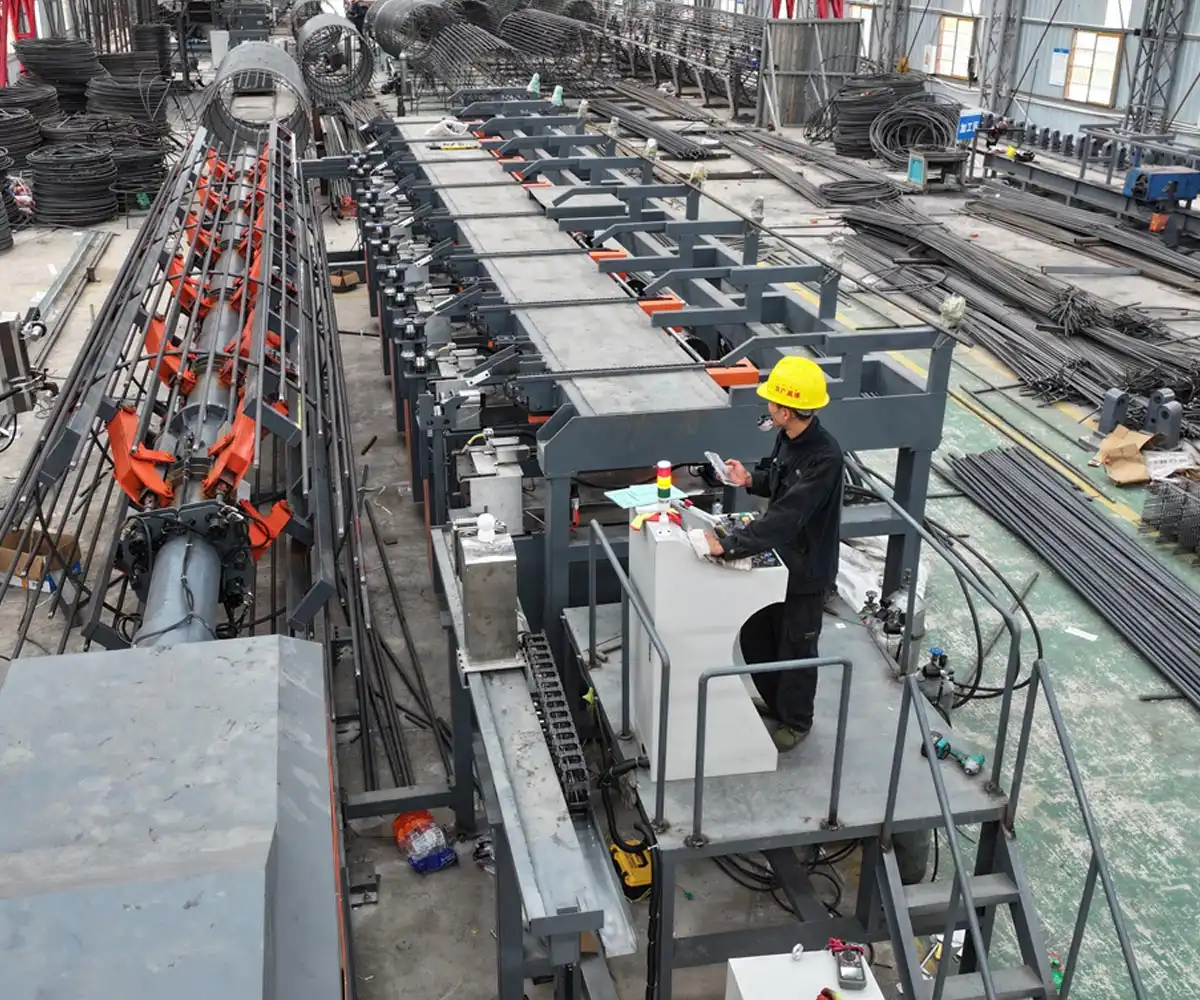
Understanding How Automatic Rebar Cage Welding Equipment Works
Modern rebar cage welding stations are built around the principle of synchronized motion: main bars feed into rotating template discs while a traveling welding carriage wraps and fuses spiral stirrups at programmed intervals. The entire sequence runs under PLC supervision with a touchscreen HMI, eliminating manual measurement at every step.
Core Mechanical and Control Architecture
The Zhongji Luyuan LYZD-GJL2500 model illustrates this architecture clearly. Main bar diameter acceptance ranges from φ18 to φ40 mm; spiral bar diameter spans φ8 to φ16 mm. Cage diameter is adjustable from φ700 to φ2500 mm, and maximum cage length reaches 12 m per section. The hydraulic system operates at ≤16 MPa, air supply pressure stays at ≤0.8 MPa, and total installed power is 30 kW with a dedicated welding power output of 100 kW. A single operator runs the entire station within a footprint of 30 m × 8.5 m, producing 13 complete cages per 10-hour shift.
Gas Shielded Arc Welding and Precision Standards
Gas-shielded arc welding delivers stable arc characteristics and low spatter, which translates to consistent weld penetration across every joint. Industry research confirms that CO₂ shielded welding achieves shear strength values that satisfy JT/T 736-2009 pile cage standards. Diameter tolerance stays within ±5 mm, and pitch error remains below ±10 mm—parameters that matter enormously when a bridge pier cage must align perfectly with precast formwork.
Key Advantages That Separate Automated Cage Fabrication from Manual Methods
The case for an automatic steel cage welding machine is no longer theoretical. A 2023 McKinsey Global Institute report on construction productivity noted that fabrication automation consistently cuts unit labor hours by 40–70% in reinforcement-intensive operations. The LYZD-GJL2500 reduces operating personnel to one person per shift, which alone reshapes the labor cost equation on multi-year infrastructure contracts.
Here are the core production and quality advantages this equipment delivers:
- High throughput with consistent geometry: The station produces 13 cages per 10-hour shift at 12 m per section. Servo-controlled rotation and a calibrated welding carriage ensure every cage leaves the station at the specified diameter, with no variance caused by operator fatigue.
- Zero missed welds through top-mounted automatic welding: The welding head approaches each intersection from above, maintaining perpendicular contact regardless of cage diameter. This geometry eliminates the angular error that causes cold welds in bottom-fed manual torches.
- Dual main bar and dual spiral bar configurations: The machine accommodates both single and double main bar arrangements, as well as single and double spiral bar winding, with spiral bar spacing programmable at ≤300 mm. This flexibility covers most pile and column cage specifications without retooling.
- Modular structure for straightforward maintenance: Component-level modularity means a maintenance technician can replace a drive module or welding carriage assembly without disassembling the entire frame, keeping unplanned downtime short.
These advantages translate directly into measurable project outcomes. A contractor running three shifts can realistically output 39 cages per day from a single station—output that would require a crew of six to eight skilled welders under manual conditions, with significantly higher rework exposure.
How to Evaluate and Select the Right Rebar Cage Welding Station?
Procurement decisions for an automatic steel cage welding machine carry multi-year consequences. Selecting a cage welding station requires matching technical parameters to project scope, not simply comparing price points.
Matching Diameter and Length Specifications to Project Demands
Bridge pile foundations in the United States typically require cage diameters between 900 mm and 1800 mm and lengths of 9 m to 12 m. The LYZD-GJL2500's φ700–φ2500 mm diameter range and 12 m length capacity cover the vast majority of these applications without customization. Projects with non-standard requirements can request extended length configurations directly from Zhongji Luyuan's engineering team.
Evaluating Supplier Reliability and After-Sales Infrastructure
Equipment uptime on an active construction site depends as much on supplier response capability as on machine quality. Zhongji Luyuan, founded in 2016 with a registered capital of 50 million yuan, maintains long-term supply relationships with China Railway, China Railway Construction, China State Construction, China Communications Construction, and China Nuclear Power Construction Corporation. The company has exported to nearly 100 countries and regions, including South Korea, Malaysia, Thailand, Kazakhstan, Israel, and South Africa. That breadth of deployment means spare parts logistics, remote diagnostics, and commissioning support are established processes rather than improvised responses.
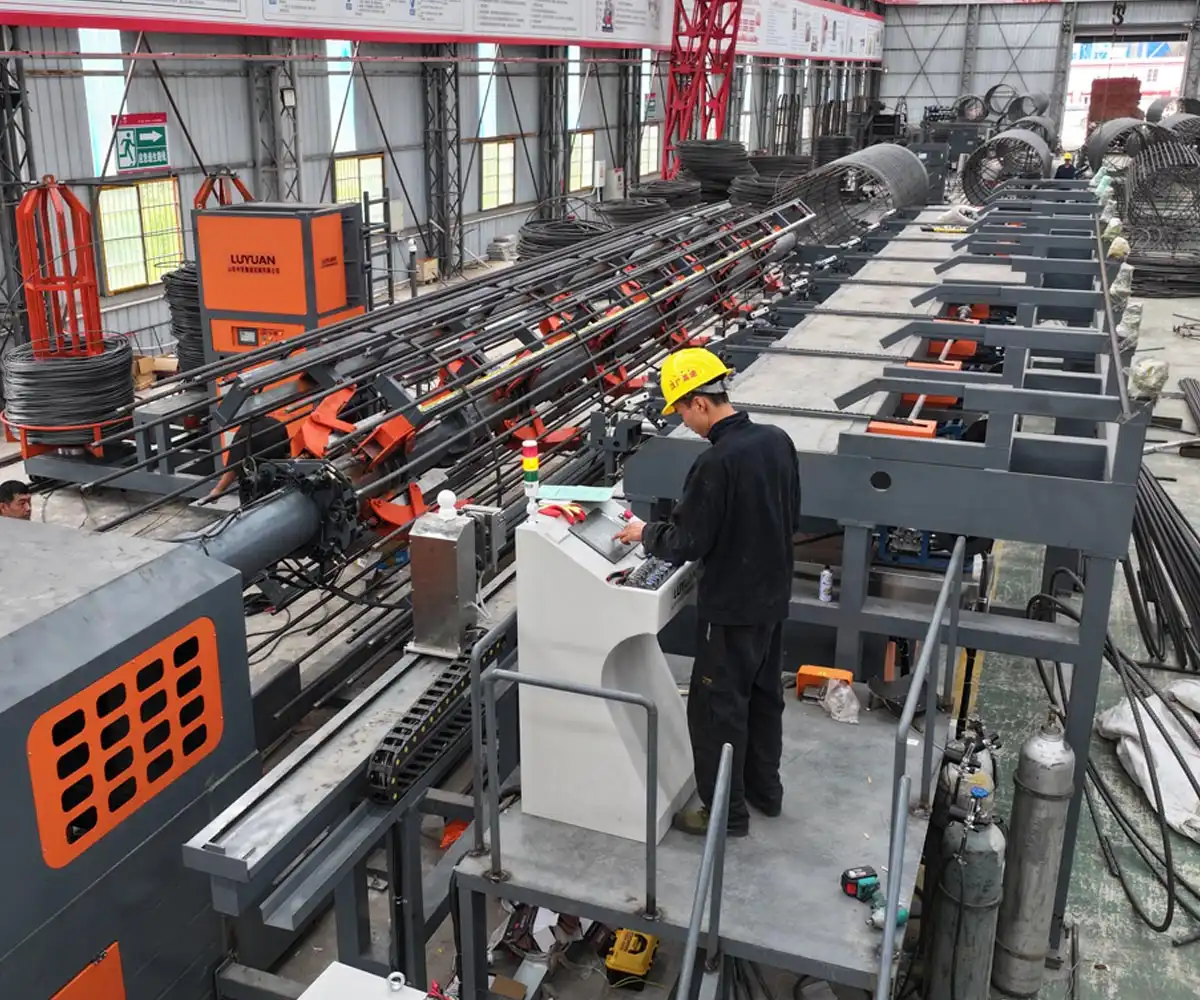
Real-World Applications Across Infrastructure Sectors
Automated rebar cage fabrication has moved from a productivity option to an operational standard across three high-demand sectors.
High-speed railway pile foundations demand ultra-long cages with tight stirrup spacing to resist high-frequency vibration loads. Manual fabrication at this specification creates quality variance that inspection bodies reject. Automated stations eliminate that variance at the source.
Expressway bridge construction often involves mobile precast yards where rapid diameter changes between pier designs are necessary. The LYZD-GJL2500's fast specification changeover capability, enabled by PLC parameter recall, reduces the time lost between cage runs to minutes rather than hours.
Urban metro and tunneling projects operate under strict structural integrity requirements for diaphragm walls and deep foundation pits. Weld integrity directly affects groundwater seepage resistance. Gas-shielded arc welding, monitored in real time by the PLC, produces joint quality that satisfies these demands consistently across thousands of cages.
Conclusion
Precision rebar cage fabrication at scale requires an automatic steel cage welding machine that integrates mechanical robustness, intelligent control, and verifiable weld quality. The LYZD-GJL2500 automatic rebar cage welding station addresses each of these requirements with a parameter set suited to the full range of U.S. infrastructure applications. One operator, 13 cages per shift, ±5 mm diameter tolerance, and a supplier network spanning nearly 100 countries—these are measurable commitments, not marketing claims. For procurement professionals evaluating long-term capital equipment decisions, the combination of production capacity, specification flexibility, and established after-sales infrastructure makes this platform a defensible investment.
FAQ
What is the realistic production output per shift?
The LYZD-GJL2500 produces 13 cages per 10-hour shift at 12 m per section with one operator. Output varies with cage diameter and spiral spacing; smaller diameter cages with wider spacing complete faster.
Can the machine handle different quantities of longitudinal bars?
The template discs are configurable, and the PLC stores multiple production programs. Both single and double main bar arrangements are supported, allowing flexible coverage of different structural specifications without hardware changes.
What maintenance does the CNC system require?
Monthly sensor cleaning, software parameter backup, and lubrication of the lead screw are standard practices. The modular frame design means most mechanical components are accessible without full disassembly, reducing scheduled maintenance time.
Does the equipment support double spiral bar winding?
The station accommodates both single and double spiral bar configurations. Double spiral winding reinforces cage structure and can increase effective output per rotation cycle, depending on project specification requirements.
How does the machine ensure weld quality on every joint?
The top-mounted welding head maintains consistent contact geometry at every intersection. The PLC monitors current and pressure in real time, flagging deviations before they become structural defects. This system eliminates the missed and false welds that manual torches produce under fatigue conditions.
Partner with Zhongji Luyuan for Your Next Rebar Cage Welding Project
Zhongji Luyuan delivers proven automatic steel cage welding machine solutions backed by over eight years of engineering expertise and active deployments across nearly 100 countries. As a trusted automatic steel cage welding machine manufacturer, we offer customized configurations, rapid commissioning support, and dedicated after-sales service. Contact our team today for a technical consultation and tailored quotation. Reach us at sales2@shandongluyuan.com or visit shandongluyuan.com.
References
1. McKinsey Global Institute. Reinventing Construction: A Route to Higher Productivity. McKinsey & Company, 2017.
2. American Concrete Institute. ACI 318-19: Building Code Requirements for Structural Concrete. ACI, 2019.
3. Transportation Research Board. NCHRP Report 697: Cast-in-Place Concrete Piling. National Academies Press, 2012.
4. International Organization for Standardization. ISO 9001:2015 Quality Management Systems — Requirements. ISO, 2015.
5. Ministry of Transport of the People's Republic of China. JT/T 736-2009: Steel Reinforcement Cage for Driven Cast-in-Situ Pile. China Communications Press, 2009.
6. American Welding Society. AWS D1.4/D1.4M: Structural Welding Code — Reinforcing Steel. AWS, 2018.