Can a rebar cage welding machine be used for large?
Aug 28, 2026
Modern infrastructure construction demands equipment that can keep pace with ambitious project timelines and stringent quality standards. When procurement managers and equipment directors evaluate fabrication solutions for deep foundations, bridge piers, or high-rise supports, one question consistently emerges: can automated welding systems handle the scale and complexity of large-scale operations?
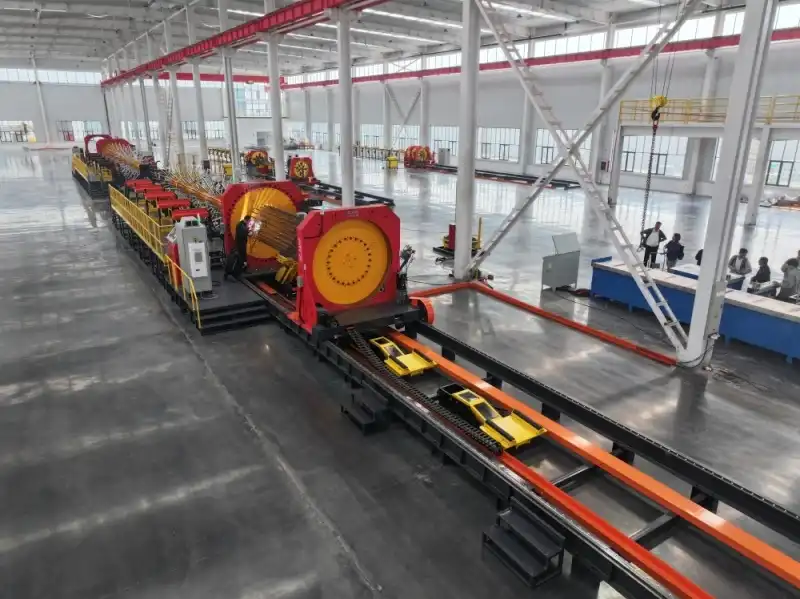
Absolutely. A rebar cage welding machine designed with robust automation, PLC-controlled synchronization, and scalable production capacity can efficiently support large infrastructure projects. These systems replace labor-intensive manual methods with high-precision robotic welding, producing cylindrical and rectangular reinforcement cages that meet strict tolerance requirements for pile verticality, seismic resistance, and structural integrity. Advanced models accommodate cage diameters ranging from 600mm to 4,000mm and lengths exceeding 20 meters, making them indispensable for highway bridge foundations, subway diaphragm walls, and offshore platform piles where consistency and throughput are non-negotiable.
Understanding Rebar Cage Welding Machines and Their Capacity for Large Projects
What Defines a Rebar Cage Welding Machine?
Most of the time, a rebar cage welding machine is a very accurate computerized system made to make reinforcement cages for deep foundation piles, bridge piers, and building supports for tall buildings. It replaces the old ways of lashing and welding with arcs by combining programmable logic controllers with synchronized rotation and welding mechanisms. It solves some of the biggest problems in the industry, like the fact that there aren't enough trained welders, that hand stirrup spacing is prone to mistakes, and that uneven weld strength can pose structural risks. This change turns a process that required a lot of work into a standardized, high-output production line. This keeps civil engineering projects' structures strong.
Categorizing Equipment by Automation Level
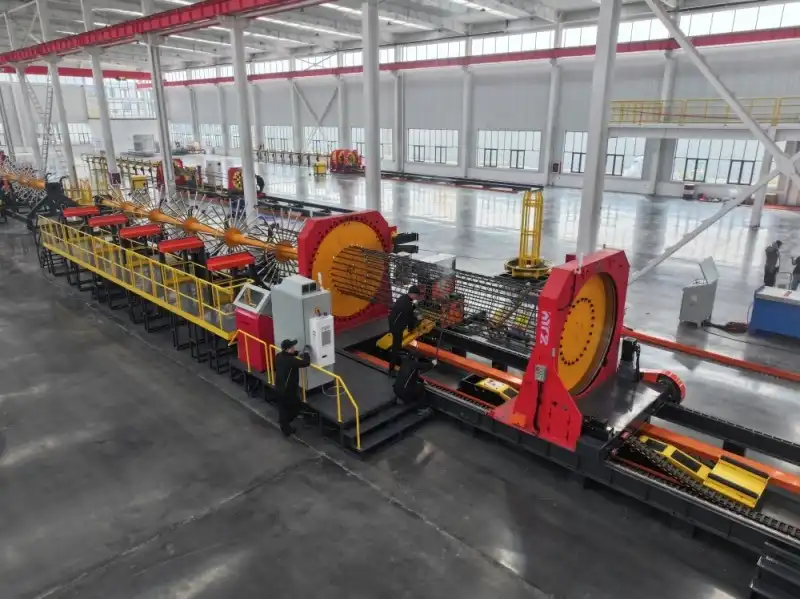
There are three main types of machines on the market: fully automatic workstations, semi-automatic systems, and machines that need to be operated by hand. Fully automatic rebar cage welding workstations have feeding systems managed by robots, welding arms with multiple axes, and mechanisms that keep turning. Semi-automatic types need help from an operator to load and place the parts, but they do the welding cycle automatically. For small-batch or custom fabrication, manual-assisted systems are only good for skilled workers who can guide the welding torch. Fully automatic workstations are best for big building projects because they can work nonstop during shifts, keep operators from getting tired, and keep the same weld entry depth across thousands of joints.
Key Capacity Factors for Large-Scale Applications
To figure out the capacity, you have to look at the welding width limits, the machine size, and the speed at which it works. High-capacity models can hold main reinforcement bars with a diameter of 12mm to 40mm, and the space between the stirrups can be changed from 50mm to 400mm. The machine usually takes up 15 to 30 meters of space, so it needs its own floor space in fabrication yards or staging areas on-site. Modern systems can make 15 to 25 meters of finished cage per hour, but the speed depends on how complicated the cage is. These standards help purchasing managers match the machine's abilities with the needs of the project. For example, they can make 200 reinforcement cages every month for a metro tunnel contract or meet the quick turnaround needs of building a high-speed rail pier.
Comparing Automatic vs Manual Rebar Cage Welding Machines for Large Scale Use
Operational Differences and Output Quality
For manual ways to work, trained workers must use arc welding guns to attach longitudinal bars and spirals at each point where they meet, while a rebar cage welding machine automates this process. This method makes the joint size, entry depth, and accuracy of the spacing less consistent. Inconsistency is made worse by tired operators who have worked long shifts, which increases the risk of a joint breaking under dynamic loads. PLC-programmed weld processes in automated systems make sure that every joint gets the same amount of heat and filler material, so there is no room for mistake. Real-time sensors check the temperature of the weld pool and change the current to account for changes in the bar width or the environment. As a result, the shear strength is always higher than the rebar's tensile strength, which is very important for buildings that are vulnerable to earthquakes.
Scalability and Production Efficiency
Scalability is needed for big projects that can't be done by hand. For a highway bridge project that needs 500 pier cages in six months, a team of 30 welders would have to work two shifts every day, and there would be delays during checks and rework rounds. Three techs work shifts at a fully automatic rebar cage welding desk to get the same work done in 70% less time. Because the system can run continuously, work doesn't stop for breaks or shift changes, which has a direct effect on project schedules. Adding a second workstation doubles capacity without raising labor costs or training times by the same amount, which makes automation useful for future contracts.
Cost Implications and ROI Perspective
A high-capacity automated welding machine costs between $150,000 and $400,000 up front, based on the size of the cage and how advanced the CNC is. Making things by hand costs less in terms of equipment, but it costs more in the long run. It costs about $55,000 to $75,000 a year for each skilled welder to work in the U.S., which includes benefits and safety insurance. Over the course of a five-year project, a contractor who uses manual methods will spend about $2.1 million on labor for a medium-sized business. On the other hand, running an automated system with few employees will cost $650,000. As automatic systems improve stirrup cutting and cut down on repairs, 8–12% more money is saved through less material waste. ROI calculations show that contractors with steady project pipelines can get their money back in 18 to 30 months.
Top Considerations When Selecting a Rebar Cage Welding Machine for Large Projects
Assessing Project Capacity and Physical Size Requirements
By matching machine capacity to project requirements, you can avoid costly mistakes like not meeting requirements or investing too much. Most bridge pier cages for raised roads are between 12 and 18 meters long and 1,200 to 2,500 mm wide. Subway diaphragm wall cages can be up to 25 meters long and 1,800 mm wide, so machines need to have longer beds and stronger turning frames. The project blueprints should be looked at by procurement managers to find out the largest cage dimensions and the monthly production volume. A machine that can handle cages with a diameter of 3,000 mm can be used for a variety of contracts, while a model with a capacity of 1,500 mm is better for smaller bridge abutments but limits its ability to grow in the future.
Advanced Technological Features
Many new technologies have been added to modern automated systems that make them more reliable. PLC control systems have touchscreen screens that let workers set the settings of the cage. The system then automatically changes the rotation speed, the journey of the welding carriage, and the feeding intervals for the stirrups. Safety systems that are built in have emergency stop circuits, overload sensors, and protective enclosures around the welding areas. Some models have laser measurement systems that check the concentricity and dimensional tolerance of the cage in real time and mark any problems before the cage leaves the production line. Because of these features, review time and redo rates go down, which means projects are finished faster.
Maintenance, Durability, and After-Sales Support
Reliability of equipment has a direct effect on the continuation of a project, and a rebar cage welding machine must be robust. On building sites for bridges, machines have to deal with the weather, dust, and changes in temperature. Heavy-duty parts like hardened steel rotation rollers, industrial-grade servo motors, and welding carriages that don't rust make machines last longer than 100,000 production hours. As part of the maintenance, the welding settings must be calibrated every three months, and the oil must be checked every day. When downtime threatens project plans, after-sales help is very important. Reliable suppliers offer technical support lines that are open 24 hours a day, IoT-based remote diagnostics, and regional service centers that are stocked with spare parts. Contracts should say how long it will take to fix problems on-site, which is usually within 48 hours for major problems.
How to Optimize Rebar Cage Welding Machine Performance in Large Construction Projects?
Preventive Maintenance Schedules
Setting up regular repair plans keeps problems from happening out of the blue. Every day, you have to check the amounts of hydraulic fluid, the wear on the electrodes, and the welding slag on the wagon tracks. Every week, schedules include calibrating sensors that measure rotation speed and checking that longitudinal bar guides are lined up correctly. As part of regular maintenance, gearboxes need to be oiled, worn bearings need to be replaced, and the emergency stop needs to be tested. As part of a yearly maintenance check, the electrical systems, the structural frame, and the welding transformer should all be checked by an expert. Keeping records of maintenance tasks helps with warranty claims and finds problems that keep happening before they get worse.
Troubleshooting Common Mechanical Issues
During long production runs, operators always run into a number of problems. Misalignment in the wire feeder mechanism often leads to uneven stirrup spacing. This can be fixed quickly by recalibrating the servo motor settings. If the weld penetration isn't complete, it could mean that the electrodes are worn out or that the amperage settings are wrong. The quality is restored by replacing the electrodes and setting the welding parameters to match the bar diameter specifications. Cage irregularity is usually caused by longitudinal bars that are loaded unevenly; this problem can be avoided by making sure that the bars are placed evenly during setup. Training workers to find and fix these problems cuts down on the need for outside experts, which cuts down on downtime from hours to minutes.
Safety Guidelines for Large-Scale Operations
Strict safety rules must be followed when using high-capacity welding tools. As part of their safety gear, workers must wear welding hats with auto-darkening glasses, flame-resistant gloves, and steel-toed boots. Setting up clear zone markings around rotating cages keeps people from touching moving parts by accident. Using lockout-tagout procedures during maintenance keeps electrical circuits from being turned on, which keeps technicians safe from arc flash hazards. Safety audits are done on a regular basis to make sure that OSHA rules are being followed for electrical safety, fire suppression systems, and ventilation in areas where things are made inside. Putting money into thorough operator training lowers the risk of accidents and your liability.
Process Integration Strategies
Overall productivity is highest when upstream and downstream actions are coordinated with welding processes, and a rebar cage welding machine enables this integration. Scheduling cage production to coincide with concrete filling times keeps the yard from getting crowded and saves money on storage. Using barcode tracking systems connects each cage to a specific foundation pile spot. This makes site planning easier and lowers the chance of mistakes during installation. When you combine machine output data with project management software, you can see the status of production in real time and make changes before delays affect activities that are on the critical path. These coordination strategies improve the efficiency of the supply chain, which is important for EPC contractors who are in charge of complex projects with multiple phases.
Purchasing Guide for Large-Capacity Rebar Cage Welding Machines
Profiling Leading Manufacturers
On the global market, there are a number of well-known brands that are known for being reliable and creative. The company Zhongji Luyuan was established in 2016 and is based in Shandong, China. Its main business is manufacturing CNC-controlled equipment for processing reinforcement. Their fully automatic rebar cage welding machines can handle cage widths of up to 4,000 mm and have linked welding systems with stirrup spacing that can be changed. The company has long-term relationships with China Railroad, China State Construction, and China Communications Construction, which shows that it can handle major projects at the national level. Zhongji Luyuan's equipment is sent to almost 100 countries, such as South Korea, Malaysia, Kazakhstan, and South Africa. This shows that their high standards are recognized around the world.
Other well-known brands include HITOP, which makes small semi-automatic models that work well for medium-sized contractors, and ZHONGYUAN, which makes modular systems that can be expanded to handle more projects. When you evaluate a manufacturer, you look at their ISO certifications, reference project lists, and factory audits to see how well they control quality during production.
Reliable Purchasing Channels
There are three main ways for procurement workers to get tools. Authorized dealers offer local support, help with installation, and management of warranties, which is helpful for contractors who are new to automated systems. When you buy directly from OEM makers, you can customize the machine's specs, like making the bed longer or getting better CNC control panels, which cuts costs by 10 to 15 percent. Contractors who work on more than one spot can get volume savings and priority production slots when they order in bulk. Leasing choices through equipment loan companies spread out the cost of capital over 36 to 60 months, which keeps the project's cash flow steady. People who buy used equipment can save 30 to 40 percent, but they need to make sure it still works by having it inspected by a third party and negotiating a warranty for any important parts.
Budget Planning and ROI Considerations
Price ranges are very different depending on the level of automation and the capacity. Entry-level semi-automatic machines start at $80,000 and are good for contractors who make less than 100 cages a year. Fully automatic systems in the middle range, which cost between $150,000 and $250,000, keep highway and bridge builders busy with projects. Large infrastructure groups in charge of metro, high-speed rail, or nuclear power projects are the ones who buy high-capacity workstations that cost more than $300,000. To figure out ROI, you have to weigh the cost of the equipment against the benefits of saving time, money, and materials, as well as speeding up the schedule. A $300,000 automated system pays for itself in 24 months for a contractor who spends $1.8 million a year on manual welding labor. The contractor also gains competitive advantages through faster bid response times and better quality reputations.
Conclusion
For big infrastructure projects, fabrication solutions that balance accuracy, speed, and dependability are needed, and a rebar cage welding machine is central to this capability. Automated welding machines have shown they can support highway bridge foundations, subway tunnels, and offshore platform piles by providing uniform weld quality, making production more flexible, and reducing the need for human labor. When deciding what to buy, it's important to match the machine's size to the needs of the project, look at the long-term return on investment (ROI), and work with makers that offer strong after-sales support. As the need for workers grows and project deadlines get shorter, investing in high-capacity automated systems is not only a good idea but also necessary to stay competitive in the infrastructure construction industry.
FAQ
Can standard equipment be adapted for larger projects?
Standard models made for cages with a diameter of 1,500 mm can sometimes be upgraded to fit larger sizes. Capacity can be raised to 2,500 mm or more by adding longer rotation frames, stronger carriage rails, and higher-torque drive motors. But upgrading old tools is only worth it when the cost of the improvements is less than 40% of the price of new equipment. Talking to makers during the bidding process makes sure that the specs match the needs of the project, which saves money on changes that have to be made after the purchase.
What safety protocols are essential for high-capacity equipment?
To use big welding tools safely, you need to take a lot of precautions. Putting up interlocked safety gates around rotation zones stops people from getting in by accident while the machine is running. Technicians are safer around electrical hazards when lockout-tagout procedures are used during maintenance. Burn accidents can be cut down by giving workers auto-darkening welding helmets and flame-resistant clothes. Regular checks of the tools make sure that the emergency stop works and that the structure is sound. Accident rates are lower than the industry average because of training programs that cover OSHA standards and risks that are specific to machines.
How does automation impact production quality and speed?
Automation gets rid of the variations that come from tired operators, inconsistent technique, and mistakes made by people. PLC-controlled welding sequences make sure that every joint has the same amount of heat and filler material, so the shear strength is higher than the tensile strength of the rebar. Real-time sensors check the temperature of the weld pool and change the parameters to keep the same temperature at all thousands of joints. When compared to manual ways, fully automatic systems can make 15 to 25 meters of final cage per hour, which is 300 to 400% faster. Rework rates drop from 12 to 15 percent to less than 2 percent when quality is improved, which directly speeds up project schedules.
Partner with a Trusted Rebar Cage Welding Machine Manufacturer for Your Large-Scale Projects
Expert advice that is tailored to your project's needs and operational limitations is needed to choose the best fabrication solution. Zhongji Luyuan has worked for major contractors on high-speed rail, highway bridges, subway construction, and nuclear power infrastructure for more than eight years, using CNC equipment for reinforcement processing. Our fully automatic rebar cage welding machines can handle cage widths ranging from 600 mm to 4,000 mm, giving big projects the flexibility and accuracy they need. We have worked with China Railroad, China State Construction, and clients from almost 100 different countries, so we know how infrastructure companies work and what they want when they buy things.
Our expert support team helps you plan for capacity, customize machines, and set them up on-site so that they work well with your production process. Full after-sales service includes remote diagnostics 24 hours a day, 7 days a week, training in preventive maintenance, and fast delivery of spare parts, which reduces the chances of downtime that could throw off project schedules. Our engineering team offers clear pricing, in-depth ROI analyzes, and custom solutions that are in line with your long-term infrastructure goals, whether you're looking at sources for an upcoming metro contract or want to improve the way you make things by hand.
Get in touch with Zhongji Luyuan right away at sales2@shandongluyuan.com to talk about your needs for a large-capacity rebar cage welding machine. You can look at our products, read technical details, and ask for a personal consultation with our procurement specialists by going to zjly2025.aixdb.cn.
References
1. American Concrete Institute. (2021). Manual of Concrete Practice: Structural Reinforcement Fabrication Standards. ACI Committee 318, Farmington Hills, Michigan.
2. Zhang, H., & Liu, Q. (2020). Automated Welding Technologies in Infrastructure Construction: Quality Control and Efficiency Analysis. Journal of Construction Engineering and Management, 146(8), 04020097.
3. National Association of Reinforcing Steel Contractors. (2022). Guide to Mechanized Rebar Processing Systems for Large-Scale Projects. NARSC Technical Report Series, Springfield, Virginia.
4. Chen, W., & Rodriguez, M. (2019). Cost-Benefit Analysis of Automation in Reinforcement Cage Production for Bridge Foundations. Construction Management and Economics, 37(11), 645-662.
5. International Federation for Structural Concrete. (2020). Fabrication and Installation of Reinforcement Cages: Best Practices for Deep Foundation Applications. fib Bulletin 92, Lausanne, Switzerland.
6. Thompson, R. A., & Kumar, S. (2021). Labor Productivity and Quality Outcomes in Manual versus Automated Rebar Fabrication Methods. Journal of Infrastructure Systems, 27(3), 05021004.