Fully Automatic Rebar Cage Welding Workstation Boosts Production Capacity
Sep 21, 2026
When production schedules tighten and labor costs keep climbing, a fully automatic rebar cage welding workstation delivers a measurable competitive edge. These systems replace manual fabrication with PLC-controlled precision, producing structurally consistent reinforcement cages at speeds that manual teams simply cannot match. Across bridge foundations, pile construction, and large-scale infrastructure projects, automated cage welding has become a strategic investment—not a luxury. This article walks you through how these systems work, how to evaluate your options, and what to expect from a modern automated fabrication setup.
Understanding Fully Automatic Rebar Cage Welding Workstations
How the System Works
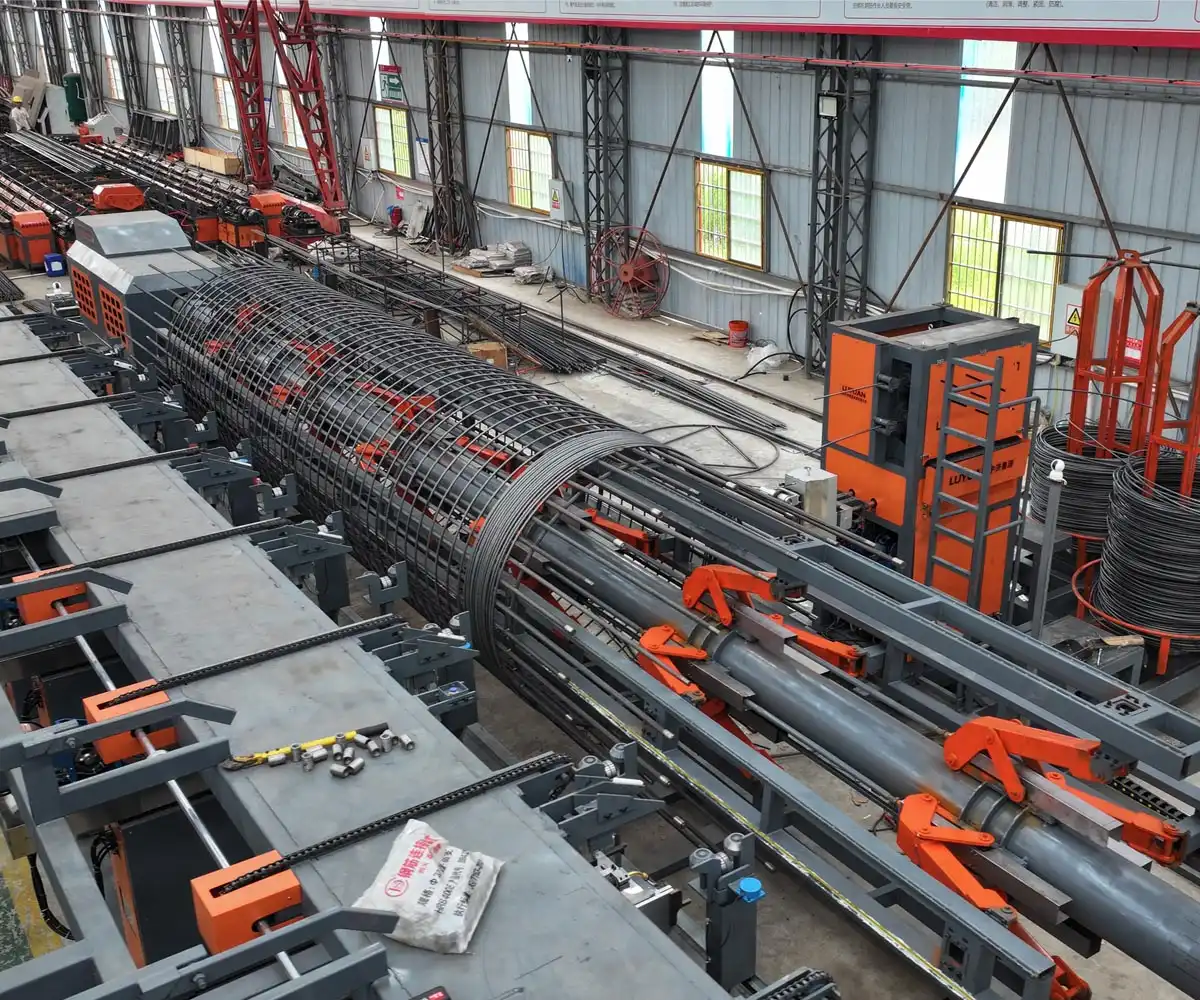
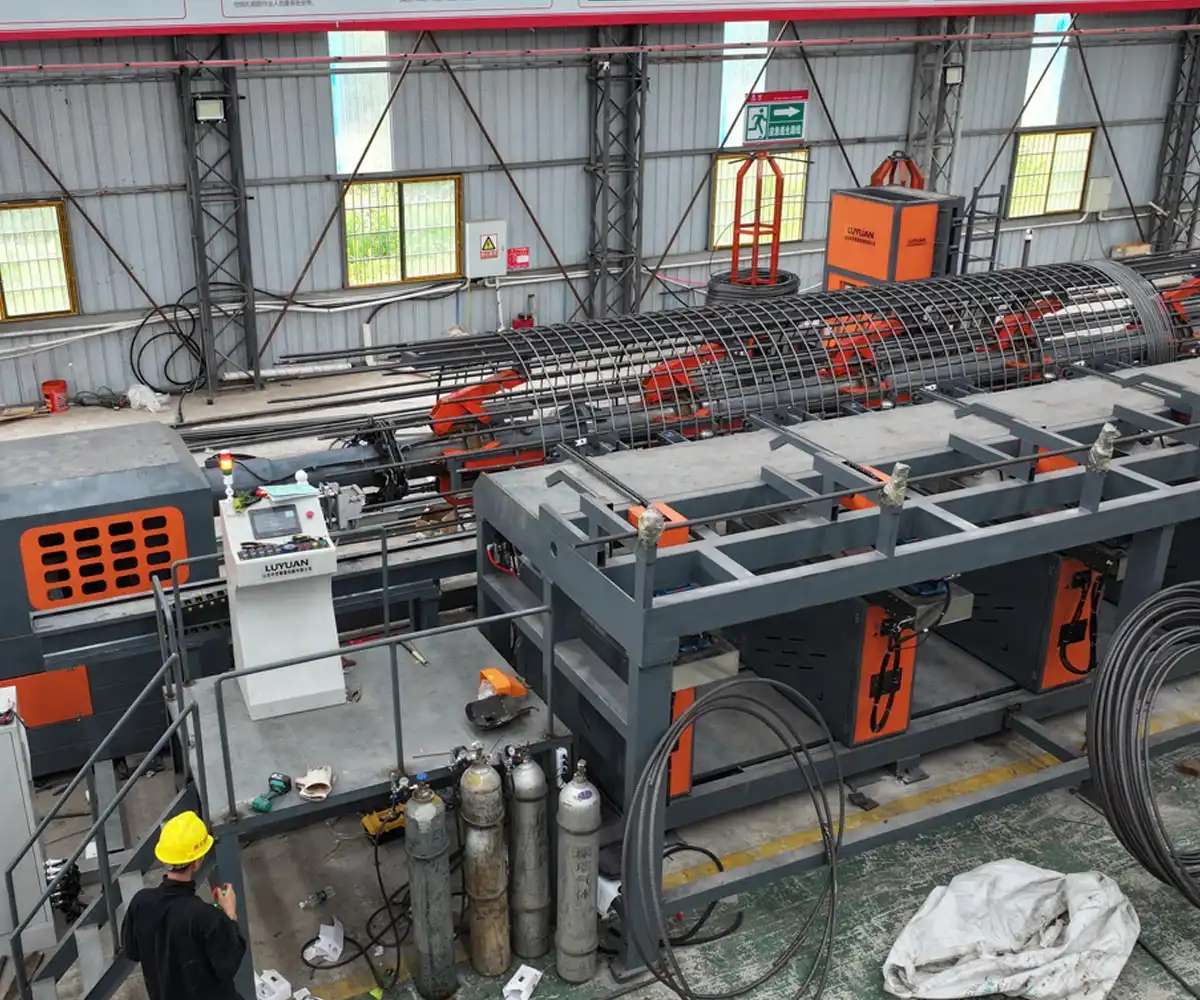
There are several parts that work together in a modern rebar cage welding system. These include an automatic main bar feeding mechanism, a spiral bar winding unit, gas-protected arc welding heads, and a PLC control unit with an industrial touchscreen interface. The operator enters the cage's dimensions (diameter, length, and stirrup spacing), and the machine does almost all of the work without any help from the operator. For instance, the Zhongji Luyuan LYZD-GJL2500 can handle cage diameters between φ700 and φ2500 mm and cage lengths of up to 12 meters. It can also handle main bar diameters between φ18 and φ40 mm and spiral bar diameters between φ8 and φ16 mm.
Workstation Configurations Available
Based on the size of the job, procurement workers can pick from fixed, modular, or combined line designs. Fixed installations work well in precast yards that handle a lot of work, while modular designs can be moved from one job site to another. The LYZD-GJL2500 has a small footprint (30 m × 8.5 m) for how much it can produce. It only needs one operator to run continuously, making 13 cages every 10 hours at a length of 12 meters per section.
Comparing Fully Automatic to Semi-Automatic and Manual Welding Solutions
For manual rebar cage production, you usually need four to six trained welders per shift, and the amount of work they can get done depends a lot on their own skill level and how tired they are. Some of that variation can be reduced by semi-automatic systems, but a fully automatic rebar cage welding workstation is needed because weld positioning and spacing still have to be done by hand otherwise.
This whole equation changes when you add an automatic reinforced cage machine. How do the three approaches stack up against each other on key operational metrics?
- Labor requirement: Manual methods need 4–6 workers per cage; the LYZD-GJL2500 requires only 1 operator, cutting labor costs dramatically on high-volume sites.
- Throughput consistency: Automated systems maintain uniform stirrup spacing (≤300 mm precision) across every cage, eliminating the rework cycles common with manual fabrication.
- Total cost of ownership: Higher CAPEX is offset by lower OPEX—reduced wages, lower scrap rates, and minimal rework mean most buyers recover their investment within 12 to 24 months on active infrastructure projects.
- Weld integrity: Gas-shielded arc welding technology eliminates missing or false welds, ensuring structural integrity compliant with ACI 318 and equivalent standards.
These benefits immediately address the problems that project managers and equipment purchase officers most often bring up: tight deadlines, a lack of skilled workers, and inconsistent quality. When you look at the numbers for a 100-cage job, you can't miss the difference in performance.
Procuring the Right Rebar Cage Welding System
There's more to choosing the right fully automatic rebar cage welding workstation provider than just looking at prices. Your actual cost of ownership and project risk profile are affected by delivery times, how responsive the company is after the sale, and how easily the equipment can be configured.
Key Evaluation Criteria for Buyers
When purchasing managers look at potential suppliers, they should make sure that they have ISO 9001 certification, CE compliance, and written project references from large contractors. Zhongji Luyuan has long-term supply agreements with China Railroad, China State Construction, and China Communications Construction. Its equipment has also been sent to almost 100 countries, which is important when making purchasing choices.
Customization and Technical Specifications
The LYZD-GJL2500 can be set up with a single or double main bar, a single or double spiral bar, and hydraulic pressures of up to 16 MPa and air pressures of up to 0.8 MPa. The total power used is 30 kW, and the welding power is 100 kW. This is a reasonable design that allows for high output without using too much energy. On request, power supplies can be set up in ways other than the standard 380V/50Hz/3-phase.
Before committing to a purchase of capital equipment, buyers should ask for proof of plant commissioning, check the terms of the guarantee, and make sure they understand the requirements for operator training. These details keep your investment safe and lower the risk of merging.
Optimizing Operations and Maintenance for Maximum Performance
The right setting and trained staff for a fully automatic rebar cage welding workstation are the first steps to operational effectiveness. The LYZD-GJL2500's tablet CNC interface is made for site workers, and most users become fully proficient after just three to five days of hands-on training. The servo control system makes precise adjustments automatically, so you don't have to do as much calibration by hand every time the cage specifications change.
It's easy to do preventative maintenance. Standard procedures include cleaning the nozzle every day, checking the tension of the wire feed once a week, and checking the guide wheels and hydraulic seals on a regular basis. These steps keep the machine going smoothly over long project cycles. The flexible frame structure makes it easier to get to parts, so maintenance teams can fix worn parts without having to wait for the machine to be completely shut down.
Quality control checkpoints built into the PLC log let site engineers check the consistency of the stirrup pitch digitally, comparing it to the design specifications at the same time. Periodic ultrasonic testing (UT) of the primary load joints can confirm the stability of the weld joints, and the servo-driven spinning system keeps the dimensions within project specifications, ensuring that the cage is circular.
Future Trends in Rebar Cage Welding Automation
Integration of Industry 4.0 is becoming more common in the reinforcement cage fabrication sector. Tier 1 contractors now expect IoT-connected production monitoring, AI-assisted predictive maintenance, and real-time quality dashboards. People who buy CNC rebar cage systems now will be ready to use these new features as they become available, without having to replace the core hardware.
Using less energy is another big procurement concern. Automation in welding lines uses a lot less energy per cage than doing the same work by hand. This is in line with sustainability requirements that are becoming more common in US and global infrastructure projects. If buyers favor eco-friendly fabrication tools now, they will have an easier time meeting compliance requirements on future government contracts.
Conclusion
Making rebar cages automatically is no longer a niche skill; it is quickly becoming a must-have for competitive building companies. Moving from manual manufacturing to a fully automatic rebar cage welding workstation cuts down on the need for human labor, improves the quality of the welds, and speeds up project timelines in ways that manual methods can't match. When buying, teams look at reinforcement cage automation, detailed technical specifications, examples from successful projects, and quick customer service after the sale to make the investment case clear.
FAQ
What distinguishes a fully automatic rebar cage welding workstation from a semi-automatic model?
The whole process of making a cage—feeding, turning, welding, and cutting—is controlled by a PLC and a fully automatic system. One person watches over the whole thing. A semi-automatic model still needs human help at several steps, like positioning the weld or feeding the bars. This adds to the work that needs to be done and makes the quality of the joint less consistent.
How do I verify that a supplier is credible?
Ask for ISO 9001 and CE certifications, written references from big contractors, and proof that the equipment has been used successfully in similar project settings before. Established suppliers like Zhongji Luyuan have sales records in more than 100 countries and have worked with state-level building groups in the past.
What routine maintenance keeps the system running at peak performance?
The main care jobs are to clean the nozzle every day, check the tension of the wire feed once a week, and look at the hydraulic seals and guide wheels on a regular basis. Because industrial-grade systems are made up of separate modules, these steps can be done without special tools, which keeps planned repair windows short.
What is the typical production cycle for a 12-meter cage?
With the right cage width and stirrup pitch, a high-efficiency system like the LYZD-GJL2500 can finish about 13 cages in a 10-hour shift, which is three to four times faster than a team of people working by hand in the same conditions.
Request a Quote from Zhongji Luyuan Today
Industrial-grade fully automatic rebar cage welding workstations made by Zhongji Luyuan are for sale and are designed for bridge engineering, pile foundation work, and big infrastructure projects. We offer automation solutions that are built to work in real projects. Our company has a registered capital of 50 million yuan, a dedicated research and development team, and after-sales support that includes installation, training, and long-term maintenance. You can email our team at sales2@shandongluyuan.com or go to shandongluyuan.com to ask for details, an estimate of delivery times, or a personalized quote.
References
1. American Concrete Institute. ACI 318-19: Building Code Requirements for Structural Concrete. American Concrete Institute, 2019.
2. International Organization for Standardization. ISO 9001:2015 Quality Management Systems — Requirements. ISO, 2015.
3. European Committee for Standardization. EN 1992-1-1 Eurocode 2: Design of Concrete Structures. CEN, 2004.
4. McKinsey Global Institute. Reinventing Construction: A Route to Higher Productivity. McKinsey & Company, 2017.
5. Occupational Safety and Health Administration. OSHA 29 CFR 1926: Safety and Health Regulations for Construction. U.S. Department of Labor, 2020.
6. World Economic Forum. Shaping the Future of Construction: A Breakthrough in Mindset and Technology. World Economic Forum, 2016.