Fully Automatic Rebar Cage Welding Workstation for Bridge and Metro Projects
Sep 22, 2026
A fully automatic rebar cage welding workstation is a PLC-controlled fabrication system that automates the complete process of assembling and welding cylindrical reinforcement cages used in bridges, metro foundations, and pile construction. Unlike manual or semi-automatic methods, these systems synchronize wire feeding, rotation, and multi-point gas-shielded arc welding into a continuous, digitalized production cycle. For procurement managers in infrastructure, rail transit, and bridge engineering, understanding this technology means gaining a real competitive edge — reducing labor dependency, accelerating schedules, and delivering structural precision that manual teams simply cannot replicate consistently.
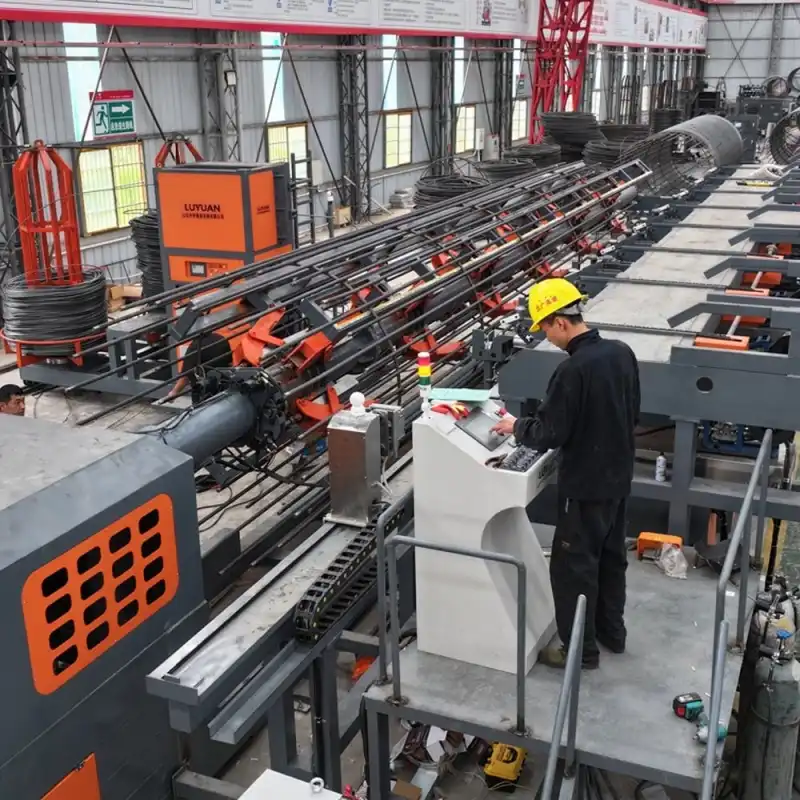
Understanding Fully Automatic Rebar Cage Welding Workstations
How the System Works
A method for making fully automatic rebar cage welding workstations works best when its motions are controlled at the same time. The PLC-controlled drive turns the main bar assembly at a set speed, and the welding head follows the spiral pitch that was programmed. Gas-protected arc welding, especially CO₂ shielding, makes sure that every part has the same level of fusion. Before production starts, the industrial tablet interface lets workers enter the cage's diameter, spiral pitch, main bar amount, and length. This cuts down on the time needed to set up the machine each time a specification is changed.
Core Technical Specifications
The LYZD-GJL2500 model from Zhongji Luyuan is a great example of what a high-performance fully automatic rebar cage welding workstation can do. Some of its features are:
- Cage diameter range: φ700–φ2500 mm
- Cage length: 12 m per section (customizable)
- Main bar diameter: φ18–φ40 mm; spiral bar: φ8–φ16 mm
- Spiral bar spacing: ≤300 mm
- Total system power: 30 kW (welding power: 100 kW)
- Operating personnel: 1 operator
- Production efficiency: 13 cages per 10 hours
- Footprint: 30 m × 8.5 m
- Hydraulic pressure: ≤16 MPa; air supply: ≤0.8 MPa
It has these specs because it's an engineering-grade fully automatic rebar cage welding workstation made for big structural uses where safety in size is a must.
Key Considerations for Bridge and Metro Project Applications
For metro diaphragm walls and bridge pier foundations, you need reinforcement cages with tight stirrup pitch tolerances. These are usually set by ACI 318 or similar building codes. A small change in the spiral spacing or the integrity of the weld can make the structure less strong, which is a risk that no project head can accept.
Selecting the Right Configuration
These are the most important things to think about when choosing a fully automatic rebar cage welding workstation for your project:
- Cage diameter and length requirements: The LYZD-GJL2500 can handle cage sections up to 12 meters long and widths up to 2500 mm. It can meet most bridge pile and metro support pile standards without having to be reconfigured.
- Main bar type compatibility: Support for both single and double main bar layouts, as well as single and double spiral bar layouts, makes it more useful for a wider range of building types.
- Welding quality assurance: Automatic welding that is mounted on top is more likely to produce straighter, more stable weld points than welding that is mounted on the side, which lowers the chance of making mistakes or missing welds.
These configuration parameters have a direct effect on the structural compliance and fabrication throughput of your project. When you choose a system that fits your cage geometry up front, you won't have to make expensive changes to the equipment during the project.
Maintenance and Operational Best Practices
It is standard practice to clean the nozzle every day and check the wire feed tension once a week. Automatic fault detection in the PLC system flags problems before they get worse, which helps keep production going on time-sensitive job sites.
Comparing Market Solutions: Making the Right Procurement Decision
Fully Automatic vs. Semi-Automatic Workstations
In semi-automatic systems, workers have to place and tack-weld spiral bars by hand before the machine finishes. This adds variation from person to person and limits throughput. A fully automatic rebar cage welding workstation doesn't need any help from a user during the welding cycle—one trained worker controls the whole process through an HMI.
There is a big difference in output. Most of the time, manual teams make three to five cages per shift. The LYZD-GJL2500 moves 13 cages every 10 hours, with each part being 12 meters long. When hundreds of pile cages are needed for big bridge or metro projects, this gap directly means faster schedules and lower labor costs.
What to Look for in a Supplier
When buying this expensive equipment, choices have to be made about a lot more than just the machine itself. Suppliers you can trust should show:
- Proven use in similar infrastructure projects (for example, highway foundations, metro systems, and bridges)
- Quality management systems that are written down and follow ISO 9001 guidelines
- Quick help after the sale, including installation and training for operators
- Customization capability for cage shapes that aren't standard
Since its founding in 2016 with 50 million yuan in registered capital, Zhongji Luyuan has sold equipment for processing reinforcement to contractors working on high-speed rails, metro systems, bridges, and nuclear power plants in almost 100 countries. Long-term relationships with China Railroad, China State Construction, and China Communications Construction give buying teams a track record that they can look at and trust.
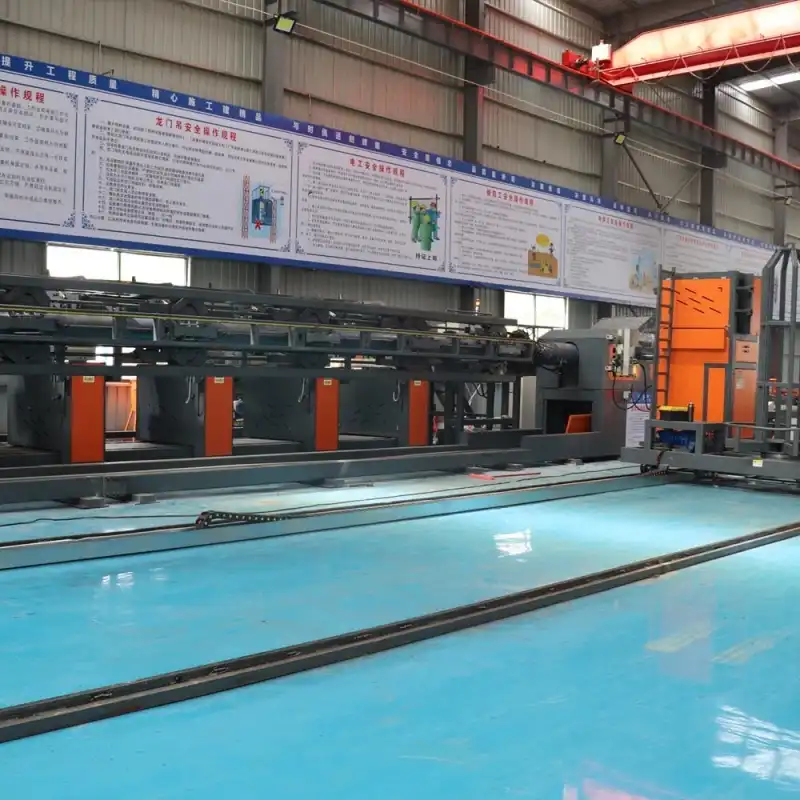
How to Choose and Buy Your Fully Automatic Rebar Cage Welding Workstation?
Procurement Evaluation Framework
Before issuing a purchase order, procurement managers and equipment directors should carefully look at the following factors for a fully automatic rebar cage welding workstation:
- Technical fit: Does the range of cage diameters, compatibility with main bars, and output rate match the size and plan of your project?
- Automation level: PLC-controlled systems with industrial touchscreen interfaces cut the time it takes to train operators to three to five days and make it so they don't have to do much during production.
- After-sales infrastructure: Make sure that spare parts, remote diagnostics, and the time it takes for service to arrive at your location are all available in your area.
- ROI projection: At 13 cages per 10 hours with one operator, the lower cost of labor compared to a team of 6–8 workers doing the same work by hand gives a meaningful payback within the project timelines.
Modular frame design and servo control systems in more advanced models lower long-term upkeep costs even more, and they also make heavy-duty tools last longer.
Future Trends in Rebar Cage Fabrication Automation
The industry that works with reinforcement is moving toward smart manufacturing environments that are fully integrated. IoT-enabled diagnostics let production managers check on the state of equipment, the number of weld cycles, and fault histories from afar. This is a feature that big EPC companies handling operations at multiple sites are asking for more and more. By noticing when a part is wearing out before it breaks, predictive maintenance programs cut down on unnecessary downtime. As green building standards get stricter around the world, energy-efficient welding power control is also becoming more popular. Companies that use procurement strategies that take these trends into account now will be better able to meet regulations and be competitive in the years to come.
Conclusion
Fully automatic rebar cage welding workstations used to be a competitive advantage, but now they are a must for bridge and metro contractors who have to meet tight project deadlines. Systems like the LYZD-GJL2500 can handle 13 cages per 10 hours, have single-operator control, and have cage diameters of up to 2500 mm. These features solve the main problems of labor cost, throughput, and structural accuracy all at the same time. To pick the best fully automatic rebar cage welding workstation, you need to carefully match the machine specs to the needs of the project and work with a provider that has a history of providing high-quality technical support and reliable after-sales service.
FAQ
What is the typical production cycle for a 12-meter rebar cage?
A high-efficiency fully automatic rebar cage welding workstation like the LYZD-GJL2500 can finish a standard 12-meter cage in 45–60 minutes, depending on the spiral pitch and diameter. This means that 13 cages can be made in a 10-hour shift, which is a lot faster than teams that do the work by hand.
How many operators does the system require?
The LYZD-GJL2500 only needs one operator. All welding factors are handled by a PLC-controlled tablet interface. This makes it less reliant on skill and lowers the cost of labor on busy job sites.
What weld quality controls are built into the system?
With top-mounted automatic welding and consistent arc parameters, the system gets rid of false and missed welds. PLC logs make sure that the spacing between spiral bars is correct, and the system works with dimensional checking methods that are in line with standards like ACI 318.
Can the workstation handle different cage specifications without major reconfiguration?
Yes. The servo control system and flexible structure design make it easy to change the main bar configurations and cage sizes quickly. The HMI lets you change the spiral pitch or switch between single and double main bar setups without taking anything apart mechanically.
What after-sales support does Zhongji Luyuan provide?
Zhongji Luyuan provides on-site setup, operator training, expert support from afar, and spare parts. Their service network can be used for foreign operations in more than 100 countries.
Partner with Zhongji Luyuan for Your Next Infrastructure Project
Zhongji Luyuan makes fully automatic rebar cage welding workstations that are trusted by contractors working on bridges, metros, and foundations who need high output, accuracy, and dependability. As a reliable producer with products in use in more than 100 countries, we offer custom designs, professional commissioning, and quick technical support that are suited to the size of your project. Get in touch with our team right away to ask for a technical consultation or quote. To get in touch with a specialist, go to zjly2025.aixdb.cn or email us at sales2@shandongluyuan.com.
References
1. American Concrete Institute. ACI 318-19: Building Code Requirements for Structural Concrete. ACI, 2019.
2. Construction Industry Institute. Automation and Robotics in Construction: Applications and Trends. CII, 2022.
3. International Organization for Standardization. ISO 9001:2015 Quality Management Systems — Requirements. ISO, 2015.
4. National Institute of Standards and Technology. Smart Manufacturing: The Emerging Technology Landscape. NIST, 2021.
5. Welding Research Council. WRC Bulletin 538: Advances in Automated Arc Welding for Structural Applications. WRC, 2020.
6. Transportation Research Board. NCHRP Report 928: Reinforced Concrete Bridge Elements — Fabrication and Quality Assurance. National Academies Press, 2023.