How Does an Automatic Pile Wire Cage Welding Machine Work?
Sep 22, 2026
An automatic pile wire cage welding machine is a PLC-controlled industrial system that fabricates reinforcement cages for bored piles, bridge piers, and precast concrete structures. It automates the entire process — from feeding main longitudinal bars into a rotating disk, to spirally winding hoop reinforcement around them, to welding each intersection point using gas-shielded arc welding. The result is a structurally consistent, dimensionally accurate rebar cage produced with minimal manual intervention, significantly faster than hand-assembly methods, and fully repeatable across high-volume production runs.
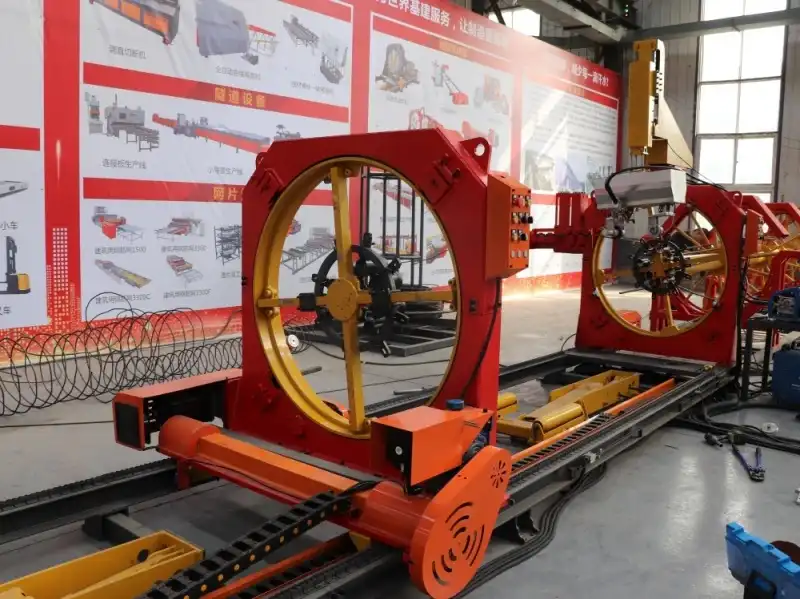
Understanding the Operating Principle of Rebar Cage Welding Automation
The main ideas behind modern rebar cage welding systems are precision welding and motion control that work together. Once the operator types in the cage's diameter, length, spiral pitch, and bar count using a PLC touch-panel interface, the machine does everything else.
How the Mechanical Sequence Unfolds?
LYZD-GJL2500 models have main longitudinal bars that are put into the spinning front disk and clamped hydraulically at up to 16 MPa. The bars have a width of 18 to 40 mm. A spiral bar feeder winds hoop reinforcement (φ8–φ16 mm) helically around the longitudinal bars at a set pitch of 300 mm as the disk turns. The CNC program tells a top-mounted automatic welding torch to fire at every crossing point using gas-shielded welding. This makes clean, slag-free fusion welds without the need for a person to place it.
Real-Time Feedback and Weld Quality Control
During the cycle, embedded sensors keep an eye on the spinning speed, wire strain, and weld current. If any parameter changes too much, the system either sends out an alert or stops the run. This closed-loop feedback gets rid of the inconsistent weld strength that comes from putting together cages by hand, which is a known problem on high-speed rail and bridge foundation projects where strict tolerances must be met.
Core Features and Production Advantages of the LYZD-GJL2500
The LYZD-GJL2500 Automatic Rebar Cage Welding Production Workstation from Zhongji Luyuan, an automatic pile wire cage welding machine, can work with cages that are 700 mm to 2500 mm in diameter and up to 12 meters long per section. It gives every weld joint the same amount of arc energy thanks to its 30 kW fixed power and 100 kW welding power source.
As a production tool, this workstation stands out on large infrastructure sites because of the following:
- Single-operator sufficiency: The fully automated sequence requires just one operator, reducing your direct labor cost per cage by a substantial margin compared to a manual team of four to six welders. On a 10-hour shift, the machine produces 13 completed 12-meter cages — a throughput rate that manual methods cannot approach.
- Top-mounted welding head for geometric stability: The overhead welding torch maintains a fixed vertical axis relative to the cage centerline. This geometry keeps each weld point perpendicular to the bar surface, producing straighter and more dimensionally stable cages — a requirement for projects governed by strict ovality tolerances.
- Dual main bar and dual spiral bar configuration: The machine supports both single and double main bar layouts, as well as single and double spiral bar winding, customizable to project specifications. This adaptability makes it viable across pile foundation, bridge, and heavy civil engineering applications without retooling the entire machine.
- Gas-shielded welding process: Unlike resistance spot welding, the gas protection method produces full-penetration fusion bonds with no oxidation slag. Weld shear strength meets the requirements for HRB400/HRB500 reinforcement under Chinese national standards and international equivalents.
These benefits lead to measurable results, such as fewer rework jobs, lower extra costs, and fewer schedule delays due to poor quality control in the cage. When procurement managers look at the total cost of ownership, the savings in labor usually cover the cost of the equipment within a certain project cycle.
Maintenance and Troubleshooting for Sustained Uptime
When construction equipment like an automatic pile wire cage welding machine breaks down on a live site, it costs money in the form of idle cranes, late pile driving, and sped-up schedules. A planned repair schedule is the first step in protecting your uptime.
Daily and Weekly Maintenance Priorities
Clean the welding torch's barrel and contact tip at the end of each shift to keep sparks from building up and making the arc less stable. Check the hydraulic tightening circuit to see if the pressure stays the same. If it drops below 16 MPa, it's probably a sign of a broken seal rather than a pump failure. Every week, grease the spiral bar feeder guides and rotating disk bearings. Calibrate the PLC pitch counter against a physical test monthly to catch any encoder drift before it compounds into cage geometry mistakes.
Resolving Common Production Interruptions
Most problems with spiral bar systems are caused by worn guide wheels or wrong spool tension settings. Wire passing problems are the most common cause of these problems. Re-tensioning the thread and changing the roller takes under 20 minutes. When the arc doesn't reliably light during welding, it's usually because the shielding gas lines are dirty or the contact tip is worn down. It only takes two minutes to replace tips that are worn out. Zhongji Luyuan sells original spare parts all over the world and offers online diagnostic help to cut down on the time it takes for technicians to be sent out.
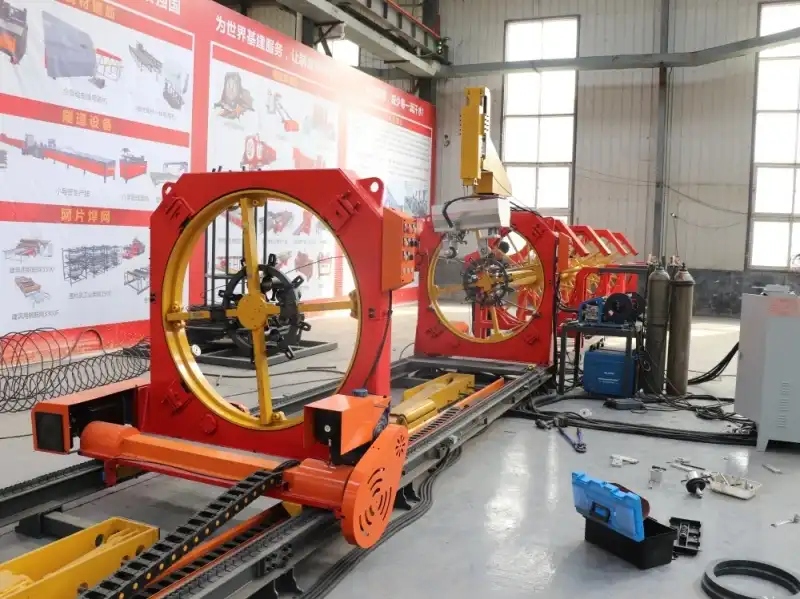
Comparing Machine Configurations: Choosing What Fits Your Project
The right rebar cage welding method for you will depend on how much you produce, the range of cage sizes you need, and the conditions at the job site. Fully automatic CNC-controlled systems, such as the LYZD-GJL2500, are automatic pile wire cage welding machines with the highest throughput and accuracy, which makes them the best choice for big building projects. Positioning steps on semi-automatic machines need more help from an operator, which works well for smaller production shops that get a lot of different, low-volume orders. For now, manual welding jigs can only be used for prototypes or repairs, not in production settings.
When purchasing teams look at different suppliers, they should pay close attention to the following factors: the range and flexibility of cage diameters, the welding method and certification of joint quality, the availability of spare parts in your area, training support after the sale, and references from similar infrastructure projects. Zhongji Luyuan has long-term supply partnerships with China Railroad, China Railroad Construction, China State Construction, and China Communications Construction. These projects serve as a reference for proving performance in the real world on a large scale.
Procurement Process: From Inquiry to Commissioning
There is a set way to go about buying this kind of capital equipment. Send a technical question with information about the cage diameter range you need, the amount of production you expect each day, the power source you have access to (standard configuration: 380V / 50Hz / 3-phase), and the size of the space you have for the LYZD-GJL2500 (30 m × 8.5 m). The engineers at Zhongji Luyuan will look at your needs and come up with a configuration, which may include changes for non-standard cage lengths or double main bar layouts.
Once the quote is accepted, the wait time includes making the product, testing it for plant acceptance, and packing it up for export. Zhongji Luyuan technicians do the installation and commissioning. It usually takes three to five days for operators to learn how to use the CNC, load rebar, and follow safety rules. The business sends goods to more than 100 different countries and regions. They have set up logistics and local service coordination in Southeast Asia, Central Asia, the Middle East, and other places.
Conclusion
One of the hardest manufacturing jobs in construction can now be done automatically by an automatic pile wire cage welding machine, such as a modern rebar cage welding production workstation. Instead of multi-person welding teams, it uses a single-operator CNC system that provides uniform geometry, reliable weld quality, and a measured production rate. This type of equipment makes a clear operational and financial case for infrastructure contractors, pile foundation specialists, and precast manufacturers who have to work with tight deadlines and rising labor costs. Zhongji Luyuan's LYZD-GJL2500 is a mature, field-proven solution made for heavy-duty, ongoing production settings.
FAQ
How long does operator training take?
Operators typically need three to five days of structured training covering CNC parameter input, rebar loading sequences, welding parameter setup, and emergency stop protocols. The touch-screen PLC interface is designed for intuitive use, which shortens the learning curve considerably.
What cage dimensions does the LYZD-GJL2500 support?
The machine handles cage diameters from φ700 mm to φ2500 mm and cage lengths up to 12 meters per section. Custom configurations for non-standard lengths are available upon request.
Can the machine process both single and double spiral bars?
Yes. The CNC system supports single spiral bar, double spiral bar, single main bar, and double main bar configurations. Switching between configurations is handled through the touch-panel interface without major mechanical retooling.
What welding method does this machine use?
It uses a gas-shielded arc welding process, which produces full-penetration welds with no oxidation slag — meeting structural requirements for HRB400 and HRB500 grade reinforcement.
What is the power requirement?
The standard power supply is 380V / 50Hz / 3-phase, with a total installed power of 30 kW and a dedicated welding power supply of 100 kW. Custom power configurations are available.
Partner with Zhongji Luyuan — Request Your Custom Configuration Today
Zhongji Luyuan delivers proven automatic pile wire cage welding machine solutions trusted by leading infrastructure contractors across nearly 100 countries. Our LYZD-GJL2500 combines PLC precision, gas-shielded welding quality, and single-operator efficiency — purpose-built for high-volume pile foundation and bridge engineering projects. Contact our team directly at sales2@shandongluyuan.com or visit shandongluyuan.com to request a technical specification sheet, discuss custom configurations, or obtain a project-specific quotation from a reliable automatic rebar cage welding machine manufacturer.
References
1. American Concrete Institute. ACI 318-19: Building Code Requirements for Structural Concrete. American Concrete Institute, 2019.
2. International Federation for Structural Concrete (fib). fib Model Code for Concrete Structures 2010. Ernst & Sohn, 2013.
3. Concrete Reinforcing Steel Institute. CRSI Design Guide for Pile Caps. CRSI, 2020.
4. American Welding Society. AWS D1.4/D1.4M: Structural Welding Code — Reinforcing Steel. AWS, 2018.
5. Post-Tensioning Institute. PTI DC80.3-17: Specification for Unbonded Single Strand Tendons and Commentary. PTI, 2017.
6. American Society of Civil Engineers. ASCE 7-22: Minimum Design Loads and Associated Criteria for Buildings and Other Structures. ASCE, 2022.