How Does a Fully Automatic Rebar Cage Welding Workstation Operate?
Sep 28, 2026
A fully automatic rebar cage welding workstation is a PLC-controlled manufacturing system that automates the complete process of assembling and welding cylindrical reinforcement cages. Raw longitudinal bars are loaded onto the feeding unit, positioned by servo-driven guides, and rotated synchronously while a gas-shielded arc welding head traces the spiral bar path. The embedded PLC logic governs rotation speed, weld current, wire feed rate, and stirrup pitch simultaneously. One operator monitors the touchscreen interface throughout the cycle. The result is a structurally consistent cage—up to 12 m long and 2,500 mm in diameter—produced with no missing or false welds.
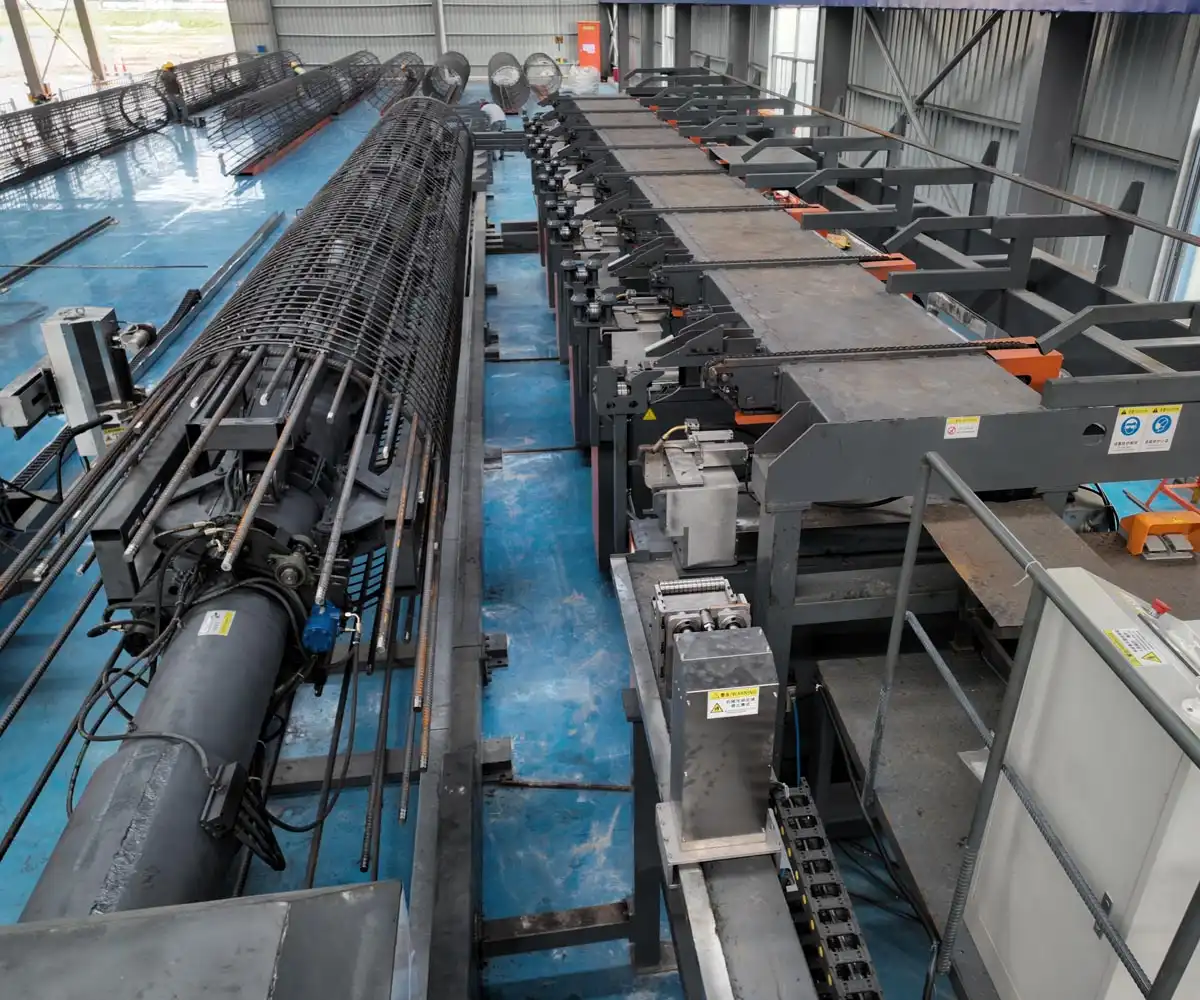
What Makes Up a Rebar Cage Welding Workstation?
Knowing how the machine works helps procurement professionals accurately judge its capabilities. The Zhongji Luyuan LYZD-GJL2500 model can handle main bar diameters of φ18–φ40 mm, spiral bar diameters of φ8–φ16 mm, and cage diameters of φ700–φ2500 mm. The structure is held together by a high-strength steel frame. Clamping and positioning are done by a hydraulic system working at -16 MPa and a gas feed at 0.8 MPa. The total installed power is 30 kW, and the welding power is 100 kW. The power comes from a standard 380V/50Hz/3-phase input.
Core Components and Their Functions
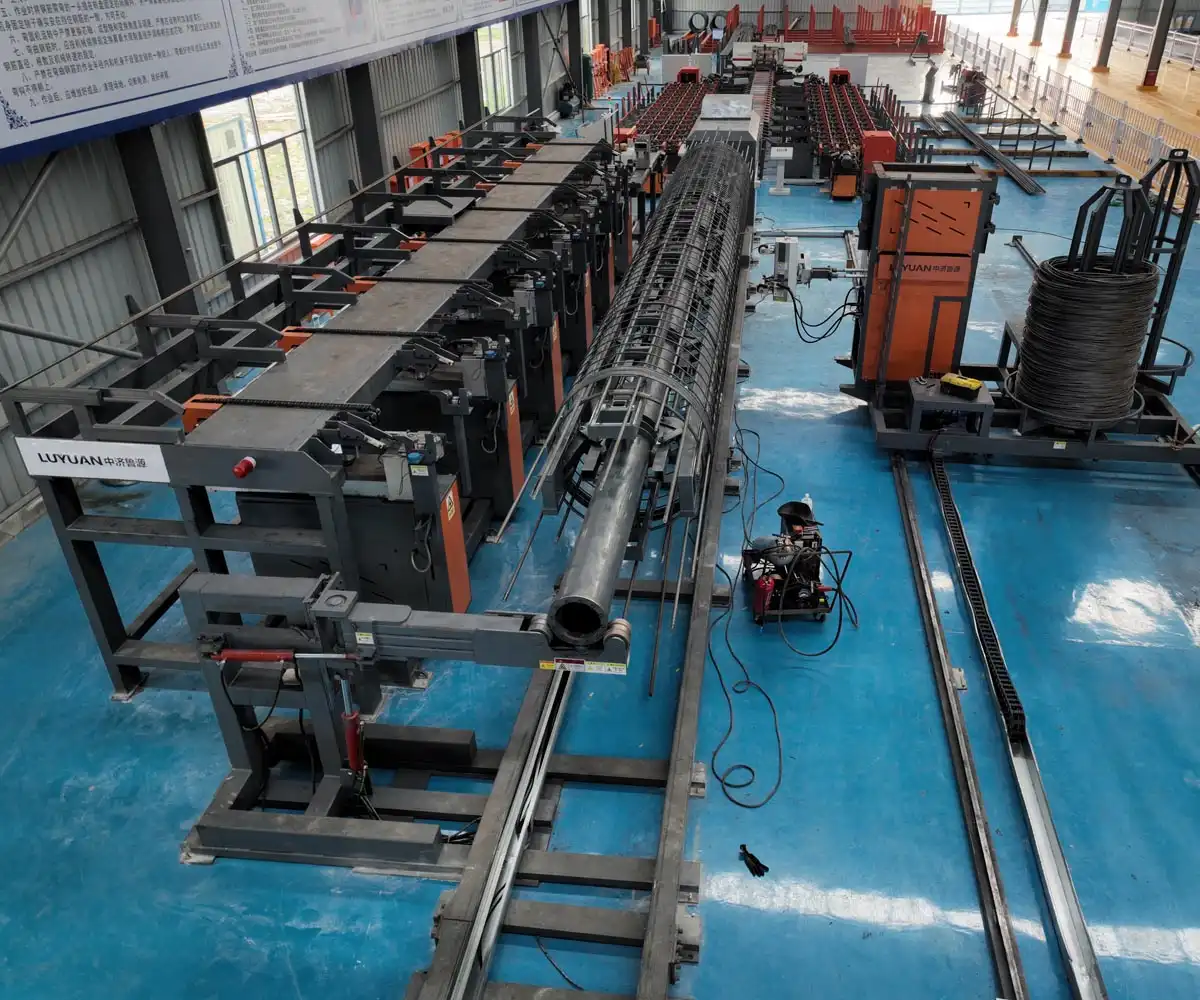
The workstation has three parts that work together: the longitudinal bar feeding and clamping unit, the spiral bar unwinding and tensioning device, and the gas-protected arc welding head on top. The PLC reads real-time encoder feedback from the rotation drive and changes the torque and angular speed to keep the stirrup pitch at ≤300 mm. With an industrial touchscreen, operators can enter cage specs and choose between single and double main bar setups without having to retool mechanically.
Operational Workflow From Load to Output
The fully automatic rebar cage welding workstation runs the whole process by itself after the user enters the cage settings on the HMI. The support ring has main bars spread out in a radial pattern. The spiral bar is run through the tensioner, and the spinning drive is turned on. Following a spiral path set by the PLC program, the welding torch makes CO₂-shielded arc welds at every crossing. During the production cycle, a normal 12-meter cage piece is finished, and the finished cage is thrown out through an integrated discharge system. Three to four times as many cages are made in ten hours as it takes for manual fabrication teams to do the same amount of work.
Key Benefits and Features That Drive Efficiency
When reviewing capital equipment, purchasing managers always put output capacity and labor cost per unit at the top of the list. The information on automated systems for making reinforcement cages shows that they are clearly better than traditional methods.
Here are the main ways that the LYZD-GJL2500 is useful for work:
- Single-operator production: The entire welding cycle requires only one person monitoring the touchscreen, reducing the crew requirement from four to six workers typical of manual yards down to one, directly cutting labor overhead on active project sites.
- Stable, repeatable weld quality: Top-mounted automatic welding geometry eliminates the angular variation inherent in handheld torch work, producing uniform weld penetration at every intersection without spatter contamination that could compromise concrete bond strength.
- Rapid specification changeover: The servo control system allows diameter and pitch adjustments through the HMI in minutes, enabling the same workstation to transition between bridge pile cages and building foundation cages within the same shift.
- Compact production footprint: At 30 m × 8.5 m, the machine fits within standard precast yard layouts without requiring structural modification to the facility.
These benefits of a fully automatic rebar cage welding workstation address the main issues that equipment managers and project directors bring up most often: the need for labor, inconsistent measurements, and tight deadlines. When one workstation can make 13 cage pieces in one shift, it has a clear and noticeable impact on the time it takes to build a pile base.
Comparing Fully Automatic vs. Semi-Automatic and Manual Workstations
The total cost of ownership, not just the buying price, is what makes the difference between the different levels of technology. For skilled welders to make a cage by hand, it needs to be reworked a lot because people get tired, and the stirrup spacing isn't always the same, which means it can fail a structural inspection under ACI 318 or Eurocode 2 tolerances. While semi-automatic systems cut down on some work, the user still needs to use their best judgment to place the welds and control the speed of the rotation.
Fully automatic systems like the LYZD-GJL2500 get rid of all the differences that a user could make in the welding loop. The PLC log keeps a digital record of the stirrup pitch at all times, which meets the quality documentation needs of high-speed rail and nuclear power projects. Industry usage data from 2023 and 2024 shows that big infrastructure builders are switching to fully automated cage fabrication to meet tighter project deadlines and depend less on a skilled welder staff that is shrinking.
The initial cost of capital is higher, but the payback period is much shorter when labor savings, less material waste from rework, and higher inspection pass rates are taken into account.
Maintenance, Troubleshooting, and Lifespan Considerations
Daily and Periodic Maintenance Priorities
Cleaning the welding nozzle, checking the tension of the wire feed, and checking the amount of hydraulic fluid are the main tasks of daily upkeep. The wire feed drive is calibrated once a week to make sure that the weld application rates are always the same. The contact tips and guide wheels are the wear parts that need to be replaced the least often. This is because they are standard parts that can be swapped out by site teams without the need for special tools.
Common Issues and Rapid Remedies
The most common problem with a fully automatic rebar cage welding workstation is that the spiral bar tensioner is out of place. The PLC fault log shows where the deviation is coming from, and most problems can be fixed in minutes by adjusting the tension through the HMI. Welds that aren't consistent are usually caused by contact tip wear or a blockage in the flow of shielding gas. Both of these problems can be found by the system's real-time monitoring alerts before they affect the quality of the cage.
The LYZD-GJL2500 is made to work hard all the time. Its reinforced steel frame and flexible unit construction make this possible. Zhongji Luyuan offers full after-sales support, which includes on-site setup, operator training, and technical support. This makes sure that any downtime is fixed quickly and doesn't cause project delays.
Procurement Guide: How to Choose and Buy a Rebar Cage Welding Machine?
To choose the right automated cage welding system, you must first know the range of cage diameters, the specifications for the main bars, and the daily output goal that your project needs. Buyers should make sure that the machine's cage width range meets the needs of all ongoing jobs, not just the current one.
As important as machine specs are, so are the qualifications of the supplier. Zhongji Luyuan was established in 2016 with 50 million yuan in registered capital. It has provided reinforcement processing services to contractors working for China Railway, China Railroad Construction, China State Construction, and China Nuclear Power Construction Corporation. Its products are exported to more than 100 countries. For foreign buyers, that track record means that the tech is proven to be reliable.
Carefully look at the terms and conditions that come after the sale. Things like installation support, the length of operator training, the availability of extra parts, and the time it takes for a technician to respond all affect how well a capital asset works with multi-shift production plans.
Conclusion
Automated manufacturing of reinforcement cages has gone from being a way to boost work to a must-have for big building projects. A well-specified fully automatic rebar cage welding workstation gets rid of the need for manual error, speeds up production cycles, and creates the high-quality documentation that projects with strict requirements need. The LYZD-GJL2500 can deliver 13 cage sections per 10-hour shift with just one operator. It can handle cage diameters from 700 mm to 2,500 mm and lengths up to 12 m. When procurement teams look at reinforcement automation, the real value of the investment is based on the output capacity, weld accuracy, and provider support depth.
FAQ
How long does it take to produce one standard 12-meter cage?
The LYZD-GJL2500 can finish a 12-meter section in 45 to 50 minutes in standard configuration, depending on the cage diameter and stirrup pitch. Throughput is always three to four times higher than when teams of people work by hand to reach the same output goal, with 13 cages being built in a 10-hour shift.
Does the system support both single and double main bar configurations?
Yes. There are single and double main bar arrangements as well as single and double spiral bar arrangements that can be used with this workstation. The PLC link lets you switch between setups without having to retool the machine mechanically.
What operator skill level is required?
The HMI is made for people who work at the ground level. Most operators can run production on their own after a three- to five-day training course that covers PLC parameter entry, basic fault analysis, and daily upkeep tasks.
How does the system ensure weld consistency across the full cage length?
The PLC constantly checks the encoder input from the rotation drive and makes real-time changes to the welding settings. The approach angle of a top-mounted torch stays the same along its 12-meter length. This stops the angular drift that leads to missed or weak welds when done by hand.
Ready to Upgrade Your Rebar Cage Production? Contact Zhongji Luyuan
The fully automatic rebar cage welding workstation for sale by Zhongji Luyuan is designed for contractors who need to make reliable, high-output cages without having to rely on too much manual labor. On-site commissioning, personalized configuration suggestions, and long-term expert help are all things that our team offers. You can email us at sales2@shandongluyuan.com or go to shandongluyuan.com to ask for a specification sheet or a production demo that fits the needs of your project.
References
1. American Concrete Institute. ACI 318-19: Building Code Requirements for Structural Concrete. ACI, 2019.
2. International Organization for Standardization. ISO 9001:2015 Quality Management Systems — Requirements. ISO, 2015.
3. European Committee for Standardization. Eurocode 2: Design of Concrete Structures EN 1992-1-1. CEN, 2004.
4. Construction Industry Institute. Benchmarking & Metrics: Automation in Reinforcement Fabrication. CII Research Report, 2022.
5. McKinsey Global Institute. Reinventing Construction: A Route to Higher Productivity. McKinsey & Company, 2017.
6. American Welding Society. AWS D1.4/D1.4M: Structural Welding Code — Reinforcing Steel. AWS, 2018.