How Does a Pile Cage Making Machine Improve Production Efficiency?
Sep 23, 2026
A pile cage making machine dramatically improves production efficiency by replacing manual rebar assembly with fully automated wire feeding, spiral winding, and precision welding in a single synchronized operation. Where a skilled crew might spend four to six hours hand-tying one 12-meter cage, an automated rebar cage welding workstation can complete the same unit in roughly 45 minutes. PLC-controlled sequencing eliminates human error, ensures consistent spiral pitch, and maintains structural concentricity across every cage produced — outcomes that manual fabrication simply cannot replicate at scale.
Assessing Production Challenges in Traditional Pile Cage Fabrication
Why Manual Fabrication Becomes a Bottleneck?
In traditional pile cage construction, a lot of work is done by hand. For example, each longitudinal bar and spiral ring is measured, placed, tied, and welded by hand. Big building projects like bridge pier foundations, metro station bored piles, and high-speed railroad deep foundations can easily need more than ten cages per shift every day. It's hard for manual teams to keep up that level of output while keeping the accuracy of the measurements. According to the American Concrete Institute, one of the most common reasons why deep foundation projects don't meet code is that the reinforcement wasn't placed correctly.
Aside from speed, human methods make welding less consistent. Weld strength varies from worker to worker, and missed welds aren't seen until they're inspected, which leads to extra work, wasted materials, and missed deadlines. When procurement managers have to work with tight delivery windows, these factors hurt both project earnings and the trustworthiness of suppliers.
The cost of labor is also very important. In the United States, skilled ironworkers and qualified welding techs get paid a lot. The cost per unit goes up a lot when three to six workers are stuck at one cage assembly station for hours at a time. This is especially true for multi-phase infrastructure contracts.
How Pile Cage Making Machines Optimize Production Efficiency
Automation That Transforms the Production Floor
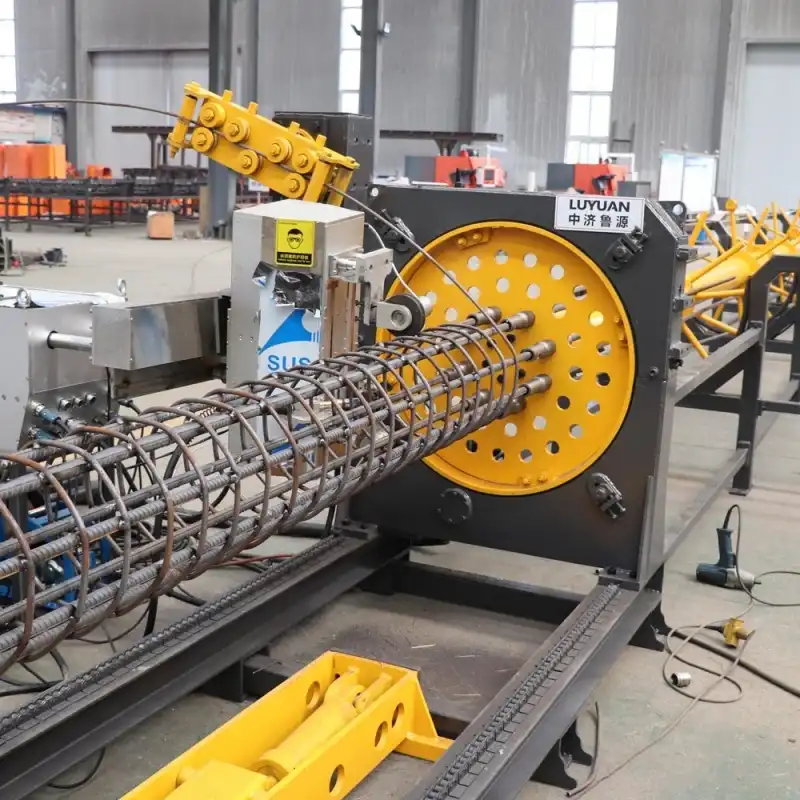
Modern equipment for making rebar cages, such as a pile cage making machine, combines spiral wire wrapping, gas-protected arc welding, and sending bars along a straight line into a single, PLC-controlled cycle. The LYZD-GJL2500 Automatic Rebar Cage Welding Integrated Workstation from Zhongji Luyuan is a good example of this ability. It can work with main bar diameters of φ18 to φ40 mm and spiral bars of φ8 to φ16 mm. It can also work with cage diameters of φ700 to φ2500 mm, which is a wide range that can be used for foundations for everything from small buildings to large bridge piers.
The machine's output makes its productivity clear: one person can run it for 10 hours and make 13 full 12-meter cage sections. That number shows a three- to five-fold increase in throughput compared to manual assembly teams, which is in line with performance standards used in studies on building automation.
Here are the main aspects of better performance that make this efficiency gain possible:
- Fully automatic PLC and HMI touch interface control eliminates manual sequencing decisions, reducing cycle time and operator fatigue. The touch-screen interface allows rapid program switching between cage specifications without physical retooling.
- Gas-protected arc welding with top-mounted automatic welding heads produces straighter, more stable weld points and eliminates missing or false welds — a chronic defect in manual torch welding on rotating cages.
- Single-operator requirement across a 30 kW primary power draw (with 100 kW dedicated welding power) means labor allocation per cage drops dramatically, releasing skilled workers to higher-value tasks elsewhere on the project site.
- Support for both single and double main bar configurations, plus single and double spiral bar options, gives engineering teams the flexibility to meet varied structural specifications without procuring multiple machines.
These skills directly lead to measured project results, such as shorter lead times for manufacturing, lower labor costs per unit, and uniform dimensional compliance across hundreds of cage production runs.
Choosing the Right Pile Cage Making Machine for Your Business Needs
Matching Equipment Specifications to Project Demands
To choose the right pile cage making machine reinforcement cage fabrication method, you need to be honest about your production rate, the range of cage specifications you need, and the limitations of your site. A semi-automatic machine might work for a processing center that works on residential projects, but large-scale infrastructure contractors who build highway bridges, metro stations, and port foundations need fully automatic systems that can keep producing a lot of work at once.
The LYZD-GJL2500 immediately deals with this. It can handle bored piles with diameters from φ700 to φ2500 mm and cage lengths up to 12 meters, which covers most of the sizes used in bridge engineering and high-rise foundation work. It can be used for both stable processing workshops and semi-fixed site setups because it is made of a modular reinforced steel frame and has a small 30 m × 8.5 m footprint.
The total cost of ownership, not just the purchase price, should be what procurement professionals think about. It costs more per cage per year for a machine that needs six human workers than for a fully automated workstation that only needs one, even if the initial cost is higher. After-sales support from the supplier is also very important. Zhongji Luyuan offers on-site installation testing, operator training, and a fast technical service network, all of which directly protect equipment uptime on projects that need to be finished on time.
Best Practices for Operation and Maintenance to Sustain Efficiency
Protecting Uptime Through Preventive Care
Maintenance schedules must be followed to keep production running smoothly. For gas-protected arc welding systems, cleaning the welding nozzles every day stops the arc from becoming unstable, which lowers the quality of the weld and causes inspection failures. Grounding circuits and anode contacts are checked once a week to catch wear and tear before it stops output.
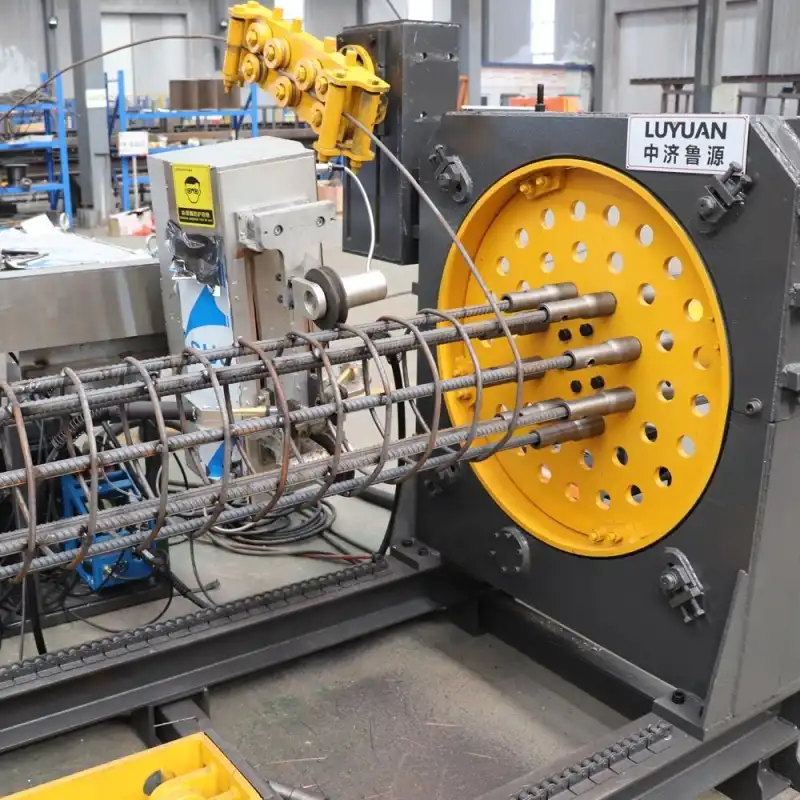
The LYZD-GJL2500, a pile cage making machine, has a modular structure that makes it easier to get to parts for regular maintenance, and its servo control system keeps setting accuracy over long hours of use without having to be constantly recalibrated. The pressure in the hydraulic system should be checked against the ≤16 MPa working limit, and the air supply lines should be checked to make sure they are at ≤0.8 MPa before each shift.
Return on investment is faster when operators are trained. Zhongji Luyuan offers structured training on-site that includes PLC program calibration, safety protocols, emergency stop sequences, and procedure changeover procedures for specifications. In terms of both speed and quality, a well-trained single person running this equipment always does a better job than a bigger manual crew.
Future Trends and Innovations in Pile Cage Making Technology
Where the Industry Is Heading?
Smart sensor arrays, IoT-enabled monitoring, and AI-assisted quality inspection are all making their way into the rebar cage production sector. These technologies help with predictive maintenance, which means they can find things like worn bearings or deteriorating welding heads before they break. They also make it possible to check dimensions in real time, which takes the place of inspection samples after production.
Because of environmental rules in state-owned engineering firms and global EPC contractors, energy efficiency is now a requirement in and of itself when buying things. These new procurement requirements are in line with equipment that is made to use less power when not in use and waste less welding gas.
Zhongji Luyuan was established in 2016 with 50 million yuan in registered capital. It continues to put money into developing smart manufacturing. Its products are used in China on high-speed railroads, highways, bridges, tunnels, rail transit, and nuclear power projects. They have also been sent to South Korea, Malaysia, Thailand, Kazakhstan, Israel, and South Africa, among other places.
Conclusion
Making pile cages by hand has real costs, like a lot of work, inconsistent measurements, and output rates that can't keep up with contemporary project schedules. A pile cage making machine such as a fully automatic rebar cage welding workstation gets rid of these problems by controlling the feeding, winding, and precise welding of the bars with a PLC. The LYZD-GJL2500 can deliver 13 cage sections per 10-hour shift with one operator. The cage width ranges from ±700 to 2500 mm, which is a standard profile that meets the needs of the widest range of infrastructure projects. The case for automation in terms of quality and efficiency is strong and can be measured by procurement managers, project leaders, and equipment engineers who are looking at how to make production more efficient.
FAQ
How much faster is an automated rebar cage machine compared to manual assembly?
A standard 12-meter cage can be made by an automated system in 40 to 50 minutes, but it would take a crew four to six hours to do it by hand. In the same kind of production settings, that means three to five times faster output.
What cage dimensions does the LYZD-GJL2500 accommodate?
The machine can work with cages that are 700 to 2500 mm in diameter and up to 12 meters long per section. There is a range of α18–φ40 mm for the main bar and Ά8–Ά16 mm for the spiral bar.
How many operators does the machine require?
The LYZD-GJL2500 only needs one person to run a full production shift. This makes it much less dependent on labor than traditional manual manufacturing.
What welding method does the machine use, and how reliable is weld quality?
Gas-protected arc welding is used on the machine, which has automatic welding heads on top. This method produces welds that are all the same and don't have any flaws. There are no missing or fake weld spots along the whole length of the cage.
What after-sales support does Zhongji Luyuan provide?
Installation, commissioning, operator training, and ongoing technical support are all done on-site by Zhongji Luyuan. Customers are also told about regular maintenance plans that will help them get the most use out of their tools.
Partner with Zhongji Luyuan for Your Pile Cage Production Needs
Major infrastructure contractors in almost 100 countries trust Zhongji Luyuan's tried-and-true pile cage making machines. The LYZD-GJL2500 is a high-output machine that has fully automatic PLC control, gas-protected arc welding, and the ability to adapt to a wide range of specifications. Get in touch with our engineering team to get a custom equipment estimate, a study of how efficient your production is, or a demonstration of your product. You can email us at sales2@shandongluyuan.com or go to shandongluyuan.com to see our full list of pile cage making machine suppliers.
References
1. American Concrete Institute. ACI 318-19: Building Code Requirements for Structural Concrete. American Concrete Institute, 2019.
2. Construction Industry Institute. Automation and Robotics in Construction. University of Texas at Austin, 2021.
3. International Federation for Structural Concrete (fib). fib Bulletin 65: Model Code for Concrete Structures 2010. fib, 2012.
4. McKinsey Global Institute. Reinventing Construction: A Route to Higher Productivity. McKinsey & Company, 2017.
5. National Institute of Standards and Technology (NIST). Measurement Science for Construction Automation. NIST, 2020.
6. World Economic Forum. Shaping the Future of Construction: A Breakthrough in Mindset and Technology. World Economic Forum, 2016.