How Does a Steel Cage Welding Machine Improve Pile Foundation Production?
Sep 17, 2026
A steel cage welding machine directly transforms pile foundation production by replacing labor-intensive manual fabrication with automated, precision-driven processes. These machines use PLC-based control systems and gas-shielded arc welding to produce reinforcement cages with consistent pitch spacing, accurate diameters, and structurally sound weld joints. In pile foundation work, where structural integrity is non-negotiable, the shift from manual assembly to automated cage forming reduces human error, accelerates production cycles, and lowers per-unit labor costs significantly. For infrastructure contractors handling large-scale bridge, metro, or highway pile work, this equipment represents a measurable leap in both output quality and operational efficiency.
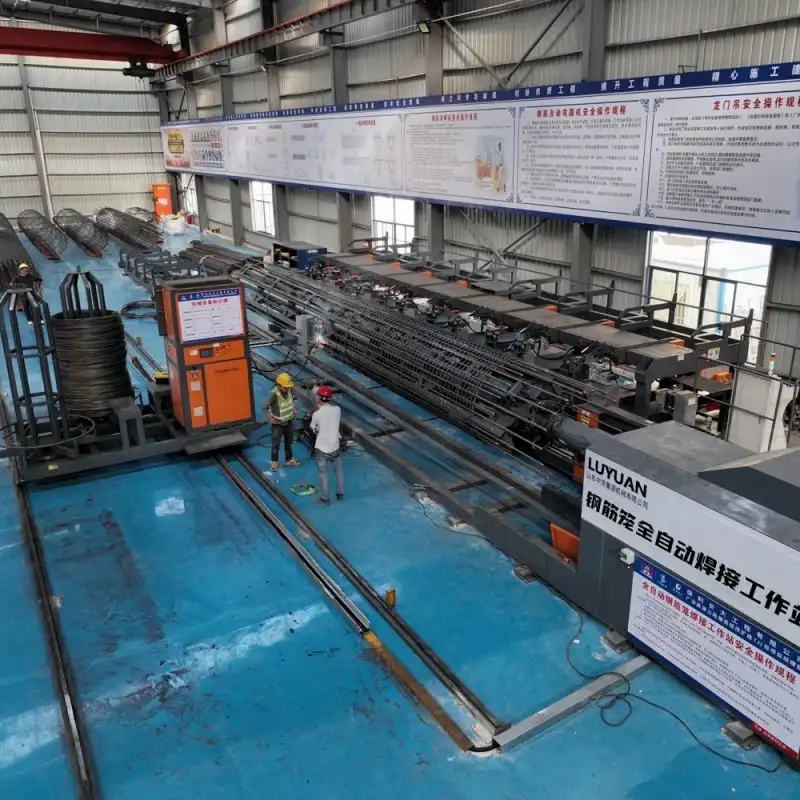
Understanding the Role of Steel Cage Welding Machines in Pile Foundation Production
Bridges, skyscrapers, and subway systems all have pile foundations that hold up the whole structure. Any flaw in the reinforcement cage, like a missed weld, a spiral pitch that isn't consistent, or a change in size, can make the structure less strong when it's under dynamic or seismic loads.
What Do These Machines Actually Do?
An automated rebar cage welding system uses electrical, mechanical, and hydraulic parts to wind main bars that go along the length of the structure and spiral bars that go around the outside into a precise cylinder shape. The system syncs the speed of rotation with the travel of the trolley so that the spiral pitch stays the same along the length of the cage. The LYGH line from Zhongji Luyuan can handle main bar diameters ranging from φ16 mm to φ50 mm and spiral bar diameters ranging from φ5 mm to φ16 mm. Depending on the type, cage diameters can be changed from 500 mm to 3000 mm.
Types and Configurations
There are six types in the LYGH line, from LYGH-1500 to LYGH-3000. The cage diameters run from 500 to 1500 mm and from 800 to 3000 mm. The cages can be made to any length up to 12 meters, and the system works with both automatic welding manipulators and human spiral bar welding. Because operators can switch between configurations based on the needs of the project, these machines are really flexible when it comes to pile types.
Common Challenges in Pile Foundation Production and How Automated Cage Forming Solves Them
There are known risks when making reinforcing cages by hand. On big infrastructure sites, problems like weld inconsistency, dimensional drift, and slow output keep happening, which is why a steel cage welding machine is increasingly seen as the practical alternative. A 2019 study in the journal Construction and Building Materials found that variations in manual welding are the main cause of foundation engineering redo costs. This kind of rework can add weeks to the schedule of big building projects.
The Automation Advantage in Practice
On busy building sites, Zhongji Luyuan's automated rebar cage welding systems offer the following main operating benefits:
- Consistent weld quality without operator fatigue: Gas-shielded arc welding with optimized current settings and wire feed speed ensures deep joint penetration on every spiral-to-main-bar intersection, eliminating missing or false welds that occur in manual production.
- High-volume throughput under sustained operation: The LYGH series achieves a reference production rate of 8 cages per 10 hours under actual site conditions—roughly three to four times faster than conventional hand assembly for standard 12-meter piles.
- Minimal labor requirement: Automatic welding mode requires only 1–2 operators per machine, a sharp contrast to the 2–4 operators needed for manual welding setups. On multi-site infrastructure projects, this translates directly into lower per-cage labor costs.
- Dimensional precision that meets structural codes: PLC-controlled synchronization between winding speed and trolley travel maintains spiral pitch error within ±5 mm, satisfying structural requirements under standards such as ASTM A615 and ACI 318.
These benefits directly fix the problems with production that cause pile foundation schedules to slip and costs to rise on high-speed rail, highway, and bridge building projects.
Safety and Environmental Considerations
When something is automated, the user is less likely to be hurt by direct arc welding. The LYGH series meets international standards for safety and the environment. The enclosed welding process keeps fumes from spreading around the work area, which is useful in urban underground construction zones where air quality rules apply.
Choosing the Right Steel Cage Welding Machine for Pile Foundation Applications
When purchasing professionals look at reinforcement cage welding equipment, they need to make sure that the steel cage welding machine's capabilities match the needs of the project exactly. The wrong design leads to either a lack of capacity or capital expenditures that aren't necessary.
Key Selection Criteria
When looking for pile cage welding tools, good purchasing choices are based on the following:
- Cage diameter range: The LYGH-1500 handles 500–1500 mm, suitable for standard highway bridge piles, while the LYGH-3000 reaches 800–3000 mm for large-diameter metro or deep foundation applications.
- Power and footprint requirements: Equipment power ranges from 16 KW (LYGH-1500) to 38 KW (LYGH-3000). Footprint with automatic welding runs from 28 m × 8.5 m to 28 m × 13.5 m—critical information for site layout planning.
- Control system capability: All LYGH models use a PLC plus an industrial HMI touch-screen interface. The servo control system on higher-spec models delivers enhanced precision and supports quick specification changeovers between cage types.
- After-sales support network: Given the high cost of downtime on active construction sites, supplier responsiveness and spare parts availability are procurement-critical factors. Zhongji Luyuan maintains a dedicated after-sales service team with installation guidance and operator training programs.
A modular structure design makes upkeep easier and cuts down on the average time it takes to fix something. A reinforced high-strength steel frame makes sure that the equipment can handle long periods of heavy production without structural stress.
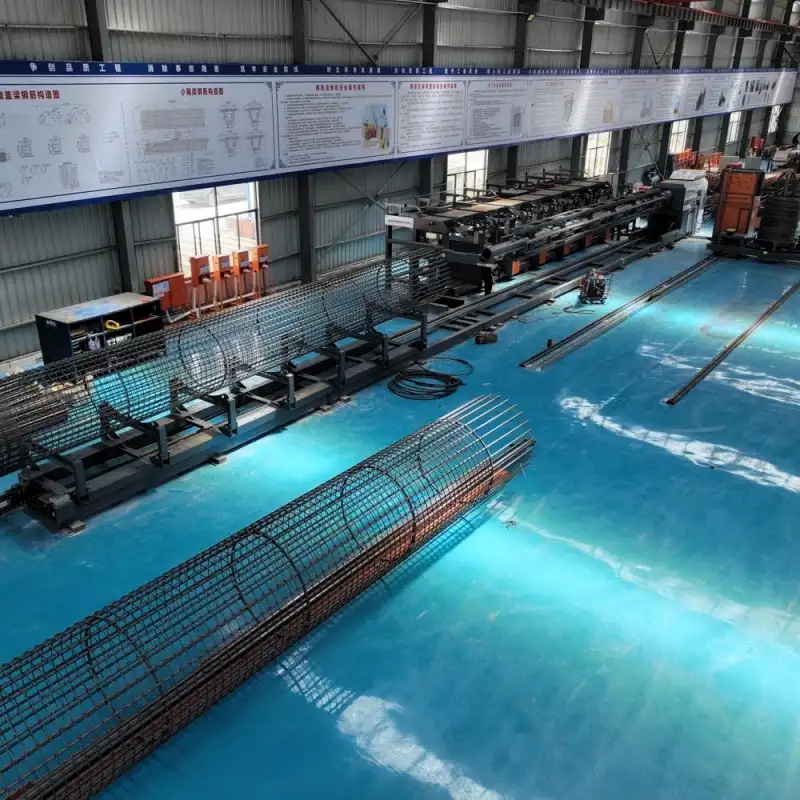
Best Practices for Operating and Maintaining Steel Cage Welding Machines
Even a well-designed steel cage welding machine needs to be operated correctly and maintained on a regular basis in order to keep working well for many years.
Operational Protocols That Protect Performance
Before each shift, operators should check the pressure in the hydraulic system (≤16 MPa) and the pressure in the air supply (≤0.8 MPa for automatic welding gas). During a 10-hour production cycle, cleaning the welding tips and checking the cooling system of the transformer on a regular basis keeps it from overheating and keeps the current flowing steadily.
Preventive Maintenance Essentials
The fixed and mobile disks should be checked for concentricity on a regular basis. Dimensional drift in this area causes "banana-shaped" cages that fail site acceptance checks. Testing the electrical insulation and making sure the grounding is correct protect the PLC logic processor from changes in voltage. This is especially important at building sites that are far away, and the power lines aren't stable. Wide-voltage operation is possible on Zhongji Luyuan's machines, and industrial-grade electrical screens protect sensitive control parts even more.
Market Trends and Future Outlook of Steel Cage Welding Equipment in Construction
As of 2023, Grand View Research found that the global construction automation market will grow at a rate of about 8.5% per year until 2030. This is because of a lack of workers, rising wages, and faster infrastructure investment in North America and Southeast Asia. As a result of this trend, there is a greater need for automated pile cage fabrication systems. This is because pile foundation specifications are becoming more complicated in seismic zones and deep urban excavation projects.
IoT integration is becoming the next big thing in utility. Machines that can watch welds in real time, log production data, and do remote diagnostics let project managers keep an eye on cage output against schedule goals even when they're not at the site. Zhongji Luyuan keeps putting money into smart manufacturing to make sure that its LYGH product line meets the changing needs of the market. This helps clients stay competitive as digitalization in construction speeds up.
Conclusion
Automated reinforcement cage welding systems have shifted from a productivity upgrade to a competitive necessity in modern pile foundation production. The combination of PLC-controlled precision, gas-shielded arc welding quality, and dramatically reduced labor requirements makes a steel cage welding machine a high-ROI investment for infrastructure contractors, bridge engineering firms, and metro construction companies working at scale. Zhongji Luyuan's LYGH series covers the full spectrum of pile cage specifications—from 500 mm to 3000 mm diameter—with proven reliability on major construction programs across nearly 100 countries.
FAQ
What rebar grades are compatible with these cage welding systems?
The LYGH series accommodates HRB400 and HRB500 high-strength rebar grades, with main bar diameters ranging from φ16 mm to φ50 mm. This covers the majority of structural pile specifications in bridge, metro, and high-rise foundation applications.
How does automatic mode differ from manual welding mode?
In automatic mode, a welding manipulator handles all spiral-to-main-bar joints under PLC control, requiring only 1–2 operators and achieving consistent weld quality across the entire cage length. Manual mode uses 2–4 operators and is suited to lower-volume or non-standard configurations.
What maintenance does the welding system require?
Key maintenance tasks include regular welding tip dressing, transformer cooling system cleaning, hydraulic pressure checks (≤16 MPa), and concentricity verification of the rotating disc assembly. Zhongji Luyuan provides operator training and maintenance documentation to support in-house service teams.
Can these machines handle varied cage lengths on the same project?
Yes. All LYGH models support cage lengths up to 12 m with customizable configurations available. Fast specification changeover via the HMI touch screen minimizes downtime between different cage types.
Partner with Zhongji Luyuan for Your Next Project
Zhongji Luyuan provides advanced steel cage welding machine solutions designed for bridge, metro, highway, and large-scale foundation projects. With precise PLC control, flexible cage configurations, and professional technical support, our LYGH series helps contractors improve production efficiency and maintain consistent welding quality.
Contact us at sales2@shandongluyuan.com to discuss your project requirements, request equipment details, or explore customized reinforcement cage welding solutions.
References
1. American Concrete Institute. (2019). ACI 318-19: Building Code Requirements for Structural Concrete and Commentary. ACI.
2. Grand View Research. (2023). Construction Automation Market Size, Share & Trends Analysis Report. Grand View Research.
3. Hamdy, O. A., & El-Dash, K. (2019). Automation effects on reinforcement cage production quality in deep foundation projects. Construction and Building Materials, 211, 345–356.
4. International Federation for Structural Concrete (fib). (2013). fib Model Code for Concrete Structures 2010. Ernst & Sohn.
5. ASTM International. (2020). ASTM A615/A615M: Standard Specification for Deformed and Plain Carbon-Steel Bars for Concrete Reinforcement. ASTM International.
6. McKinsey Global Institute. (2022). Reinventing Construction: A Route to Higher Productivity. McKinsey & Company.