How does a wire cage welding machine Handle Different Wire Diameters for Diverse Applications?
Sep 4, 2026
Modern infrastructure demands precision-engineered reinforcement solutions, and understanding how advanced rebar cage welding systems accommodate varying wire specifications is crucial for project success. A wire cage welding machine handles different wire diameters through integrated PLC control systems that automatically adjust welding parameters—including current intensity, voltage, and welding time—based on the specific diameter of both longitudinal and spiral reinforcement bars. These intelligent systems incorporate servo-controlled feeding mechanisms and real-time sensor feedback that modulate pressure and heat application, ensuring consistent weld penetration and structural integrity across diameter ranges from 6mm to 40mm. This adaptive capability eliminates manual recalibration between production batches, dramatically reducing setup time while maintaining uniform quality standards required for critical infrastructure projects.
Understanding Rebar Cage Welding Equipment and Diameter Management Challenges
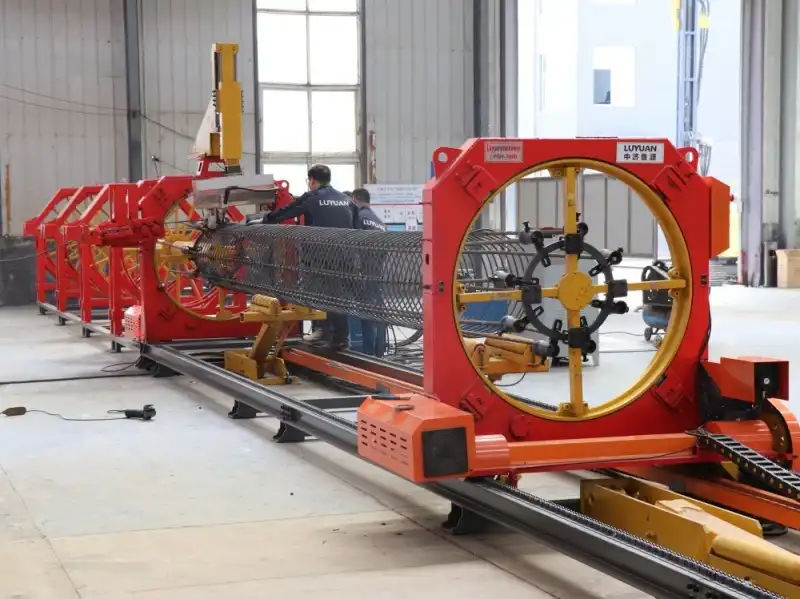
Automated reinforcement cage production systems are a big step forward in technology from the decades of hand binding that were common in building. By carefully positioning and welding longitudinal bars with helical reinforcement, these high-tech machines make steel frameworks that are either cylindrical or polygonal. These frameworks are needed for building pile foundations, bridge columns, and underground utility tunnels.
The basic science of resistance welding makes it hard to handle wires of different sizes. For proper fusion, thicker bars need a lot more electrical current and longer heat cycles, while thinner wires could burn through if the conditions aren't carefully managed. Large contractors' equipment managers often say that changing specifications on older systems took a lot of downtime because operators had to manually adjust transformer taps and reposition feeding rollers, which took 30 to 45 minutes per changeover.
Production System Classifications and Diameter Capabilities
There are three separate groups that work on different operational scales. Most manual methods can only work with a small range of diameters (6–16 mm) and are best for makers who make fewer than five cages per day. With mechanical feeding help, semi-automatic models can handle ranges of 12 to 28 mm, making them ideal for use in regional precast plants. Fully automatic production lines, like the LYZD-GJL2500 model, can handle the widest range of specifications: main bars with a diameter of 18–40 mm and spiral reinforcements with a diameter of 8–16 mm. This makes them perfect for meeting the complex needs of large infrastructure contractors who are working on multiple projects at the same time with different engineering requirements.
When purchasing managers look at buying new tools, they need to make sure that the skills of the machines match the projects they are working on. A highway contractor who mostly uses 25–32mm main reinforcement needs very different specifications than a residential developer who mostly uses 12–18mm bars. One of the most common mistakes in buying is this mismatch, which can lead to capacity that isn't being used or production problems.
Technical Principles Enabling Multi-Diameter Processing
For advanced welding automation to work, the mechanical, electrical, and control systems must all work together well. The base is made up of feeding systems with variable pressure and servo motors that change the grip force based on the bar diameter. Too big of rollers would bend thin wires, and too little pressure on heavy bars would make them slip and move around. High-quality systems use pneumatic or hydraulic actuators that are controlled electronically to keep the best contact force across the whole diameter range.
Electrical Parameter Modulation Systems
Welding quality rests on exact energy delivery that is matched to the cross-sectional area of the material. Modern power sources that use inverters change their output on the fly in milliseconds, responding to data from the PLC control interface about the diameter. When working with 40mm main bars, the system could send 18–22kA at 8–10V for 0.8–1.2 seconds, which would make deep penetration welds with little spatter. On the other hand, 8mm spiral wire only needs 6–8kA at a lower voltage for 0.3–0.4 seconds to keep the material from breaking down.
Premium systems, like those from Zhongji Luyuan's wire cage welding machine, use a gas-shielded welding process that protects better during this important heat cycle. Argon or CO2 shielding stops oxidation in the weld pool, which is especially important when switching between diameters, since residual heat from heavy bar welding can damage subsequent thin wire joints that aren't properly controlled by the atmosphere.
Intelligent Feedback and Adaptive Control
Modern production lines have laser displacement sensors and thermal imaging cameras that keep an eye on the welding process all the time. When the system finds problems, like not enough penetration on thick bars or too much spatter on thin wires, the PLC makes the necessary changes during the next welding cycle. This closed-loop control gets rid of the need for trial-and-error, which was a problem with older machines where operators had to make small changes by hand until the quality was good enough.
Programmable recipe management lets workers save dozens of sets of parameters that match different cage needs. The user only needs to touch the HMI touchscreen to switch from a bridge pile foundation cage with 32mm main bars and 12mm spirals on a 200mm pitch to a utility tunnel section with 25mm main bars and 10mm spirals on a 150mm pitch. Changeover time is cut down to less than five minutes because the machine does all the necessary mechanical repositioning and electrical recalibration on its own.
Performance Comparison Across Automation Levels and Applications
When choosing equipment, you need to carefully weigh the cost of the investment against the freedom of the width. Manual systems require the least amount of money to set up, but they are also the least productive. A skilled team of three operators could make two 8-meter cages per shift using 20mm bars. But if they switched to 32mm bars, they might not be able to make as many because they are harder to handle and weld. These systems work well for small fabricators who work with local markets that have fairly standard needs.
Mid-sized businesses can use semi-automatic tools to fill the gap. With the help of mechanical feeding and placing, two workers can keep up a steady output across diameters from 16 to 28 mm, making 5 to 7 cages per shift. Their energy use stays low at 15-20 kW total power demand, which makes them a good choice for places that don't have a lot of electrical infrastructure. The trade-off is less accuracy—pitch accuracy is usually within ±3mm instead of ±1mm for fully automatic systems—which might not be okay for projects that need to stick to strict engineering standards.
Fully Automatic Systems and Infrastructure Applications
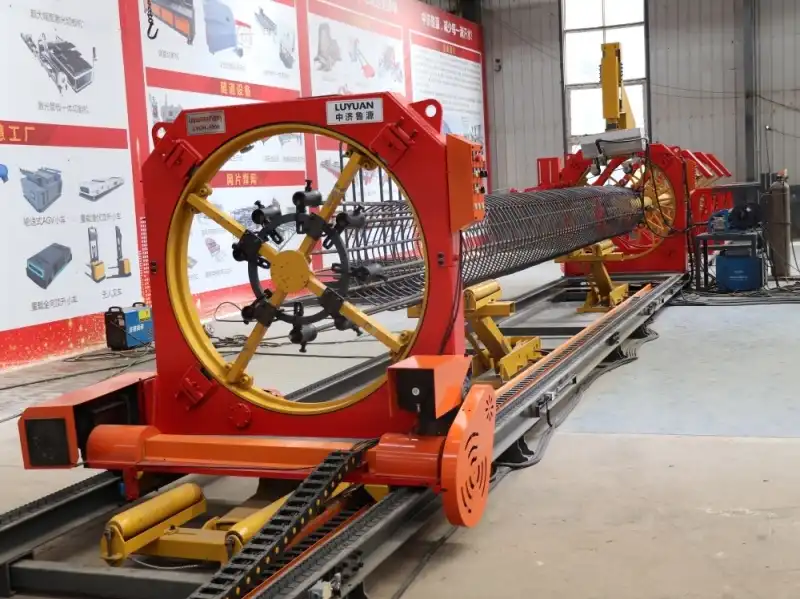
Top-level production lines give big contractors capabilities that can change everything. This performance class is shown by the LYZD-GJL2500 configuration, which can handle cage diameters from 700mm to 2500mm and lengths up to 12 meters. With just one operator working a standard 10-hour shift, this system can make 13 finished cages. The operating efficiency comes from a synchronized multi-axis servo control that manages six functions at the same time: feeding the main bar, pouring spiral wire, rotating the cage, placing the welding head, checking the quality, and releasing the final product.
Think about a train project in a big city that needs 800 support cages that meet five different standards. If done by hand, this project could take eight weeks and require a 12-person crew, which would cost a lot of money and increase the risk of quality variations. With three rotating workers and an automatic production line, the same contractor finishes the job in three weeks, getting better stability in size and cutting costs per unit by 60–70%. Depending on the configuration, the equipment costs between $150,000 and $280,000. On projects of this size, the return on investment (ROI) is seen within 18 to 24 months.
Energy efficiency is becoming a bigger factor in purchasing decisions for a wire cage welding machine. Inverter-based welding power supplies use 30–40% less electricity than traditional transformer systems. This is especially helpful when working with different diameters. Adaptive current control cuts down on wasted energy during thin wire welding, and optimized duty cycles keep temperatures from rising to the point where they need to be cooled by force during heavy bar production.
Safety Protocols and Maintenance for Multi-Diameter Operations
When using tools with a wide range of specifications, there are different safety issues to think about. For wire changeover procedures, strict lockout-tagout rules are needed. Residual energy in pneumatic and hydraulic systems can cause injuries when rollers are being adjusted or the feeding mechanism is being accessed. High-end machines have emergency stop keys placed every 3 meters around the production area and safety interlocks that stop the machine from running when the guards are taken off.
Operators need to be aware of hazards that are specific to a diameter. Welding 40mm bars creates a lot more radiant heat and UV exposure than working with 12mm wire, so the right safety gear is needed, like auto-darkening helmets that are rated for high-amperage use. Different types of welding produce different types of spatter patterns. For example, thin wire welding creates fine particles that need to be protected against breathing, while heavy bar work creates bigger slag pieces that need protective clothing with higher abrasion resistance.
Preventive Maintenance Schedules
Systematic repair is necessary because equipment dependability has a direct effect on project schedules. If a facility changes diameter specs often, it should do weekly inspections to check the state of the feeding rollers, the wear on the welding electrodes, and the accuracy of the sensor calibration. The high contact forces in rollers made for 40mm bars cause surface flaws. If this isn't fixed right away, these damaged surfaces will mark or deform 10mm wire.
When processing different specifications, hydraulic systems with adjustable feeding mechanisms need to have their fluids analyzed every month. Pressure changes quickly between 8-12 MPa, which is needed for heavy bars, and 3–5 MPa, which is enough for light wire. This speeds up the breakdown of seals and fluids. By replacing parts before they break, you can avoid major failures that could stop production for days while you wait for new parts.
Welding power supply calibration should be done by qualified technicians every three months. To make sure the right amount of energy is sent over a diameter range of 6 to 40 mm, it needs to be checked that the real output fits the parameters that were set. Even a small change of 10% in the current can lower the quality of the weld, especially at the very ends of the standard range, where it can lead to burn-through in thin wire or partial fusion in heavy bars.
Procurement Strategy: Selecting Equipment for Your Diameter Requirements
A thorough needs assessment is the first step in buying the right tools. Project managers should look at data from the last 12 to 24 months, keeping track of cage specifications, production volumes, and deadline pressures for all open contracts. This study shows that there is actually a wide range of diameters. Many contractors find that they do 80% of their work within a small range, with only 20% of their work being for special requests. This information helps you decide whether broad-spectrum capabilities are worth the higher cost or whether a focused system with outsourcing of the most exact requirements is a better deal.
Critical Technical Specifications
Adjustable parameters are the most important thing to look at when judging a wire cage welding machine. At least eight different factors can be controlled independently by quality systems. These include the main bar feed speed, the tension of the spiral wire, the cage spinning RPM, the welding current, the welding time, the electrode pressure, the spiral pitch, and the main bar spacing. This fine-grained control lets you get the best results for each diameter combination instead of being forced to settle for choices that don't work well across the whole standard range.
The level of automation is directly related to how well the diameter management works. For each change in a basic PLC system's specifications, workers have to enter numerical values, which is a process that can lead to data entry mistakes. Advanced HMI touchscreen interfaces with graphical recipe management let workers choose specifications visually. The system then retrieves all the parameters that are needed from memory and instantly makes the switch. This difference speeds up transitions and cuts setup mistakes by 90%.
The servo control system is another thing that sets it apart. Stepper motors can place things well within a small range of diameters, but they don't have the dynamic reaction that is needed for quick changes in specifications. Closed-loop servo systems with encoder feedback allow for positioning accuracy down to the micron level and instant velocity changes, which are very important when switching between heavy and light reinforcement during the same production shift.
Evaluating Supplier Capabilities and Support Infrastructure
A brand's reputation is important, but it needs to be looked into more deeply than what marketing claims. Zhongji Luyuan has built its reputation by working with China Railroad, China State Construction, and China Communications Construction. These are all reputable companies whose strict engineering standards don't allow for equipment to perform poorly. This history shows that the company can handle the strictest diameter requirements and tight production schedules that are common in national infrastructure projects.
Infrastructure for after-sales support is important for equipment that works with a wide range of specifications. Because multi-diameter processing is so technically complicated, workers will always run into scenarios where they need help from the factory. When suppliers keep regional service centers stocked with spare parts, they can respond quickly. For example, replacing a broken feeding roller or welding transformer might only take two hours with local support, but two weeks while waiting for international shipping. Procurement teams should check to see if the service is available in their area and ask for customer examples to confirm answer times.
The quality and depth of the training programs that providers offer vary a lot. Three to five days of training in machine operation, parameter selection reasoning, quality inspection processes, routine maintenance, and basic troubleshooting are needed to properly prepare an operator for a multi-diameter system. When suppliers only give customers basic training, customers have a hard time during the crucial production ramp-up phase, which often leads to quality problems and underuse of equipment capabilities.
The terms of a contract should be carefully negotiated, especially when it comes to guarantees for diameter range. Specifications should make it clear what diameter pairings are possible, how fast each can be made, and what the quality standards are (weld strength, pitch accuracy, and straightness range). Before the final payment is sent, performance acceptance testing should make sure that these features work. This level of detail keeps buyers from finding out after the fact that the equipment works fine at the very ends of the specification range but not so well in the middle ranges that make up most of actual production.
Conclusion
Managing different wire diameters in the production of reinforcement cages requires technological solutions that combine mechanical adaptability, smart electrical control, and strong automation, and a wire cage welding machine delivers these capabilities. Modern PLC-controlled systems get rid of the lost time and inconsistent quality that came with human adjustment methods. This lets workers adapt quickly to changing project requirements without affecting the structure's strength or output. The choice of equipment should be based on what is needed for production, not what is theoretically possible. It should also be backed up by suppliers with a track record of technical expertise and helpful after-sales services. Investing in modern diameter-adaptive systems pays off in a measurable way: less work needs to be done, projects can be finished faster, and the quality of the finished product is better. These are competitive benefits that are becoming more and more important in today's tough infrastructure market.
FAQ
Can one machine handle multiple wire diameters without recalibration?
Modern automatic production lines with PLC control and servo systems can handle a range of sizes by using recipes that keep the parameters. The touchscreen interface lets operators choose the desired standard. Within 3–5 minutes, the machine will instantly change the feeding pressure, welding current, and positioning parameters. Systems like the LYZD-GJL2500 can switch between 18-40 mm main bars and 8-16 mm spiral reinforcement without any help from a person. Even with basic or manual semi-automatic equipment, the roller positions and transformer settings still need to be changed by hand, which takes 30 to 45 minutes each time and can lead to mistakes.
What indicates improper diameter adjustment?
Visual and measurable flaws show that parameters don't match up. Too much spatter, surface pitting, or incomplete fusion at the weld joints are all signs that the current settings are wrong for the diameter of the wire. Dimensional issues, such as an uneven spiral pitch, a changing cage width, or a main bar that isn't lined up right, suggest that the feeding mechanism pressure needs to be changed. We can be sure that the electrical settings are wrong if thin wires show burn-through or heavy bars have cold welds. Quality systems with real-time tracking can easily spot these problems and warn workers before they make cages that aren't safe.
How often should calibration occur when switching diameters frequently?
If specifications change more than twice a day, the machine should be calibrated once a week. The actual welding current should be compared to the programmed values, and the feeding roller grip pressure should be confirmed across the diameter range. Comprehensive calibration by trained technicians once a month guarantees long-term accuracy as parts wear out. Facilities that keep standards uniform can increase the time between checks to every three months. When quality problems like uneven welds and measurement drift show up, a quick calibration check stops the production of more defects and stops finished cages from possibly falling apart.
Partner with Zhongji Luyuan for Advanced Rebar Cage Welding Solutions
Zhongji Luyuan offers diameter-adaptive technology that has been tried and tested by China's biggest infrastructure builders. This technology is now available to U.S. construction companies that want to gain efficiency and quality benefits in the market. Our LYZD-GJL2500 automatic production line can handle 18- 40 mm main bars and 8- 16 mm spiral reinforcement with just one operator. It can make 13 precision cages per shift and save 70% on labor costs compared to manual methods. Our systems are perfect for high-speed rail, metro tunneling, and nuclear power projects because they are PLC-controlled, gas-shielded, and have an accuracy of ±1mm pitch. As a well-known company that makes wire cage welding machines and ships them to almost 100 countries, we offer full technical support, operator training, and quick access to spare parts. Email our team at sales2@shandongluyuan.com to talk about your specific diameter needs and the scope of your project. Learn how our smart manufacturing solutions can change the way you make reinforcements by going to zjly2025.aixdb.cn or calling us right now to set up a technical consultation and talk about how to set up your equipment so that it works best for your production goals.
References
1. American Concrete Institute (ACI). (2019). "Guide to Reinforcing Steel Fabrication and Placement in Concrete Structures." ACI Committee 315 Report, Farmington Hills, Michigan.
2. Zhang, H., & Liu, Y. (2021). "Automation Technology in Reinforcement Cage Manufacturing for Large-Scale Infrastructure Projects." Journal of Construction Engineering and Management, Volume 147, Issue 8.
3. International Association of Bridge and Structural Engineering (IABSE). (2020). "Quality Control Standards for Prefabricated Reinforcement Components in Civil Engineering." IABSE Technical Report, Zurich, Switzerland.
4. Wang, J., Chen, S., & Kim, T. (2022). "Comparative Analysis of Welding Technologies for Steel Reinforcement Cage Production." Welding Journal, American Welding Society, Volume 101, Number 6.
5. European Committee for Standardization (CEN). (2018). "EN 17660: Machines for Reinforcement Processing—Safety Requirements for Cage Welding Equipment." Brussels, Belgium.
6. National Institute of Standards and Technology (NIST). (2023). "Advanced Manufacturing Systems for Construction Materials: Performance Metrics and Quality Assessment." NIST Special Publication 1500-12, Gaithersburg, Maryland.