Steel Cage Welding Machine Delivers Precise Rebar Cage Manufacturing
Sep 22, 2026
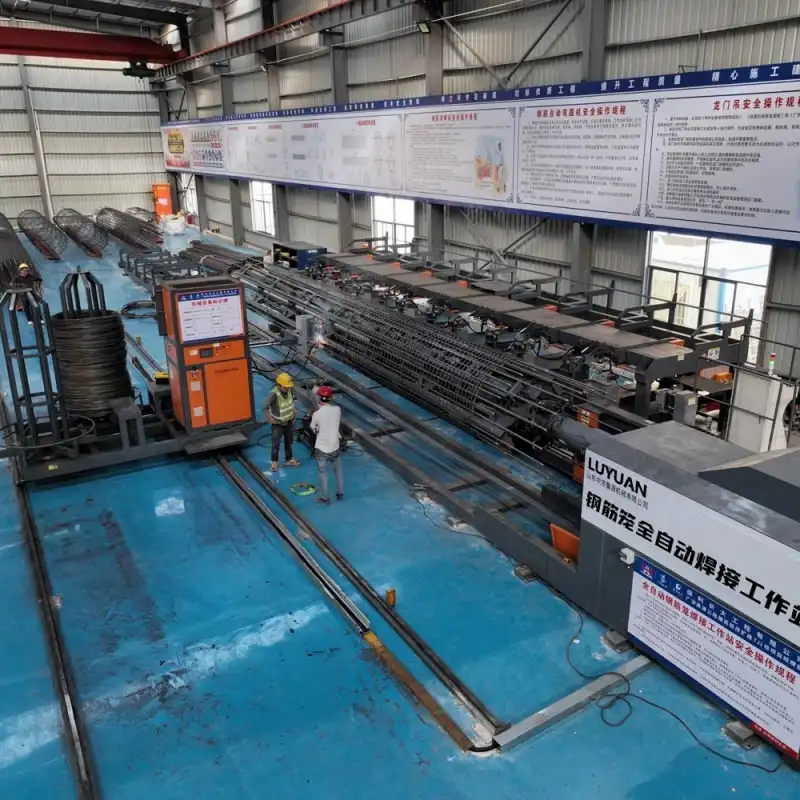
A steel cage welding machine is an automated industrial system engineered to fabricate reinforcement cages used in pile foundations, bridge piers, and large-scale infrastructure projects. By synchronizing mechanical rotation, hydraulic support, and PLC-controlled welding, it winds and welds longitudinal main bars with circumferential spiral bars into dimensionally consistent cylindrical structures. Compared to manual fabrication, this technology eliminates inconsistent weld spacing, reduces labor dependency, and accelerates production cycles — addressing three of the most persistent bottlenecks in modern construction reinforcement workflows.
Understanding How Automated Rebar Cage Welding Systems Work
Traditional methods for making rebar cages rely on hand-tying and spot welding, which takes a long time and can lead to differences in the sizes of the cages. Instead, automated rebar cage welding systems use a synchronized mechanical process: the main longitudinal bars are put into a rotating disk assembly, and a traveling welding manipulator keeps welding the spiral bar at precisely controlled pitch intervals.
The architecture of the controls that run this process is very important. The LYGH line from Zhongji Luyuan uses a PLC and an industrial HMI touch screen platform. This lets operators enter the cage diameter, spiral pitch, and cage length straight through an easy-to-use interface. The system then completes the welding cycle with little help from a person. In automatic welding mode, only one or two people are needed to run the machine.
Gas-Shielded Arc Welding for Superior Joint Integrity
Gas-shielded arc welding is used to join the spiral bar to the main bar in the LYGH series. This method gives a consistent penetration depth across the joint. This method keeps the quality of the weld even when working with main bar diameters from φ16 mm to φ50 mm and spiral bar diameters from φ5 mm to φ16 mm. The end result is a strong cage with no false or missing welds, which is very important for bridge engineering and deep pile foundation work.
Hydraulic and Mechanical Precision in Heavy-Duty Operation
The LYGH series steel cage welding machine uses a hydraulic support system that works at -16 MPa to keep the roller height constant even when long, heavy cages are attached to them. This keeps the pitch mistake within ±5 mm, which is required by ASTM and ACI building standards, so the structure doesn't sag while cages up to 12 meters long are being processed.
Key Performance Advantages in Rebar Cage Production
There is a big difference in output between making cages by hand and using machines. When conditions are good, manual teams usually make two to three cages per shift. Zhongji Luyuan's operational data shows that the LYGH series can produce 8 cages every 10 hours in real-world conditions, which is three to four times as much as manual methods.
Here are the main performance benefits that make the LYGH line stand out:
- High production throughput with consistent standards: The automated welding manipulator eliminates weld variability, ensuring every spiral joint meets the same structural specification across the entire cage length — critical for projects where structural uniformity is non-negotiable.
- Significant labor cost reduction: Under automatic welding mode, a single LYGH unit requires only 1–2 operators, compared to 2–4 workers needed in manual welding configurations. For large rebar processing centers running multiple shifts, this directly reduces monthly labor expenditure.
- Modular structure with servo precision: The reinforced structural frame and servo control system maintain dimensional accuracy across repeated production cycles, while the modular design simplifies component replacement and scheduled maintenance.
- Safe, compliant operation: The system meets international safety standards, with reduced manual intervention lowering the risk of on-site welding injuries. The touch-screen CNC interface allows operators to monitor and adjust parameters without direct proximity to the welding zone.
These performance traits of a steel cage welding machine directly address the things that project directors and equipment managers look at most closely: uptime reliability, accuracy in measurements, and the effect on managing the construction schedule.
How to Select the Right Model for Your Project Requirements?
Picking the right rebar cage welding gear relies on three things: the cage diameter range your projects need, how much you want to produce each day, and how much floor room you have.
The LYGH line comes in six basic styles:
The LYGH-1500 is 500–1500 mm, 16 KW, and has a footprint of 28 m × 8.5 m. The LYGH-1800 is 500–1800 mm, 18 KW, and also has a footprint of 28 m × 8.5 m. The LYGH-2000 is 600–2000 mm, 23 KW, and has a footprint of 28 m × 9 m. The LYGH-2200 is 600–2000 mm, 23 KW, and it is a footprint of 9.5 m. The LYGH-2500 is 800–2500 mm, 25 KW, and has a footprint of 11.5 m. The LYGH-3000 is 800–3000 mm, and it has a footprint of 13.5 m.
| Model | Cage Diameter | Equipment Power | Footprint (Auto Welding) |
|---|---|---|---|
| LYGH-1500 | 500–1500 mm | 16 KW | 28 m × 8.5 m |
| LYGH-1800 | 500–1800 mm | 18 KW | 28 m × 8.5 m |
| LYGH-2000 | 600–2000 mm | 23 KW | 28 m × 9 m |
| LYGH-2200 | 600–2000 mm | 23 KW | 28 m × 9.5 m |
| LYGH-2500 | 800–2500 mm | 25 KW | 28 m × 11.5 m |
| LYGH-3000 | 800–3000 mm | 38 KW | 28 m × 13.5 m |
All models of the steel cage welding machine come with a 30 KW automatic welding power supply, a hydraulic pressure ceiling of ≤16 MPa, and a standard cage length capacity of 12 meters (which can be changed). For heavy infrastructure projects like metro pile foundations, highway bridge piers, and large-diameter bored piles, the LYGH-3000 is made for cage diameters of up to 3000 mm.
Matching Automation Level to Operational Context
Full automatic welding mode works best for projects that have to be finished quickly every day and must meet strict cage standards. Processing centers that have to deal with different cage sizes for different clients may like having the option to mix automatic and human welding setups. Zhongji Luyuan can make changes to the equipment to fit the needs of each project. For example, they can adapt the power source and make the cages longer than 12 meters, which is not the normal length.
Real-World Application: Infrastructure Projects Where Precision Is Non-Negotiable
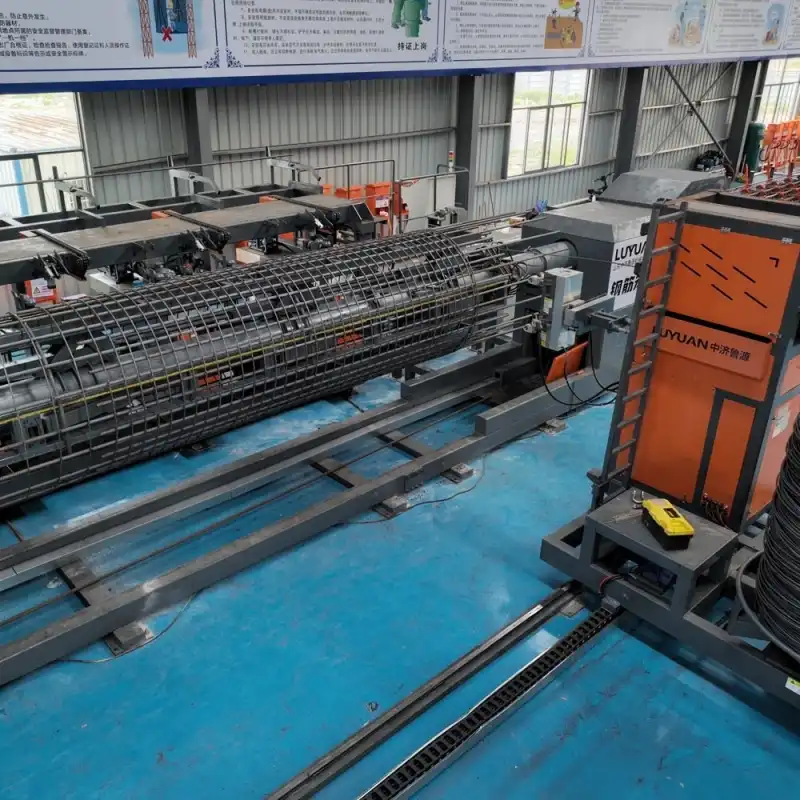
In a number of tough construction sites, the LYGH series has shown that it works well.
When building a high-speed train bridge, the bridge pier pile cages have to be able to handle dynamic axle loads and earthquake stress cycles. Any change in the spiral pitch or quality of the welds poses a risk to the structure. Automated reinforcement cage welding methods get rid of the human factors that lead to these differences, so cages that meet GB50010 and ASTM A615 rebar standards don't need to be fixed.
For urban metro deep foundation projects, the risk of borehole collapse means that the delivery of the cage must happen exactly at the same time as the drilling is finished. With an output rate of 8 cages per 10-hour shift, the LYGH series provides just-in-time operations for cage delivery, which avoids costly delays caused by production bottlenecks.
Large companies that make precast concrete and use the LYGH system on automatic production lines say that the cage shape stays the same even during high-volume runs. This is necessary for premade bridge parts and utility tunnel uses where fit-up quality on-site is controlled by dimensional tolerance.
Conclusion
Automated rebar cage fabrication is no longer a way to gain a competitive edge; it's now something that all major building companies do. Modern projects need a steel cage welding machine that combines PLC accuracy, gas-shielded weld integrity, and expandable capacity. Zhongji Luyuan's LYGH series has all of these. These systems make a measurable return on investment (ROI) in pile foundation, bridge, and prefabrication applications. They can cover cage diameters from 500 mm to 3000 mm, make 8 cages every 10 hours, and only need one operator to work. The LYGH line is a well-known and tried-and-true choice for equipment managers and project leaders who are planning their next procurement cycle.
FAQ
How does the machine maintain consistent spiral pitch across a 12-meter cage?
The PLC makes sure that the speed of the disk rotation and the speed of the truck movement are always in sync. If there is a difference between the winding rate and the trip distance, the cage will automatically make a change to keep the spiral pitch within the set parameters along the whole length of the cage.
Can the LYGH series process different rebar grades within the same shift?
The system can work with both HRB400 and HRB500 grades of rebar. Through the HMI interface, operators can change the welding current and wire feed speed to meet the thermal needs of different bar grades without having to switch out hardware.
What quality checks apply to finished cages?
Weld spot shear strength, cage concentricity, and spiral pitch consistency are all checked as part of the standard inspection process. These checks are in line with what ASTM and ACI 318 say about structural concrete.
How does the machine perform on remote construction sites with unstable power supply?
The LYGH line uses a standard 380V, 50Hz, three-phase power source and lets you change how the power is set up. Industrial-grade electrical protection parts keep the PLC and frequency converters safe from voltage changes that happen a lot at remote sites.
What does routine maintenance involve?
As part of routine maintenance, the welding tip is dressed, the generator cooling system is cleaned, the hydraulic fluid is inspected, and the roller alignment is checked. The modular frame design lets you get to parts without taking the whole thing apart, which cuts down on planned downtime.
Request a Custom Configuration from Zhongji Luyuan — Trusted Steel Cage Welding Machine Supplier
Zhongji Luyuan has worked on national-scale projects with China Railroad, China State Construction, and China Communications Construction, and it has sent goods to almost 100 countries. As a specialist in steel cage welding machines, we set up each LYGH unit to fit the cage requirements, site conditions, and output goals of your project. To get a technical advice and equipment plan, email our engineering team at sales2@shandongluyuan.com or go to shandongluyuan.com.
References
1. American Concrete Institute. ACI 318-19: Building Code Requirements for Structural Concrete. American Concrete Institute, 2019.
2. American Welding Society. AWS D1.4/D1.4M: Structural Welding Code — Reinforcing Steel. American Welding Society, 2018.
3. ASTM International. ASTM A615/A615M: Standard Specification for Deformed and Plain Steel Bars for Concrete Reinforcement. ASTM International, 2022.
4. Nawy, Edward G. Reinforced Concrete: A Fundamental Approach. Pearson Education, 2009.
5. International Federation for Structural Concrete (fib). fib Model Code for Concrete Structures 2010. Wilhelm Ernst & Sohn, 2013.
6. Construction Industry Institute. Prefabrication and Modularization: Increasing Productivity in the Construction Industry. Construction Industry Institute, 2012.