Pile Cage Machine Delivers Efficient Solutions for Construction Projects
Sep 20, 2026
Modern construction projects demand speed, precision, and structural integrity from the ground up — literally. A pile cage machine addresses all three by automating the fabrication of cylindrical rebar cages used in deep foundation engineering. Rather than relying on manual tying and positioning, these machines synchronize the placement of longitudinal bars with the continuous winding and welding of spiral stirrups, producing structurally compliant cages at scale. For procurement managers, equipment directors, and project engineers working on bridges, rail infrastructure, or high-rise foundations, understanding this technology is a decisive step toward smarter capital investment.
Understanding Pile Cage Machines and Their Role in Construction
What Does a Rebar Cage Fabrication Machine Actually Do?
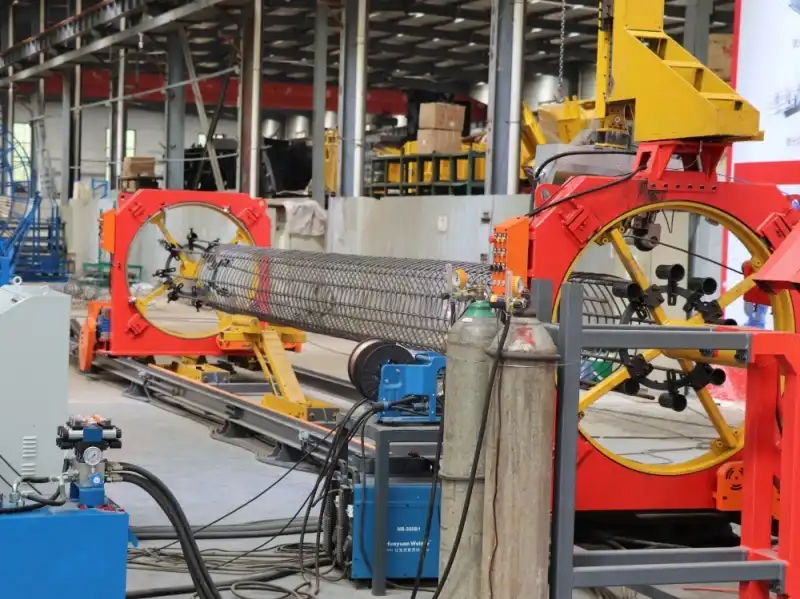
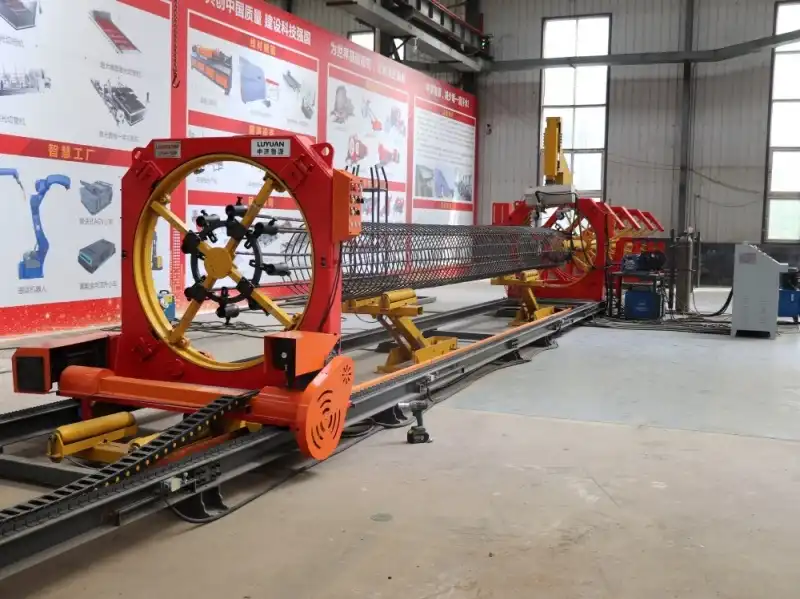
A pile cage machine has a rotating drive system and a longitudinal travel mechanism at its core. These work together to automatically put together cages. A spinning mandrel holds the main support bars, and a spiral stirrup wire wraps around them at set pitch intervals. Modern models use gas-protected welding to join every crossing point together, so they don't need to be tied by hand at all. The end result is a load-bearing cage with straight lines that is ready for the pile base placement.
Categories That Match Different Project Demands
Some rebar cage tools don't work with rebar cages in the same way. There are manual, semi-automatic, and fully automatic models on the market, as well as hydraulic and electric models. Lighter types can handle cage diameters between 300 and 800 mm and are good for projects in cities where room is limited. Heavy-duty systems, like Zhongji Luyuan's LYZD-GJL2500, can handle widths from φ700 mm to φ2500 mm and cage lengths of up to 12 meters. This means they can be used for large-scale bridge pier foundations and deep-pile structures.
Automating the production of rebar cages has benefits for operations that go far beyond speed. A lot less work needs to be done because the LYZD-GJL2500 only needs one person per shift to keep making 13 cages in a 10-hour run. There are no more missed or false join spots, and the welding is much more consistent. When heavy rebar is moved by machine instead of by hand, worker safety also goes up.
Comparing Pile Cage Machines with Traditional Methods and Among Machine Types
Manual Tying vs. Automated Fabrication
For manual rebar cage production, several workers must place the bars, tie the spiral reinforcement by hand, and visually check the pitch spacing. There are a lot of mistakes in stirrup pitch consistency, and the amount of work that can be done is limited by the size of the team. These structural and organizational problems can be fixed by automated pile cage machine welding systems, which make every weld point the same by following PLC-controlled steps.
Electric vs. Hydraulic: Choosing the Right Drive System
Electric-driven systems are better for enclosed processing centers and urban job sites with noise restrictions because they are cheaper to run, quieter, and easier to maintain. For big infrastructure projects where main bar diameter and structural load are the most important things, hydraulic machines are better because they have more clamping force and can handle main bar sizes up to φ40 mm. The LYZD-GJL2500 works with hydraulic pressure of -16 MPa and air supply pressure of 0.8 MPa. It balances force output with controlled energy use at 30 kW total power, with 100 kW of power set aside for welding.
Lightweight vs. Heavy-Duty: Portability Against Capacity
Models that are light and have modular frames can be moved quickly from one job site to another. Heavy-duty systems put consistent production ahead of portability, and their frames are reinforced to work all the time. Before choosing between the two groups, procurement workers should look at the cage diameter range, production volume goals, and site movement needs.
Operation, Maintenance, and Safety Guidelines for Optimal Use
Daily Setup and Operational Best Practices
To use a pile cage machine rebar cage welding workstation, you must first compare the PLC tablet factors to the target cage specifications. These are the diameter, main bar count, spiral pitch, and cage length. The LYZD-GJL2500's touch-screen CNC interface makes it easy for operators to set these variables without needing to know a lot about programming. This cuts down on training time by a large amount.
Here are the basic repair tasks that will make your tools last longer:
- Daily lubrication of drive chains and guide rails prevents metal fatigue and binding under continuous load cycles.
- Monthly encoder calibration maintains millimeter-level accuracy in spiral pitch spacing, ensuring every cage meets structural specifications.
- Welding electrode inspection should occur weekly to detect wear that degrades fusion quality at rebar intersections.
- Hydraulic system pressure checks verify that operating pressure stays within the ≤16 MPa design threshold to prevent seal degradation.
Sticking to these routines directly cuts down on unplanned downtime, which is a major organizational worry for projects with tight deadlines. If you don't do preventive maintenance on a production line that makes 13 cages per shift, it can cause big delays in the building process.
Safety Protocols and Compliance
Through fully automated welding processes, the LYZD-GJL2500 reduces the need for human interaction. This lowers the risk of arc flash exposure and crush injuries that come with handling rebar by hand. Industrial-grade machines have electrical cabinets that are resistant to dust and water, making them suitable for use in on-site settings. It is still the operator's job to make sure that the machinery meets OSHA safety standards and IEC electrical standards. This should be checked before any new equipment is put into service.
Procurement Guide: How to Choose, Buy, and Manage Pile Cage Machine Investments
Matching Specifications to Project Requirements
The first step in the procurement process for a pile cage machine is to get a clear picture of the production volume, cage shape range, and installation schedule. A project that needs cages with diameters up to 2500 mm and lengths of 12 meters has very different equipment needs than a medium-sized urban piling job. Checking that a supplier can work with custom rebar diameter ranges (φ6–φ40 mm), cage diameters (500–2500 mm), and power supply configurations (380V / 50Hz / 3-phase or other options) makes sure that the equipment fits in with the site's existing infrastructure.
Evaluating Suppliers: OEM Credentials and After-Sales Reliability
Buying from a verified maker instead of a middleman greatly lowers the chance of buying something. Zhongji Luyuan was established in 2016 with 50 million yuan in registered capital. It makes the LYZD-GJL2500 and has long-term partnerships with China Railroad, China State Construction, China Communications Construction, and China Nuclear Power Construction Corporation. Their equipment has been sent to almost 100 countries, such as South Korea, Malaysia, Thailand, Kazakhstan, and Israel. This shows that they can make things well and have experience with global shipping.
When you buy new equipment, you get full protection, help with installation and commissioning, and training on how to use it. These are things that you can't always get with used or hired equipment. Before signing a contract, it's important to make sure that the after-sales service response time and availability of spare parts are clear.
Future Prospects and Innovations in Pile Cage Machine Technology
IoT connectivity and AI-assisted tracking are being used more and more in the rebar cage making business. Predictive maintenance systems look at sound data and temperature readings from drive components to let workers know before problems happen, instead of waiting until production has been interrupted by downtime. Manufacturers can fix problems with PLC settings and welding parameters using remote testing, which cuts down on the time it takes for a worker to arrive on-site.
Sustainability is also changing the priorities for designing equipment. Servo-controlled motors that are energy-efficient use less power when they're not in use, and gas-protected welding processes produce less spatter and waste material than older resistance welding methods. These changes lower the total cost of ownership over the life of a machine, which increases project ROI, which is a key metric for procurement managers looking at how much to spend on capital equipment.
Conclusion
Adding a capable pile cage machine pile cage welding workstation to an automated rebar cage fabrication system turns a process that requires a lot of manual labor and mistakes into a dependable industrial operation. Zhongji Luyuan's LYZD-GJL2500 combines high output volume, wide width flexibility, and single-operator efficiency into a single machine made for tough infrastructure uses. Investing in automated fabrication technology is a simple way for construction companies and rebar processing centers that care about productivity, structural accuracy, and long-term equipment reliability to gain a measurable competitive edge.
FAQ
What cage diameters can an automatic rebar cage welding machine handle?
Modern systems like the LYZD-GJL2500 can handle diameters between ±700 mm and 2500 mm, and their configurations can be changed to fit the needs of each project. Models that are smaller can handle lengths up to 300 mm.
How many operators does automated cage production require?
The LYZD-GJL2500 only needs one operator per shift, while manual fabrication workflows need four to six workers. This means that the cost of labor per cage produced is lower.
What welding method do these machines use?
Gas-shielded welding with CO2 or a mix of gases is the standard method. It gives consistent fusion strength at every rebar intersection without the need to move the electrodes by hand.
Can the machine handle varying spiral bar spacing?
Yes. With the PLC interface, the spiral bar spacing can be set to exact increments of up to 300 mm. This lets the structure's load change in different pile zones within the same cage.
What maintenance does a hydraulic pile cage machine require?
The system consistently works within its design limits thanks to daily lubrication of the drive chains, monthly calibration of the encoders, weekly inspections of the welding electrodes, and regular checks of the hydraulic pressure.
Connect With Zhongji Luyuan for Your Next Pile Cage Machine Order
The LYZD-GJL2500 from Zhongji Luyuan is a reliable pile cage machine supplier that works with building companies in almost 100 countries. It gives a clear return on investment (ROI) on every job thanks to its flexible features, one-operator design, and full after-sales support. You can email our expert team at sales2@shandongluyuan.com or go to shandongluyuan.com to get cost information, specs, and a consultation that is specifically designed for your production needs.
References
1. American Concrete Institute. ACI 318-19: Building Code Requirements for Structural Concrete. American Concrete Institute, 2019.
2. Construction Industry Institute. Automation and Robotics in Construction. Construction Industry Institute Research Report, 2022.
3. ENR (Engineering News-Record). Top 400 Contractors Annual Report. ENR Media, 2023.
4. International Federation for Structural Concrete (fib). fib Model Code for Concrete Structures. Ernst & Sohn, 2020.
5. McKinsey Global Institute. Reinventing Construction: A Route to Higher Productivity. McKinsey & Company, 2017.
6. World Steel Association. Steel in the Circular Economy: A Life Cycle Perspective. World Steel Association, 2021.