Rebar Cage Making Machine Improves Accuracy in Concrete Structures
Sep 20, 2026
A rebar cage making machine is an automated reinforcement fabrication system that winds and welds spiral stirrups onto longitudinal bars with controlled precision. In modern concrete construction — from bridge piers to pile foundations — the dimensional consistency of a reinforcement cage directly determines whether the surrounding concrete performs as engineered. Manual fabrication introduces cumulative tolerance errors that compound over a cage's length, whereas an automated cage-forming machine holds spiral pitch deviation within tightly controlled limits, eliminates missed or false welds, and produces repeatable geometry across every unit. The result is a structurally sound, inspection-ready cage that reduces rework and keeps project schedules intact.
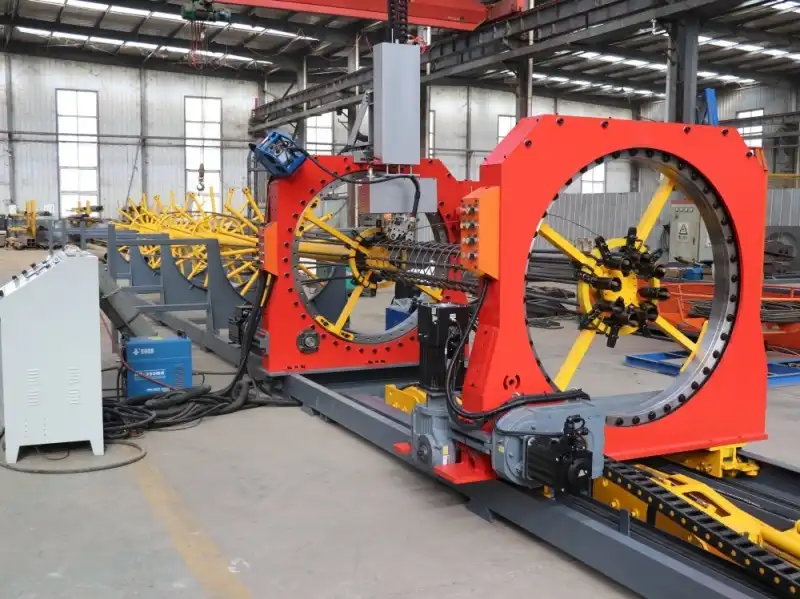
How Does Automated Cage Fabrication Directly Improve Structural Accuracy?
The tensile strength of reinforced concrete comes from the way the steel cage is shaped in relation to the material. It's hard for load to move between the two materials when the spiral pitch isn't constant, or the cage ovality is bigger than what's allowed. According to a study published in the journal Construction and Building Materials, changes in the dimensions of reinforcement cages are linked to measurable drops in the piles' ability to hold weight, especially when they are loaded laterally during an earthquake.
From Manual Error to Machine Precision
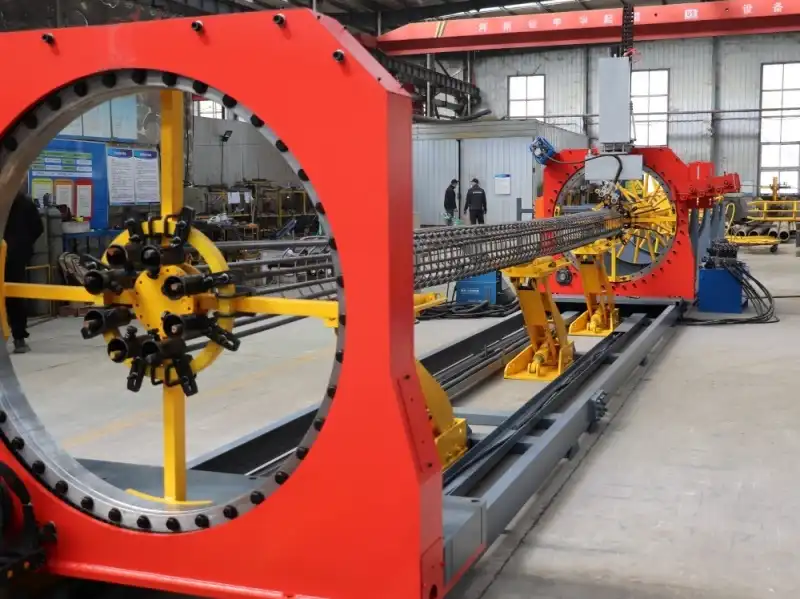
When putting together a cage by hand, it takes four to six workers to keep the gaps between the bars and the cages straight at the same time. This can go wrong even with experienced teams. That variation is taken care of by a PLC in a fully automated reinforcement cage welding machine, which makes the motors work together. The spinning disk and welding trolley move together to keep the spiral bar spacing at 300 mm. The gas-protected weld quality is the same at every intersection, so there is no burn-through and no skipped joints.
Why Welding Method Matters?
Gas-insulated welding, which is what Zhongji Luyuan does with the LYGH rebar cage making machine line, makes a smaller heat-affected zone than regular arc welding. This keeps the base metal's yield strength and stops localized weakening that could cause cracks to form when the load changes. Independent testing according to ISO 9001 standards confirms the integrity of the welds along the entire length of the cage. This gives structural engineers a quality baseline before the cage goes into the borehole.
Types of Rebar Cage Making Machines and Their Applications
Different kinds of equipment are needed for different projects. Knowing the different types of machines helps buying teams match machine capabilities to site needs so they don't over-specify or under-invest.
Once they are set up, automatic systems like the LYGH series can run without any help. The winding rotation is done instantly by semi-automatic machines, but they need two to four people to operate the human welding guns. Manual jig frames are still only useful for very small, non-essential jobs, and they can't achieve the repeatability in dimensions that building projects need.
LYGH Series: Scalable Specifications for Every Project Scale
The LYGH line from Zhongji Luyuan has six standard models with cage diameters ranging from 500 mm to 3,000 mm:
| Model | Cage Diameter Range | Equipment Power |
|---|---|---|
| LYGH-1500 | 500–1,500 mm | 16 kW |
| LYGH-1800 | 500–1,800 mm | 18 kW |
| LYGH-2000 | 600–2,000 mm | 23 kW |
| LYGH-2200 | 600–2,000 mm | 23 kW |
| LYGH-2500 | 800–2,500 mm | 25 kW |
| LYGH-3000 | 800–3,000 mm | 38 kW |
All types of rebar cage making machine can handle main bar diameters ranging from φ16 mm to φ50 mm and spiral bar diameters ranging from φ5 mm to φ16 mm. They can also handle cage lengths of up to 12 m (customizable), hydraulic pressure of up to 16 MPa, and an automatic welding power supply of 30 kW. With robotic welding, each shift only needs one or two workers.
These machines are used for drilling pile foundations for highway and high-speed rail projects, building deep-water bridge piers, urban metro bored pile networks, and nuclear power plant foundation systems. They have to work in places where zero-defect cage geometry is required.
Operation Best Practices for Peak Fabrication Accuracy
It's just as important to choose the right model as it is to use the tools properly. Before the first rotation starts, the touchscreen CNC interface lets operators enter the cage diameter, spiral pitch, and length. Most machine operators can start making things right away after a short three- to five-day training period that covers PLC programming and safety protocols.
Here are the care steps that will keep things accurate for a long time:
- Daily lubrication of guide rails and drive chains prevents wear-induced pitch drift that accumulates over extended production runs.
- Monthly PLC sensor calibration ensures the synchronization signal between the rotating disc and welding trolley remains within the ±5 mm tolerance specification.
- Hydraulic oil temperature monitoring during continuous production protects the support arms from deformation that would alter cage ovality mid-cycle.
- Pre-shift weld quality checks on sample joints confirm gas pressure is within the ≤0.8 MPa operating range before full production begins.
These practices are easy to put into action, directly extend the service life of machines, and keep the output dimensions within engineering specifications. A LYGH machine that is well taken care of can produce eight cages per ten-hour shift, which is a standard that has been proven to work in real life.
Comparing Market Solutions: What to Evaluate Before Purchasing?
You can get a rebar cage making machine from a number of different places, and price alone is not a good indicator of ownership costs. Infrastructure companies' purchasing managers always put the most weight on three things: processing accuracy under sustained load, the availability of after-sales parts, and commissioning support at the project site.
Zhongji Luyuan was established in 2016 with 50 million yuan in listed capital. It works together with China Railroad, China Railroad Construction, China State Construction, and China Nuclear Power Construction Corporation. The company sells its goods in almost 100 countries and regions, such as the US, South Korea, Malaysia, Thailand, Kazakhstan, and Israel. Because of the wide range of deployments, supplies for spare parts and online diagnostic help are already set up in major markets. This lowers the risk of extended downtime for projects that need to be completed by a certain date.
Before you choose a rebar cage machine supplier, make sure that the equipment has official CE or ISO 9001 certification, that the PLC control system (Siemens or an equivalent) is backed by a local service network, and that the manufacturer can give you project references in the type of application that applies to your contract, such as bridge, pile, or transit.
Cost-Benefit Analysis: The Financial Case for Automation
Three savings streams work together to cover the initial cost of an automated cage welding system. Moving from a four-person manual crew to a one- to two-person automatic process cuts direct labor costs by 50–75% per cage. This is the most noticeable change. Those savings add up quickly on a big infrastructure project that makes hundreds of cages every month.
It is the second stream of material productivity. When the spiral pitch stays the same, there is no need to over-wind to make up for expected variations. This means that less spiral bar is used per cage. When the machine can hold tolerances that hand production can't, structural repair, which is the most expensive line item when cage shape fails inspection, drops to almost nothing.
Different models in the LYGH line use between 16 kW and 38 kW of energy, which isn't very much considering the 30 kW welding power and production rate. When projects switch from manual fabrication to automated systems, they report that they get their money back within 18 to 24 months with normal production volumes. On the other hand, they get their money back faster for high-volume contracts.
Conclusion
Precision is not just a nice-to-have when making reinforcing cages; it's necessary for the structure. A rebar cage making machine gets rid of the differences in size that come up with manual methods. This means that the weld quality is always the same, the geometry is always the same, and engineering tolerances are always followed. When procurement professionals in infrastructure, rail transit, bridge engineering, and energy construction buy the right automated cage welding system, they get faster schedules, less reliance on labor, and concrete structures that work as planned for their entire service life.
FAQ
How does automation improve cage fabrication accuracy compared to manual methods?
Automated systems govern spiral pitch through synchronized PLC motor control, holding spacing deviation within ±5 mm across the full cage length. Manual methods depend on worker positioning, which introduces cumulative error that worsens on longer cages. Gas-shielded welding eliminates missed joints and burn-through that are common in manual arc welding.
What cage diameter range do the LYGH series machines cover?
The LYGH series spans 500 mm to 3,000 mm across six standard models, with main bar diameters from φ16 mm to φ50 mm. Custom configurations are available for project-specific diameter or length requirements beyond the standard 12 m cage length.
What certifications should I verify before purchasing?
Confirm CE marking and ISO 9001 certification. These validate that the machine has been tested for dimensional accuracy, weld integrity, and operational safety under continuous production conditions.
Are operator training and commissioning support included?
Zhongji Luyuan provides installation guidance, commissioning support, and operator training. A three-to-five-day training period covers CNC programming, safety protocols, and daily maintenance routines sufficient for productive operation.
Partner with Zhongji Luyuan for Your Next Rebar Cage Machine Project
Zhongji Luyuan delivers proven automatic rebar cage making machine solutions trusted by major infrastructure contractors across nearly 100 countries. Our LYGH series combines PLC precision, gas-shielded welding, and heavy-duty durability — backed by a dedicated after-sales team. Contact our technical team today to request specifications, a customized quote, or a factory demonstration tailored to your project requirements. Reach us at sales2@shandongluyuan.com or visit shandongluyuan.com.
References
1. Construction and Building Materials — Elsevier, 2021
2. Journal of Structural Engineering — ASCE, 2020
3. Automation in Construction — Elsevier, 2022
4. International Journal of Advanced Manufacturing Technology — Springer, 2019
5. ACI Structural Journal — American Concrete Institute, 2023
6. Engineering Structures — Elsevier, 2022