Pile Cage Machine Ensures Accurate Rebar Cage Manufacturing
Oct 8, 2026
A pile cage machine is a high-precision, automated CNC system engineered to produce cylindrical reinforcement cages for deep foundation construction. By synchronizing the placement of longitudinal main bars with the continuous winding and welding of spiral stirrups, this equipment converts a labor-heavy manual process into a standardized, high-speed production line. For contractors working on bridges, pile foundations, metro tunnels, or high-rise structures, the ability to maintain consistent cage geometry and weld integrity is not optional—it directly affects structural safety and project scheduling. This article explains how modern rebar cage welding equipment delivers that precision at scale.
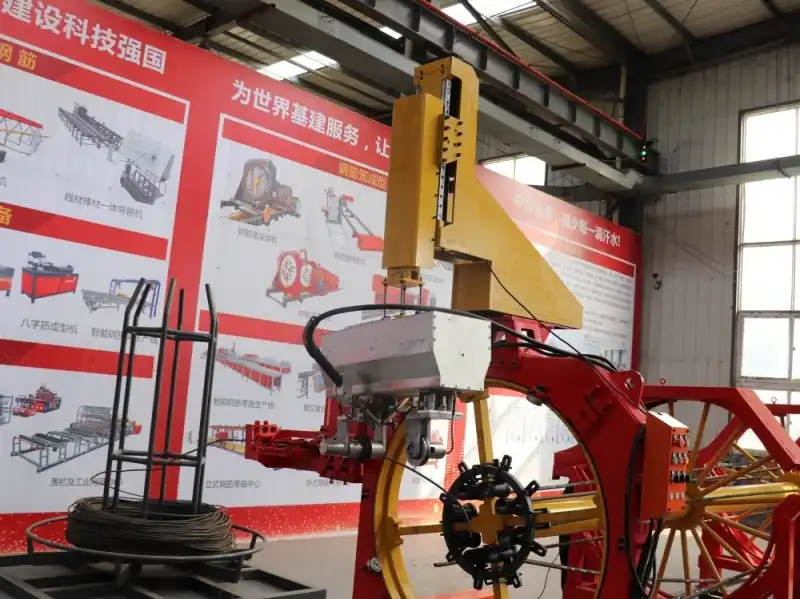
Understanding Pile Cage Machines and Their Role in Rebar Cage Manufacturing
What Is a Pile Cage Machine?
Pile cage machines are custom-built industrial systems that make it easy to make round rebar cages that are round. They have a rotating drive system, a horizontal travel system, and a welding head that work together to place main bars and turn spiral stirrups at the same time. This is used instead of tying and welding by hand, which, according to the American Concrete Institute (ACI), always leads to spacing mistakes of more than 15 mm in the field.
Types: Automatic, Semi-Automatic, and Manual
Full-automatic PLC control means that only one person is needed per shift for automatic systems. More work needs to be done by hand to feed bars and change the spacing on semi-automatic tools. Making things by hand requires skilled workers, which drives up both costs and mistakes. Automatic equipment is the usual choice among top contractors in the U.S. and around the world for large-scale building projects with tight tolerances.
Key Applications Across Construction Sectors
A lot of different types of construction use rebar cage production equipment, including bridge pier foundations, bored pile construction, metro station deep foundations, highway interchange structures, and containment support piles for nuclear power plants. The Federal Highway Administration (FHWA) says that over 40% of deep foundation projects in the United States are dug-shaft buildings, which require precise rebar cages. This shows how important it is to make a lot of cages quickly and correctly.
Comparing Pile Cage Machines: Enhancing Accuracy and Efficiency
Automated vs. Manual Fabrication
Every step of putting together a rebar cage by hand is prone to mistakes, such as odd spike spacing, weld penetration, and shape distortion from the weight of the heavy steel. With servo-controlled positioning and gas-shielded welding, automated welding workstations get rid of these differences, making cages that are the same diameter and pitch all the way along their 12-meter length. A study released in a building engineering magazine looked at projects that went from manual to automated production and found that they were 30–50% more productive.
Automatic vs. Semi-Automatic Equipment
To help you make decisions about procurement, here is a direct comparison:
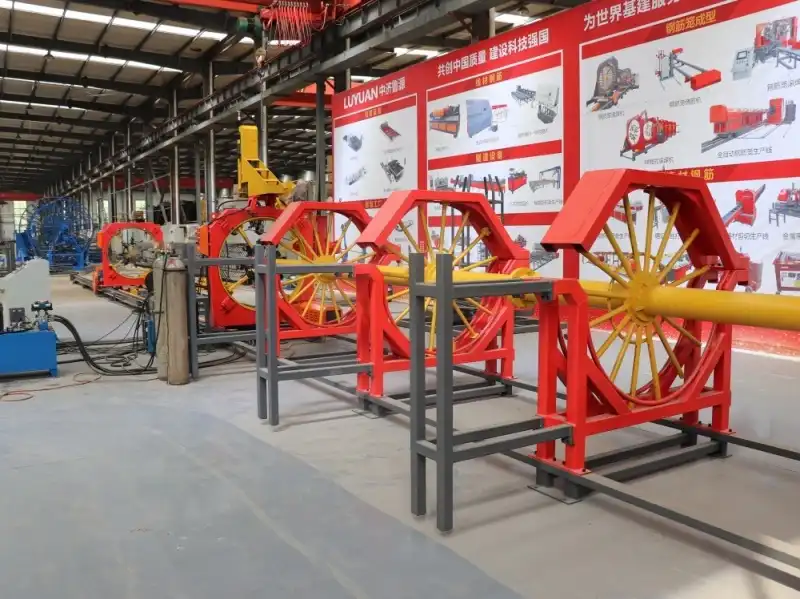
Model LYZD-GJL2500 is an example of an automatic pile cage machine. It can work with cage diameters ranging from φ700 to φ2500 mm, main bar diameters ranging from φ18 to φ40 mm, and spiral bar diameters ranging from φ8 to φ16 mm. It can make 13 cages in 10 hours (12 m per section), and it only needs one person. 30 kW of power is used, and 100 kW is used for welding. 30 m x 8.5 m footprint.
- Automatic (e.g., Model LYZD-GJL2500): Handles cage diameters from φ700 to φ2500 mm, main bar diameters of φ18–φ40 mm, spiral bar diameters of φ8–φ16 mm, outputs 13 cages per 10 hours (12 m per section), and requires only one operator. Total power is 30 kW, with welding power at 100 kW. Footprint: 30 m × 8.5 m.
- Semi-Automatic: Typically limited to cage diameters under φ1200 mm, requires two to three operators, and depends on manual adjustment for pitch changes, which slows production during specification transitions.
This has a direct effect on the project's return on investment (ROI). The fully automatic system makes more than twice as much as a worker's hour of work, and under normal conditions, there are no records of missing or false welds.
Selection Criteria for Procurement Managers
When looking to buy a rebar cage welding machine, there are four things that are the most important. Long-term upkeep costs depend on how long an item lasts. The throughput ability must fit the volume needs of the job. The control system changes how long it takes to train a user. Lastly, the modular design of the structure cuts down on the time needed for maintenance. The LYZD-GJL2500 takes care of all four: its reinforced heavy-duty steel frame is made for continuous heavy-duty operation; its PLC touchscreen interface needs little training; and its modular architecture lets parts be serviced without stopping the whole line.
Operating and Maintaining Your Pile Cage Machine for Consistent Precision
Standard Operating Procedures
The user uses the touchscreen CNC control panel to enter the cage's dimensions, such as its width, length, and bar spacing, before each production run. The PLC system sets the travel rate, rotation speed, and welding power instantly. The operator watches over the whole process from a single control station and only steps in to load materials. This process almost completely eliminates mistakes made by people and makes sure that every cage meets the requirements from the first one to the last.
Scheduled Maintenance Protocols
Drive chains, guide rails, and spinning fixtures should all be oiled every day as part of routine upkeep. Millimeter-level accuracy is maintained over time by calibrating the encoder and welding electrodes once a month. To keep production going, the spare parts that need to be replaced most often, like welding tips, sealing rings, and drive belts, should be kept on-site. It is known that machines with strengthened frames and industrial-grade anticorrosive electrical casings have a low failure rate.
Safety and Compliance Guidelines
Before going into the machine's working area, all workers must follow the electrical lockout-tagout steps. OSHA 29 CFR 1910.252 says that gas-shielded welding needs to be done with enough airflow and spark flash safety. The LYZD-GJL2500's design makes it so that less work needs to be done by hand during the welding cycle. This lowers the risk of direct exposure. Its electrical cabinet has IP55 ingress protection, which means it can be used on open construction sites.
Procurement Insights: Buying the Best Pile Cage Machine for Your Business
Evaluating Suppliers and Distributors
Before choosing a pile cage machine provider, you should check their manufacturing skills, track record of exporting, and availability of after-sales infrastructure. Shandong Zhongji Luyuan Machinery Co., Ltd. was established in 2016 with 50 million yuan in registered capital. They have sold CNC rebar processing equipment to contractors in almost 100 countries, such as South Korea, Malaysia, Thailand, Kazakhstan, and Israel. Their collaborative experience with China Railway, China State Construction, and China Nuclear Power Construction offers verifiable project references.
Total Cost of Ownership
When making purchases, more than just the initial buy price should be taken into account. Over a 10-year working life, the total cost of ownership includes setting up and start-up, training for operators, yearly upkeep, and extra parts. Based on published building cost standards, an automatic system that only needs one operator instead of three for manual methods saves enough on labor costs that the equipment investment is usually paid back within 18 to 30 months on big infrastructure projects.
Warranty, Support, and Parts Availability
Zhongji Luyuan has a specialized after-sales service team that helps with installation, operator training, and technology issues. The equipment comes with a guarantee, and original replacement parts can be found. The company's established logistics network across export markets makes sure that critical parts get to the site without having to wait longer than expected. This is important for procurement managers who want to keep the supply chain running smoothly.
Case Studies and Future Trends in Pile Cage Machine Technology
Real-World Performance in Infrastructure Projects
A bridge builder who used a robotic rebar cage welding machine said that they were able to make 13 cages in a 10-hour shift, compared to only 4 cages per shift when they used to do things by hand. After the change, the rate of weld failure dropped from about 8% to less than 1%. Consistent cage circularity, even with φ40 mm main bars, got rid of expensive repairs that had been delaying pile installation by three to five days per week on a metro deep foundation project.
Emerging Technology Trends for 2024 and Beyond
Servo-controlled multi-axis positioning for more accurate geometry, integration with project management software for real-time production tracking, and energy-efficient welding power sources that lower running costs are some of the ways that cage manufacturing equipment is changing right now. The LYZD-GJL2500 already has both double main bar and double spiral bar designs, which are becoming standard for heavy-load base uses in seismic zones. Through modular upgrades, these new technologies let builders keep up with changing building codes without having to buy new tools.
Industry Professional Feedback
On high-speed rail projects, equipment managers always set three priorities: speed, weld consistency, and low operator dependence. All three are taken care of by design in the fully automatic cage welding workstation. One production engineer said that after using the machine on a tunnel foundation job, they were able to run it for 10 hours with just one person and make sure there were no missing welds. This completely changed how much it cost to process rebar.
Conclusion
It's not a nice-to-have that rebar cages are made correctly; it's a structural requirement that affects every pile, pier, and foundation in modern infrastructure. Automated pile cage machine welding equipment gets rid of the mistakes and need for labor that come with manual fabrication. Zhongji Luyuan's LYZD-GJL2500 can handle main bars up to φ40 mm and cage widths from φ700 to φ2500 mm. It can also make 13 cages in a 10-hour shift with one person. If procurement teams are looking at buying capital equipment with a 10-year working horizon, this is a good investment because of the output, weld quality, and help after the sale.
FAQ
1. How does the machine accommodate different cage diameters?
The LYZD-GJL2500 supports cage diameters from φ700 to φ2500 mm. Adjustment is performed through the PLC touchscreen interface, which reconfigures the synchronized positioning arms without manual retooling. Specification changes between production runs take minutes rather than hours.
2. Can the equipment integrate with automatic welding robots?
Yes. The system's gas-shielded welding heads operate in full-automatic mode. The control architecture supports integration with external welding modules for projects requiring 100% automated fusion across all weld points.
3. What maintenance cycle should operators follow?
Daily lubrication of drive chains and guide rails is standard. Monthly encoder calibration and welding electrode inspection maintain dimensional accuracy. High-frequency wear components should be stocked on-site to prevent production interruption.
4. How many operators does the machine require?
One operator per shift. The PLC system manages rotation speed, travel rate, and welding parameters automatically once cage specifications are entered.
5. Can the machine process variable stirrup pitch within a single cage?
Yes. The CNC interface allows programming of multiple pitch zones within a single production cycle, meeting structural engineering requirements for load-varying pile designs.
Connect with Zhongji Luyuan for Your Pile Cage Machine Needs
Zhongji Luyuan is a dedicated pile cage machine maker with a track record in almost 100 countries. They can make equipment designs that fit the needs of your project. Whether you need standard or custom cage sizes, our expert team is here to help you from the first question to the final completion. You can email us at sales2@shandongluyuan.com to get a quote and talk about how our automatic rebar cage welding workstation can help you reach your production goals.
References
1. American Concrete Institute (ACI). ACI 318-19: Building Code Requirements for Structural Concrete. ACI, 2019.
2. Federal Highway Administration (FHWA). Drilled Shafts: Construction Procedures and LRFD Design Methods. U.S. Department of Transportation, 2010.
3. Occupational Safety and Health Administration (OSHA). Welding, Cutting, and Brazing Standards: 29 CFR 1910.252. U.S. Department of Labor, 2021.
4. Passe, P., & Brown, D. Deep Foundation Construction Quality and Inspection. Transportation Research Board, 2018.
5. International Federation for Structural Concrete (fib). fib Bulletin 39: Seismic Bridge Design and Retrofit. fib, 2007.
6. Construction Industry Institute (CII). Benchmarking & Metrics Report: Automation in Reinforcement Fabrication. University of Texas at Austin, 2022.