What Should You Consider When Choosing a Pile Cage Machine?
Oct 8, 2026
Selecting the right pile cage machine directly affects your project's output quality, labor cost, and delivery schedule. A reinforcement cage welding system automates the winding and welding of longitudinal bars and spiral stirrups into cylindrical cages used in pile foundations, bridge piers, and deep-foundation structures. The right equipment reduces manual error, cuts rebar waste, and keeps production continuous across large-scale civil projects. This guide walks through the key decision points—from machine type to procurement strategy—so you can invest with confidence.
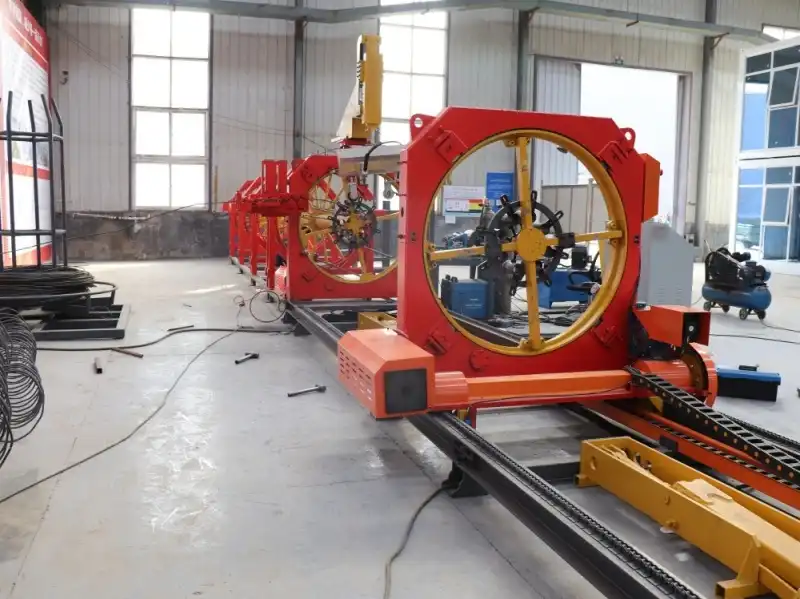
Understanding Pile Cage Machines: Types and Functions
What Is a Rebar Cage Welding System?
An automatic CNC machine called a rebar cage welding system can do gas-protected welding, main bar feeding, and spiral bar winding all at the same time. It turns a job that used to require a lot of human work into a standard industrial process. Every weld point is exactly where it should be, so there is no more of the pitch spacing problems that cause bridge and highway projects to fail structural audits.
Automatic vs. Semi-Automatic Options
PLC full-automatic control runs fully automatic machines. While the machine feeds, winds, and welds without stopping, one operator keeps an eye on the touchscreen interface. Moving semi-automatic units by hand between stages of production slows things down and makes them more dependent on labor. Fully automatic production is the norm for big building projects like subways, high-speed rail, or highway bridges.
Core Components and Process Flow
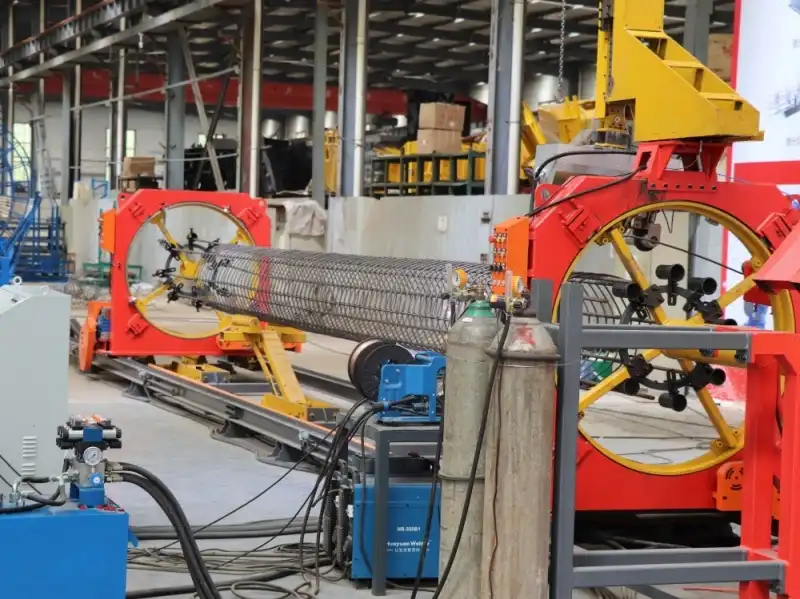
A unit for production uses a rotating drum, a longitudinal travel carriage, an automatic welding head, hydraulic clamping, and a control cabinet that is run by a PLC. The welding head uses CO2 gas-protected arc welding to join each joint with the same depth of entry. The PLC saves more than one cage specification, so workers can change the diameter setting without having to retool the whole pile cage machine.
Critical Factors to Evaluate When Choosing a Pile Cage Machine
Production Capacity and Speed
The amount of production is the main measure. For instance, the LYZD-GJL2500 can deliver 13 cages in a 10-hour shift, with each part being 12 meters long. It can handle cage widths ranging from φ700 mm to φ2500 mm and main bars ranging from φ18 mm to φ40 mm. When time is limited, projects need exact numbers for output, not rough amounts. Before you buy something, you should always ask for written test results that were done under real load conditions.
Welding Quality and Structural Integrity
Cages pass or fail an engineering check based on the quality of the welding. Find tools that use gas-insulated welding and have pressure controls that work on their own. Automatic welding heads that are placed on top make join points that are straighter, more stable, and don't miss or fake welds. The LYZD-GJL2500 meets the same welding standards for both single and double main bar setups, as well as for single and double spiral bar settings.
Equipment Durability and Maintenance Load
A heavy-duty, high-strength steel frame makes it last longer when it's used for continuous production. Check the pressure ratings for the hydraulic system. The LYZD-GJL2500 works at ≤16 MPa with an air supply of ≤0.8 MPa. Also, make sure that spare parts are easy to find. A modular design makes maintenance easier in the field and cuts down on the time needed for repairs, which directly saves your building schedule.
These three things—throughput, weld quality, and mechanical durability—are the most important things to look at when evaluating equipment. On big project sites, people often feel bad after buying something because they skipped any one of them.
Comparing Market Options: Brands, Features, and Pricing
Factory-Direct Suppliers vs. Dealers
When you buy straight from a manufacturer, you can get technical help, talk about customization, and be held more accountable after the sale. Although dealers may have local stock, they may charge more and not have the technical knowledge to meet the unique needs of a job. This much capital equipment is less risky when it is bought directly from the plant.
Key Differentiators Between Manufacturers
The legal capital of Shandong Zhongji Luyuan Machinery Co., Ltd. is 50 million yuan, and the company has been making CNC rebar handling equipment since 2016. The company works with many different companies, such as China Railroad, China Railroad Construction, China State Construction, and China Communications Construction. It sells its tools in South Korea, Malaysia, Thailand, Kazakhstan, Israel, and more than 100 other countries. That track record in a variety of engineering settings is a good starting point for any procurement decision.
Price Range and Total Cost of Ownership
Entry-level cage welding tools with smaller diameters cost a lot less at first, but the cost of labor per cage goes up over time because they produce less and need more human work. When a fully automatic pile cage machine like the LYZD-GJL2500 only needs one operator to do all the work, that saved labor can be turned into a measured return on investment (ROI) within a set project time. To figure out the total cost of ownership, you need to think about how often it needs to be serviced, how much power it uses at 30 kW operating power (with 100 kW welding power), and how much space it takes up (30 m × 8.5 m).
How to Maximize Your Investment: Operation and Maintenance Tips
Daily Operational Best Practices
Before each shift starts, put a trained person in charge of the touchscreen CNC interface. Make sure that the choices for spiral bar spacing are correct for the day. The LYZD-GJL2500 can handle spiral spacing of up to 300 mm. At startup, check the data for the hydraulic pressure and air flow. Less physical work means fewer mistakes made by people, but the operator still has to look at the first cage of each batch to make sure the welding arc quality is good.
Routine Maintenance Schedule
Drive chains and guide rails should be oiled as part of daily maintenance. Encoder calibration, welding electrode condition, and hydraulic seal inspection should all be part of monthly checks. A servo control system can work with higher accuracy for longer periods of time, but only when it is calibrated. Keeping a repair log helps with guarantee claims and records the state of equipment so that it can be sold again in the future.
Troubleshooting Common Issues
Weld penetration that isn't constant is generally a sign of electrode wear or a drop in gas pressure. Changes in the width of the cage are often caused by worn template arms or encoder drift. When repair is done on time, both problems are fixed quickly. Because production-grade machines are made up of separate modules, you can take out and replace a single part without having to stop the whole production line.
Procurement Considerations: Buying Process and Customization Options
Sourcing Channels and Negotiation
You can get cage welding gear from business-to-business (B2B) sites, local dealers, or the factory itself. Direct interaction with the factory is the only way to go for project-specific needs like custom cage diameters, double main bar setups, or lengths that aren't standard. Rebar diameters can be changed from 6 mm to 40 mm, cage diameters from 500 mm to 2500 mm, and cage lengths up to 12 m can be customized by Zhongji Luyuan. 380V/50Hz/3-phase power source choices can be changed upon request.
Customization and Configuration Options
When normal specs don't match your project plans, customization lets you choose the type of main bar (single or double), spiral bar (single or double), and power supply configuration. When negotiating a large order, you should talk about delivery times, help with installation, and promises to train operators. Make sure that the provider does more than just send the equipment and commission it.
Logistics and Installation
Because the LYZD-GJL2500 has a 30 m × 8.5 m size, the spot needs to be planned ahead of time. Make sure the floor load rates and utility connections, especially for three-phase power, are correct before the equipment arrives. Ask the maker for a commissioning plan to make sure that all of the steps needed to set up the machine's mechanics, electricity, and software are taken care of by the installation team before the first production run.
Conclusion
Buying a rebar cage welding pile cage machine is a big investment that will have long-lasting effects on the cost of labor, the quality of the structure, and the ability to keep making things. Compare the supplier's production output to what your real plan calls for, check the quality of the welding against what your technical specs say, and make sure they can help you after delivery. The hardest parts of production on infrastructure projects are taken care of by equipment that has PLC control, gas-shielded welding, and a modular frame. Buying from a supplier who has worked on national-level projects before adds another level of security to the process.
FAQ
1. What cage diameters can a modern rebar cage welding machine handle?
Most production-grade machines cover a wide range. The LYZD-GJL2500 handles φ700 mm to φ2500 mm, covering pile foundations for bridges, metros, and high-rise buildings. Smaller models in the same product family cover diameters down to 300 mm.
2. How many operators does a fully automatic machine require?
The LYZD-GJL2500 requires only one operator per shift. The PLC and touchscreen control system manage winding, welding, and travel automatically once the parameters are set.
3. What welding method does it use?
Gas-shielded welding (CO₂ arc welding) is standard. It produces strong, consistent weld bonds at each bar intersection without manual intervention.
4. How often does the machine need maintenance?
Daily lubrication of moving components and monthly calibration of encoders and welding electrodes are the standard schedule. Following this schedule keeps weld accuracy within specification and extends equipment service life.
5. Can the machine be customized for non-standard project requirements?
Yes. Main bar diameter, spiral bar type, cage length, and power supply configuration are all adjustable. Contact the manufacturer directly with your project drawings for a customized configuration proposal.
Request a Quote from Zhongji Luyuan — Pile Cage Machine Supplier for Infrastructure Projects
Zhongji Luyuan sells tested CNC rebar cage welding tools to builders in almost 100 different countries. We are a direct pile cage machine maker with experience in metro, high-speed rail, and bridge projects. We offer factory-direct prices, custom configurations, and full support after the sale. To get a custom price today, email sales2@shandongluyuan.com with the details of your project.
References
1. American Concrete Institute. ACI 318-19: Building Code Requirements for Structural Concrete. ACI, 2019.
2. American Institute of Steel Construction. Steel Construction Manual, 16th Edition. AISC, 2022.
3. Federal Highway Administration. Design and Construction of Driven Pile Foundations. U.S. Department of Transportation, 2016.
4. International Federation for Structural Concrete (fib). fib Model Code for Concrete Structures 2010. Ernst & Sohn, 2013.
5. Portland Cement Association. Design and Control of Concrete Mixtures, 16th Edition. PCA, 2016.
6. Transportation Research Board. NCHRP Report 461: Static and Dynamic Lateral Loading of Pile Groups. National Academies Press, 2001.