What Benefits Does CNC Stirrup Bending Machine Bring to Precast Concrete Production Lines?
Oct 20, 2026
A CNC stirrup bending machine brings measurable, practical benefits to precast concrete production lines. By automating the full cycle of straightening, measuring, bending, and cutting rebar, it replaces slow manual workflows with consistent, high-speed output. Precast manufacturers report traction speeds reaching up to 100 m/min and length accuracy within ±1 mm. For production teams managing tight schedules and strict quality standards, this technology directly addresses labor dependency, dimensional inconsistency, and material waste — three of the most persistent problems in precast rebar fabrication.
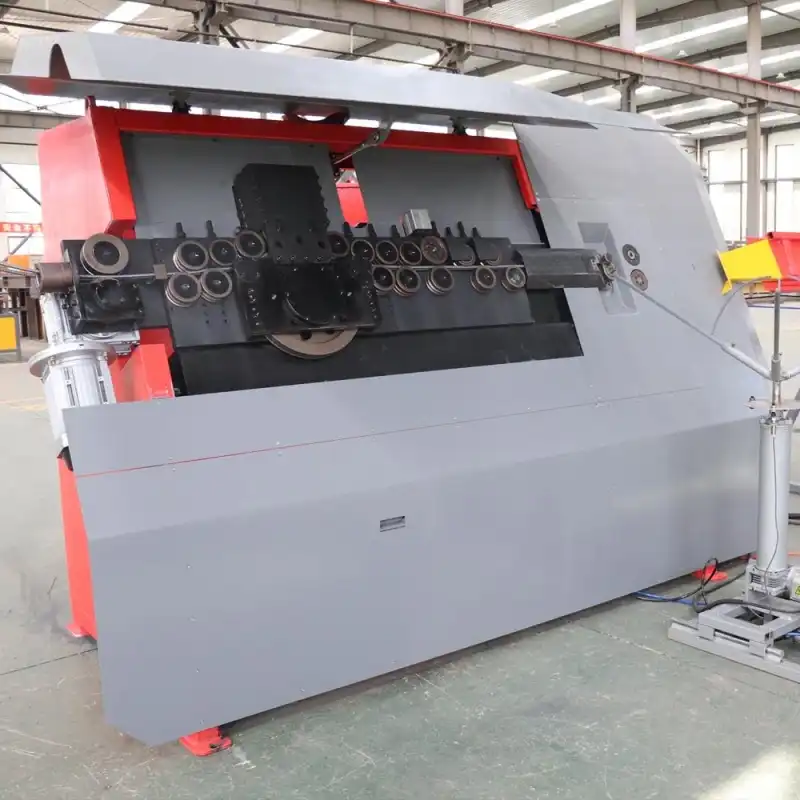
Understanding CNC Stirrup Bending Machines in Precast Concrete Production
What the Machine Actually Does
At its core, a CNC stirrup bending machine integrates four operations into one automated sequence: straightening coiled rebar, measuring cut length, bending to a programmed geometry, and cutting. High-torque servo motors drive each stage, while a CNC control panel manages the full process cycle. The result is a continuous, repeatable production loop that requires minimal manual intervention.
Core Components That Drive Precision
The machine's straightening section uses multi-roller configurations to eliminate the natural curvature of coiled wire before bending. Bending pins and cutters are typically fabricated from high-alloy tool steel, heat-treated to HRC 58–62 for wear resistance. The CNC encoder provides real-time feedback to the servo system, preventing cumulative length errors across long production runs — a critical feature for precast plants producing thousands of identical stirrup sets.
How It Fits Into a Precast Line?
Modern precast production lines demand speed, repetition, and dimensional accuracy across every concrete element — from bridge beams to tunnel linings. Automated stirrup benders connect directly to downstream assembly stations, feeding completed stirrups at the pace the line requires. This removes the bottleneck that manual bending creates and keeps the entire precast workflow moving on schedule.
Core Benefits of CNC Stirrup Bending Machines for Precast Concrete
Companies that use automatic rebar bending systems always say that they make their work better, save time, and cost less. These are the main advantages this tool brings to the job site:
- Higher throughput without added headcount: Bending speeds of up to 110 m/min and continuous operation allow one machine to replace multiple manual workers, directly reducing labor costs on high-volume projects.
- Dimensional accuracy that reduces rework: Bending angle precision of ±1° and length tolerance of ±1 mm mean each stirrup meets specification the first time. Rework rates drop, and material waste from mis-cut bars decreases.
- Improved operator safety: Automated bending removes workers from direct contact with moving rebar. Emergency stop circuits and protective enclosures are standard quality-control items, reducing the risk of workplace injuries.
More work gets done with fewer people: one CNC stirrup bending machine can do the work of several people working by hand at speeds of up to 110 m/min and nonstop use. This directly lowers the cost of labor on big projects.- Accuracy in measurements that reduces the need for extra work. Each stirrup is made to meet the standards the first time. It has a bending angle tolerance of ±1° and a length tolerance of ±1 mm. The number of rework jobs goes down, and bars that were cut wrong lose less material.- More secure for users: Rebar is bent automatically, so workers don't have to touch it. Safety features like emergency stop circuits and protection barriers are standard quality control items that make work less likely to be unsafe.
Comparing CNC Stirrup Bending Machines with Traditional and Manual Methods
Accuracy and Consistency
Bending by hand depends on how skilled the person is and on physical templates. People who are very good at their jobs sometimes make mistakes with angles that add up over time. In a CNC-controlled bending system, each unit moves in the same direction. This means that the shape stays the same when the system bends at least 500 pieces, which is a standard way to check its accuracy over time.
Throughput and Labor Dependency
It's faster to do individual jobs with semi-automated bending tools, but you still have to measure and move them by hand. Plus, they make forms easier to understand. A programmable stirrup bender can handle different geometry presets, like square, hexagonal, and spiral shapes, and can go from one to the other without having to change the tools. This means that concrete builders can use the same machine for many different jobs.
Selecting the Right Model
They should think about three things before they buy: the thickness range of the rebar they need (usually 5–13 mm for stirrup wire), the daily production goal, and the space they have on the floor. Single-wire models work best for smaller plants or lines of specialized goods. On the other hand, double-wire configurations increase output for businesses that make a lot of things. Based on how the plant is set up, either inline or offline integration makes more sense from an operational point of view.
Maintenance and Operational Best Practices for Longevity and Performance
Routine Maintenance Tasks
Maintenance that is planned affects how often service is done. As for how often to grease the straightening roller shafts and bent pin parts, check with the maker. If you have a lot to do, check your blades' cutting edges once a week. Dull blades can lead to burring and wrong measurements. When a company releases new software, it often includes changes that make the spring-back compensation better. These changes directly affect how accurate the angle is.
Safe Operating Protocols
Before using any cnc stirrup bending machine automatic system for moving rebar, operators should read up on it. Testing of safety procedures should be done before and after every three months as part of safety checks and when the project is first launched. As part of this, the emergency stop reaction time and the enclosure's soundness should be checked. Not leaving enough space around the busy bending area of the machine is a simple safety measure that is often forgotten.
Troubleshooting Common Issues
Most of the time, encoder calibration or worn bending pins are to blame for bending angle drift. If there are a lot of length mistakes over a long production run, it's likely that the traction roller grip or the encoder input is not working right. There are differences between standard runs and other runs. If production managers write down these differences, they can find them early on and fix them before they affect the whole batch.
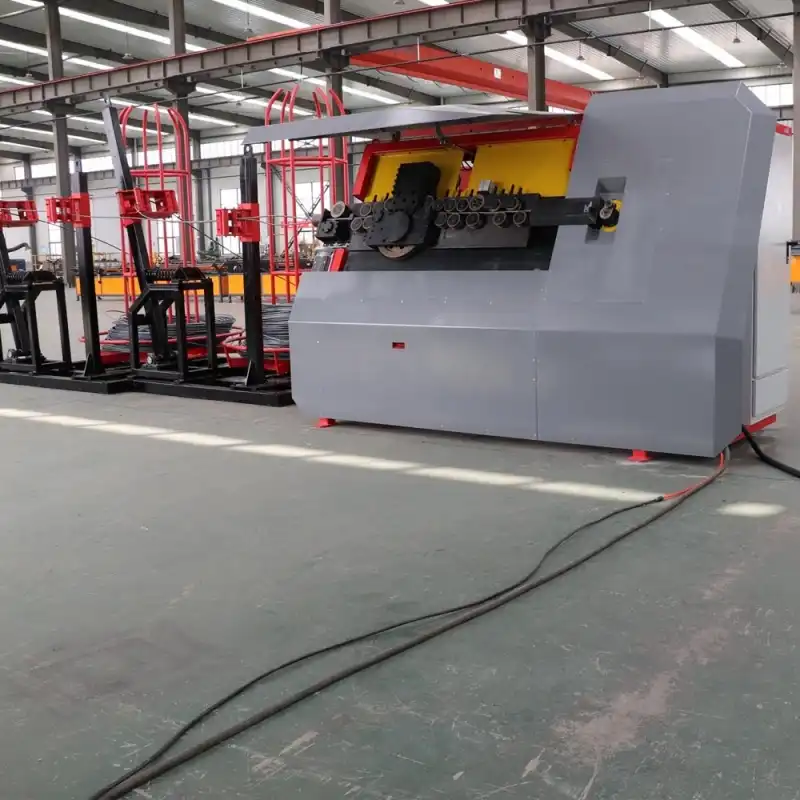
Procurement Considerations for CNC Stirrup Bending Machines
Specifications That Matter
Before you ask to buy something, make sure that the diameter range, maximum bending angle (±180° is normal for professional-grade tools), and traction speed specs all fit the shape of the thing you're making. At the very least, a machine should have both ISO 9001 factory certification and CE safety certification to show that it is very good. Before you choose a provider, ask them to give you a report on a 50-piece dimensional accuracy test.
Total Cost of Ownership
The price to buy is one part. How well that purchase works after five to ten years will depend on how quickly you can get help, how easy it is to get replacement parts, and how long the warranty lasts. A machine that breaks down for no reason for two weeks costs a lot more than the price difference between sources on a high-speed railroad project.
Evaluating Suppliers
If you're looking for a seller in the infrastructure sector, look for one with documented project references. Places where rebar handling tools have the most trouble working are in bridge engineering, train transit, and tunnel building. When suppliers sell their goods in more than one market and work with big engineering groups, it shows that their goods can be relied on in a lot of different work situations. If you want to buy capital tools, that track record is more important than a book of specs.
Conclusion
A CNC stirrup bending machine for precast concrete makers can control three things that have a direct effect on the outcome of a project: speed, accuracy, and the cost of labor. There is a ±1° error in how much this machine can bend. It can move at more than 100 m/min and work nonstop during shifts. It fits in between things that can be done by hand and things that are needed for big building projects. If a procurement team wants to buy capital equipment, the performance data and seller qualifications listed above can help them make an informed decision.
FAQ
How many stirrups can a CNC machine produce per hour?
Production rate depends on stirrup geometry and wire diameter. On straightforward rectangular shapes using 8 mm wire, production rates of 600–1,200 pieces per hour are achievable on professional-grade equipment. More complex polygonal shapes with multiple bends reduce cycle speed but still outperform manual methods significantly.
How does CNC bending improve safety compared to manual methods?
Manual rebar bending involves direct physical contact with spring-loaded steel under tension. Automated systems enclose the active bending zone and process the bar without operator handling. Emergency stop systems with verified response times and protective guards are required under standard safety certifications.
Can the machine be configured for different stirrup geometries?
Yes. CNC control panels store multiple geometry programs — rectangular, trapezoidal, polygonal, and custom shapes. Switching between programs takes seconds, with no physical retooling. This makes the equipment practical for precast plants that supply multiple project types simultaneously.
What rebar diameters does this equipment handle?
Standard CNC stirrup bending machines process wire diameters from 5 mm to 13 mm. Double-wire configurations are available for smaller-diameter wire to increase throughput. Confirm diameter compatibility with the supplier before purchase.
Connect With Zhongji Luyuan for Your Next Equipment Decision
To start, Zhongji Luyuan had a registered capital of 50 million yuan in 2016. Since then, it has sold CNC tools for handling rebar to building projects in almost 100 countries. The company works directly with China Railway, China State Construction, and China Nuclear Power Construction. If you need a single CNC stirrup bending machine or a fully automated rebar processing line, email sales2@shandongluyuan.com or visit shandongluyuan.com to get more information, project references, or a straight price.
References
1. American Concrete Institute. ACI 318-19: Building Code Requirements for Structural Concrete. American Concrete Institute, 2019.
2. Concrete Plant International. Automation Trends in Precast Concrete Manufacturing. Concrete Plant International, 2022.
3. Engineering News-Record. Labor Productivity in Large-Scale Infrastructure Construction. Engineering News-Record, 2021.
4. International Federation for Structural Concrete (fib). fib Bulletin 72: Structural Concrete – Textbook on Behaviour, Design and Performance. fib, 2014.
5. OSHA. Safety and Health Regulations for Construction: Steel Erection Standards. U.S. Department of Labor, 2020.
6. Precast/Prestressed Concrete Institute. PCI Design Handbook: Precast and Prestressed Concrete, 8th ed. PCI, 2017.