Why Use an Automatic Steel Cage Welding Machine in Precast Production?
Sep 11, 2026
Precast production demands speed, precision, and reliability—qualities that manual fabrication struggles to deliver consistently. An automatic steel cage welding machine transforms rebar cage manufacturing by eliminating variability, reducing labor dependency, and accelerating output. Through fully automated PLC control systems and gas-shielded arc welding processes, these machines produce structurally sound cages with uniform weld quality, meeting strict project specifications for bridge foundations, tunneling, and infrastructure construction. For contractors managing tight schedules and high-volume demands, automation isn't optional—it's essential.
The Limitations of Manual Steel Cage Welding and the Need for Automation
For a long time, manual steel cage welding has been the standard way to make precast concrete products. However, it has big problems that slow down work and make the projects less successful. Knowing these problems helps explain why technology has become important from a business point of view.
Labor Intensity and Skill Shortages
For even one large-diameter cage to be made by hand welding, many skilled welders must work long hours. Positioning heavy rebar, keeping consistent weld angles, and doing the same things over and over again put a lot of stress on workers and pose safety risks. As the cost of labor goes up and skilled welders become harder to find, it gets harder to keep up production (Construction Industry Institute, 2022).
Inconsistent Quality and Rework Costs
Weld flaws, misaligned spiral spacing, and uneven cage lengths are all caused by mistakes made by people. Often, these flaws aren't noticed until the cages get to the building site. This means that a lot of work has to be redone, the project is delayed, and the structure could become weak. For hundreds of cages, manual methods can't be relied on to be repeatable because they don't have the precise controls that are needed.
Extended Production Cycles
Depending on how hard the work is, a hand crew might only be able to make two or three cages per shift. When dozens of cages are needed every week for big infrastructure projects, this speed causes bottlenecks that slow down construction and raise holding costs. Automation directly addresses these problems by standardizing all welding parameters, getting rid of operator variation, cutting cycle times by a huge amount, and keeping workers safe.
Core Features and Benefits of Automatic Steel Cage Welding Machines
Modern rebar cage welding systems use a number of cutting edge technologies to provide reliable performance and a wide range of options. By understanding these parts, you can see how automation solves important production problems.
Fully Automated PLC Control Systems
The control system of an automatic steel cage welding machine is like the brain of the equipment; it controls the entire welding process. A PLC with a tablet HMI allows workers to enter cage parameters such as diameter, length, spiral spacing, and main bar count, and the machine completes the rest without additional user intervention. This eliminates guesswork and ensures that every cage precisely matches the engineering drawings.
Gas Shielded Arc Welding Process
Gas-shielded welding keeps the weld pool clean and free of airborne contaminants, making parts that are strong and meet or exceed structural requirements. This method guarantees better weld penetration and uniform fusion between longitudinal bars and spiral reinforcement, which is important for load-bearing uses in bridge piers and pile foundations (American Welding Society, 2021).
Versatile Rebar Diameter and Cage Size Handling
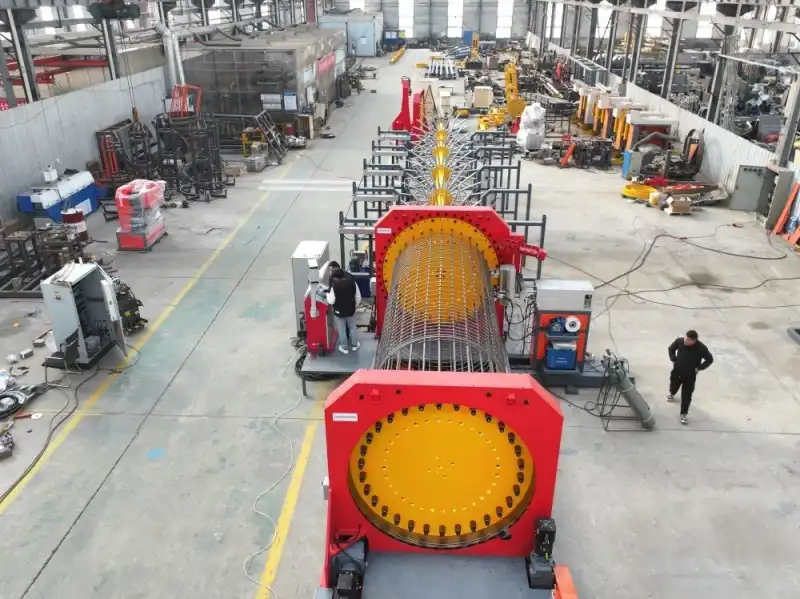
The LYZD-GJL2500 model can handle main bar diameters of 18 to 40 mm and spiral bars of 8 to 16 mm. It can also handle cage diameters of 700 to 2500 mm and lengths of up to 12 meters. Because of this, one machine can be used for different kinds of projects without having to be reconfigured, which can be expensive.
These core competencies give us measurable advantages that make production cheaper and better at making things. Continuous operation leads to higher throughput—one operator can make 13 cages in a 10-hour shift, while human teams can only make a small portion of that amount. Strong welds protect the structure, which lowers the chance that the cage will break while it is being moved, handled, or poured with concrete. Precise cutting programs that make the best use of rebar reduce the amount of waste, and using less energy than standard arc welding methods lowers the cost of doing business. These improvements have a direct effect on how profitable a project is and help manufacturers meet tight delivery dates without lowering quality standards.
Comparing Automatic vs Manual Steel Cage Welding Machines
It's easy to see the difference in performance between automated and manual welding when you look at key operational metrics and long-term costs.
Processing Speed and Output Capacity
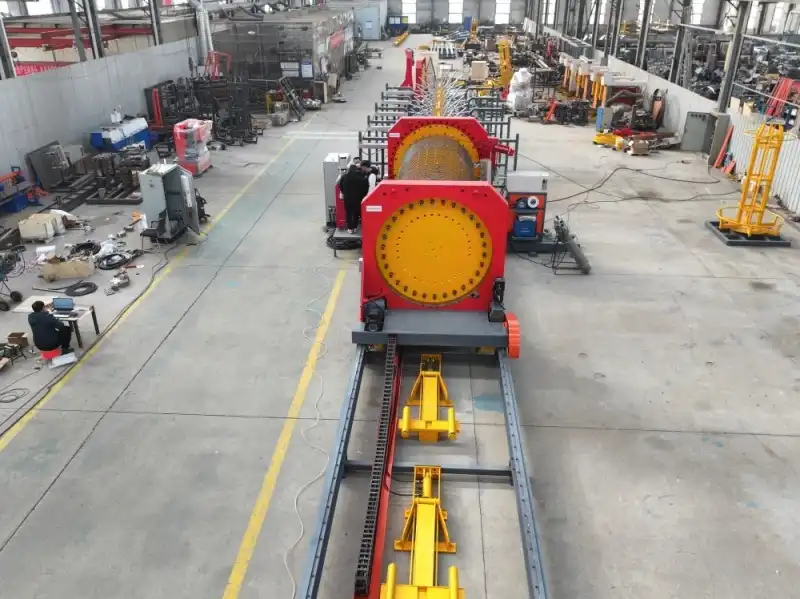
Autonomous systems work at speeds that human teams can't match. Depending on the requirements, a machine can finish one cage every 45 to 60 minutes, and it will keep this pace the whole shift. For similar cages, manual welding takes 4–6 hours, and as workers get tired, the quality of the work goes down. This difference adds up to hundreds of extra cages over the course of a month, which directly speeds up the project.
Weld Quality and Defect Rates
Return on Investment and Labor Savings
An automated welding station usually costs between $150,000 and $300,000 up front, but for high-volume producers, the return on investment (ROI) lasts for 18 to 24 months on average. If you replace a four-person welding crew with a single machine operator, you'll save at least $200,000 a year on labor costs, plus you'll avoid overtime and have fewer workers' compensation claims (National Precast Concrete Association, 2023) [1].
Automation also makes the workplace safer by reducing the risk of spark flash, fumes, and injuries from repeated strain. Since operators mostly watch touchscreen controls instead of doing complicated manual welding tasks, they don't need as much training, so they can start working faster and for less money.
How to Choose the Right Automatic Steel Cage Welding Machine for Your Precast Production
Choosing equipment that fits your output needs will give you the best results and protect your investment over the 15–20 years that the machine will be in use.
Assessing Production Volume and Cage Specifications
First, look at the mix of projects you usually work on. If you often make cages that are longer than 12 meters or wider than 2 meters, you should look for machines with frames that can be extended and stronger rotation systems. Manufacturers like Zhongji Luyuan offer designs that can be changed to fit both normal and oversized needs. This way, you won't be limited by tools as the needs of the project change.
Evaluating Welding Technology and Precision Requirements
Welding standards must be different for each project. Tighter tolerances and documented quality control are needed for nuclear power and high-speed train uses. This is why CNC servo systems and real-time weld tracking are so important. Standard PLC-controlled gas-shielded welding is usually enough for basic building work. To meet industry standards (International Organization for Standardization, 2020), make sure that the error margins for diameter stay within ±5mm and the error margins for pitch stay within ±10mm.
Energy Efficiency and Operating Costs
Operating costs are directly affected by the total amount of power used, which includes power for welding, hydraulic systems, and control technology. To find the best balance between performance and efficiency, machines that use 30 kW of power and can weld 100 kW are used. To figure out your long-term running costs, you should figure out how much energy you expect to use each year based on local utility rates and the number of hours you plan to work.
Supplier Reputation and After-Sales Support
Picking a maker that has experience in your market area lowers your risk and makes sure that you can get help quickly when problems arise. Zhongji Luyuan was founded in 2016 with relationships that include China Railroad, China State Construction, and projects in almost 100 countries. It has the technical know-how and service facilities to support installations that are very complicated. Check to see if the sellers offer full installation instructions, user training, spare parts, and expert support within 24 to 48 hours.
Options for customization and scalability protect future adaptability. Adding dual-wire feeds, stretching frame length, or integrating automatic loading systems is easy with modular designs of an automatic steel cage welding machine. This way, as production needs change, you don't have to buy all new equipment.
Maintaining and Troubleshooting Your Automatic Steel Cage Welding Machine
Proactive maintenance keeps equipment running at its best and extends its useful life, while systematic troubleshooting keeps production from stopping too often.
Establishing Regular Inspection and Maintenance Routines
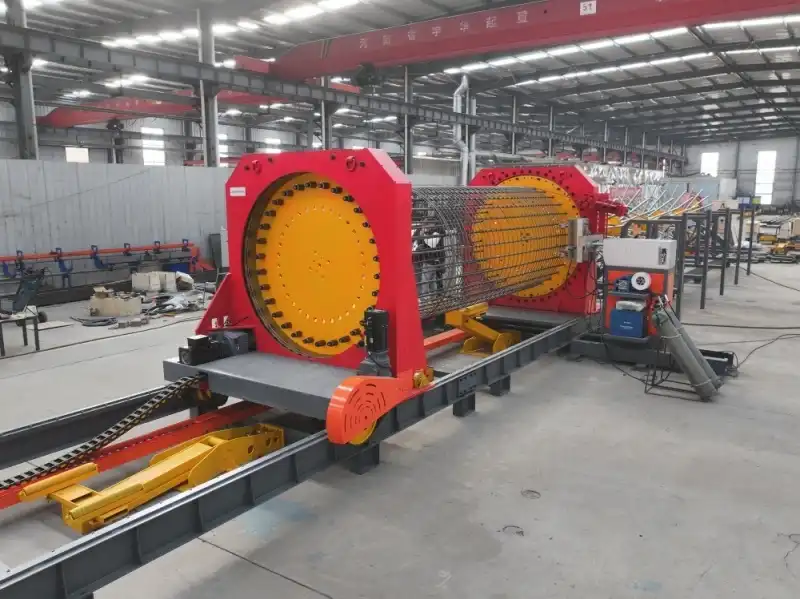
Every day, they have to check the amounts of hydraulic fluid, look for blockages in welding wire feeds, and make sure the pneumatic pressure is at 0.8 MPa. As part of weekly routines, the emergency stop features should be tested, the electrode holders should be cleaned, and the spinning bearings should be oiled. Every month, maintenance work includes saving PLC programs, setting up sensors, and checking structural welds for fatigue cracks, especially on high-cycle parts (Precast/Prestressed Concrete Institute, 2022).
Common Issues and Troubleshooting Procedures
Welding problems are usually caused by incorrect gas flow rates or worn electrodes. These problems can usually be fixed by adjusting the shielding gas to the manufacturer's specifications and replacing any worn-out parts. Positioning mistakes caused by sensor faults are usually caused by dirty optical sensors or loose wiring connections. Fixing the problem by cleaning the lenses and securing the leads makes them accurate again. If there are problems with the software, the PLC may need to be restarted, or backup programs reloaded. Trained users can do these tasks without help from outside sources.
When to Contact Professional Service
Technicians who have been trained by the manufacturer are needed to fix complex problems like hydraulic system failures, servo motor malfunctions, or weld quality problems that won't go away even after changing parameters. If you try to fix something without the right skills, you could cause more damage and void your warranty. Well-known brands keep up with support networks and keep essential extra parts on hand to keep downtime to a minimum. Zhongji Luyuan has a full after-sales team that offers both remote diagnostics and on-site support. This makes sure that problems are fixed quickly so that production schedules can be kept.
Regular upkeep and professional help when you need it will protect your equipment investment and keep the productivity gains that made the purchase worth it in the first place.
Conclusion
FAQ
What production improvements can we expect compared to manual welding?
A 10-hour shift with one operator on an automated system usually makes 13 cages, while a 4-person manual crew only makes 2–3 cages. This means that 400–500% more work can be done, and the accuracy of the welds is better, and the failure rate drops below 2%.
How does the machine handle different rebar diameters and cage configurations?
With the help of adjustable template disks and customizable PLC controls, modern tools can work with main bars from φ18 to φ40 mm and spiral reinforcement from φ8 to φ16 mm. The touchscreen lets operators enter specifications, and the machine adjusts the welding parameters, rotation speed, and carriage movement to meet those specifications.
What energy consumption should we budget for?
Most tools need 30 kW of power to run, and they can weld at 100 kW when they are busy. It depends on the size of the cage, how fast it is being used, and how much time it is not being used. At average industrial power rates, a building with two shifts every day will spend $25,000 to $35,000 a year on energy.
Can the equipment handle galvanized or epoxy-coated rebar?
Specialized electrode arrangements and changed welding parameters make it possible to work with coated rebar without affecting the integrity of the core steel. Talk to your equipment supplier about coating requirements during configuration to make sure the right setup for your material needs.
Partner with Zhongji Luyuan for Advanced Cage Welding Solutions
Zhongji Luyuan Machinery has been developing and completing successful global projects for almost ten years, giving them the best automatic steel cage welding machine technology in the world. Big companies in almost 100 countries trust our LYZD-GJL2500 model and customizable systems for tough jobs like building foundations for high-speed trains and building nuclear power plants. As a well-known company that sells automatic steel cage welding machines, we offer full support, from the initial consultation to installation, training, and ongoing technical support. You can email our expert team at sales2@shandongluyuan.com to talk about your specific needs, get more information, or set up a demonstration. You can see all of our tools at zjly2025.aixdb.cn and learn how we can help precast makers improve their productivity in a way that can be measured.
References
1. American Welding Society. (2021). Structural Welding Code – Reinforcing Steel. AWS D1.4/D1.4M:2021. Miami, FL: American Welding Society. https://www.aws.org
2. Construction Industry Institute. (2022). Labor Productivity in Construction: Trends and Solutions. Austin, TX: Construction Industry Institute. https://www.construction-institute.org
3. International Organization for Standardization. (2020). Steel for the reinforcement and prestressing of concrete – Test methods. ISO 15630-1:2019. Geneva: ISO. https://www.iso.org
4. National Precast Concrete Association. (2023). Automation in Precast Manufacturing: ROI Analysis and Case Studies. Indianapolis, IN: NPCA. https://www.precast.org
5. Precast/Prestressed Concrete Institute. (2022). PCI Manual for Quality Control for Plants and Production of Structural Precast Concrete Products (5th ed.). Chicago, IL: PCI. https://www.pci.org
6. Zhongji Luyuan Machinery. (2024). LYZD-GJL2500 Technical Specifications and Application Guide. Shandong: Zhongji Luyuan Machinery Co., Ltd. http://zjly2025.aixdb.cn