CNC Vertical Rebar Bending Center LYWQ-32 Improves Production Flexibility for Customized Reinforcement Components
Oct 14, 2026
The CNC Vertical Rebar Bending Center LYWQ-32 is an automated rebar processing machine built for high-precision, large-scale infrastructure work. It processes reinforcement steel bars up to 32mm in diameter, delivering angle accuracy of ±1° and length precision of ±1mm. For contractors managing bridge projects, high-speed railway construction, or prefabricated concrete production, this vertical bending center answers the demand for consistent output, reduced manual labor, and the flexibility to handle complex, customized rebar geometries across shifting project requirements.
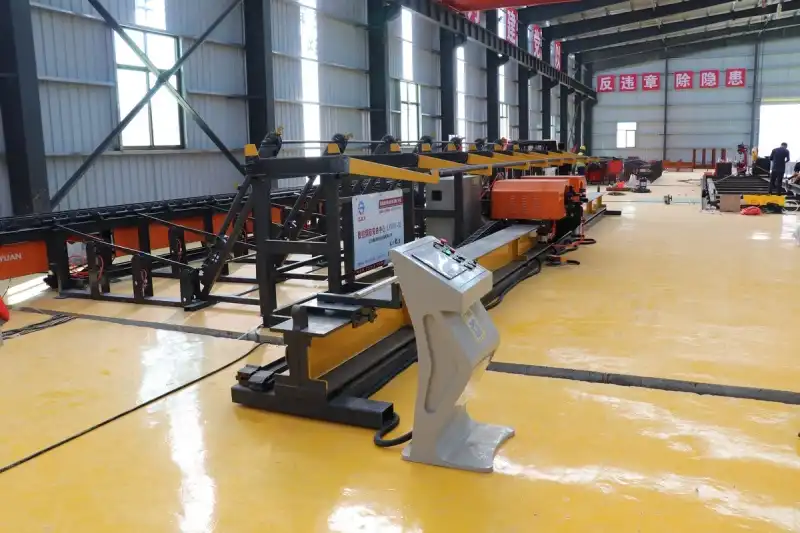
Understanding the CNC Vertical Bending Center LYWQ-32
Core Technical Specifications
The LYWQ-32 can work with Grade I, II, and III rebar that is up to 32 mm in thickness. It can bend at 60°/s, and because it has two heads, it can bend both sides of a bar at the same time. Compared to single-head configurations, this cuts cycle time by a large amount. The control box has an IP54 rating, which means that it keeps electronics safe from dust and water on busy building sites.
Vertical Bending Mechanism and Workflow
When the machine is set up for vertical processing, the way the material goes through it changes. Bars feed vertically, which takes up less floor space and makes the operator's position more comfortable. High-torque servo motors precisely control the feeding distance, and a stronger hydraulic locking system keeps the bar from moving during high-tensile bending operations. The PLC control system can directly import CAD data, so form programs can load without having to be entered again by hand.
Safety and Quality Compliance
The LYWQ-32 has CNC anti-collision routines and a quick emergency stop response. All units pass a final test using Grade III 32mm rebar, which makes sure they meet GB/T 1499.2 and other similar foreign standards that are similar. Wear-resistant alloy steel bending pins have a 30% longer service life than standard industry options. This means that parts don't have to be replaced as often on long-term projects.
Why Traditional Bending Solutions Fall Short for Customized Reinforcement Components
Accuracy Gaps in Manual and Semi-Automatic Equipment
When someone bends something by hand, they have to rely on their skill and accurate measurements, which means that there are always some errors. When making thousands of identical stirrups for a bridge project, even a 2–3° difference in angle adds up to a lot of structural rework. Some human work is done by semi-automatic tools, but they still don't have the closed-loop feedback that CNC systems do.
Inflexibility When Designs Change
Traditional tools force users to use them in fixed ways. Retooling takes hours every time project engineers change the shape of a rebar bar, which happens a lot on building projects where the designs are changed. This pushes back production plans and makes the cost of work go up. Because digital shape files can't be loaded, every change needs to be made physically instead of through software.
Higher Long-Term Operating Costs
Older horizontal bending machines take up more floor space, need to be moved around by hand more often, and make more scrap because of mistakes in measuring. Even a small increase of 3% in material waste can add up quickly in processing centers that handle 5–8 tons of rebar per shift. The cost of trained operators' labor also goes up when machines need constant human supervision instead of running programs automatically.
Comparing the LYWQ-32 with Other Rebar Bending Solutions
Automation Level and Production Output
A lot of standard CNC bending tools can only use one head and can only design simple shapes. The CNC Vertical Rebar Bending Center LYWQ-32's two heads work together to process both ends of the bar in one pass, which greatly cuts down on the time needed for each piece. This directly boosts daily output for large-scale production runs on highway or rail projects, without adding workers or running extra shifts.
Here are the main differences in performance between the engineering and procurement teams that matter:
- Bending accuracy: ±1° angle and ±1mm length precision, maintained across 1,000 consecutive bends with less than 0.5° variance in repeatability testing.
- Structural integrity: The frame undergoes load testing at 120% of rated capacity, confirming stability under maximum operational stress.
- Hydraulic reliability: Pressure stability is confirmed over 48 continuous hours of operation, with monitoring for micro-leaks and pressure drops.
Instead of depending only on marketing claims, these confirmed performance benchmarks give procurement teams a solid way to compare products.
After-Sales Support and Total Cost of Ownership
Industrial PLC and servo systems come with a standard 12-month guarantee from Zhongji Luyuan. An IoT module built into the system also allows for remote diagnostics. This cuts down on the time it takes to fix problems on faraway building sites. A lot of the time, competing providers don't have remote monitoring, which means that techs have to drive before they can start diagnosing.
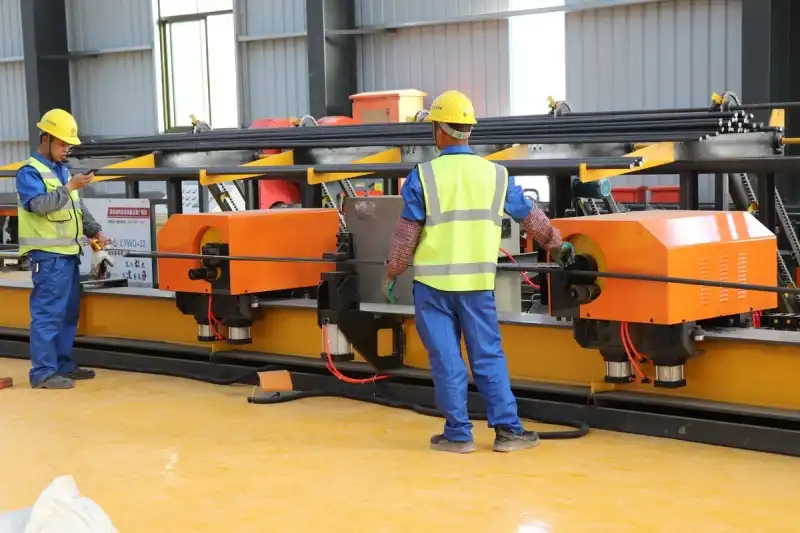
Enhancing Production Flexibility: Practical Applications
Bridge and Viaduct Construction
Pier reinforcement cages and complicated stirrups need exact geometry so that the structure's integrity is not compromised. The CNC Vertical Bending Center LYWQ-32 consistently makes these parts with accurate measurements, which lowers the number of parts that fail testing and keeps expensive repair work from having to be done on structures that are already put together.
High-Speed Railway Infrastructure
Box beam rebar and tunnel lining parts must meet strict size requirements. The machine works in dusty outdoor building areas, and the IP54-rated control cabinet keeps the electronics working well even in those circumstances. When engineering models are loaded straight into standardized shape programs, production stays in line with project requirements.
Prefabricated Concrete Production
The LYWQ-32 is built into automatic production lines by PC companies. CAD data is easily imported into the machine's control system. This means that factories can switch between designs for housing parts without having to stop production to retool by hand. The end result is continuous output for a range of rebar shapes during the same shift.
These use cases show that the machine is useful for more than just speed. It's useful for contractors who are managing multiple project specifications at the same time because it can handle different geometries without setup delays.
Procurement and Support: How to Choose and Acquire Your LYWQ-32
Evaluation Criteria for Procurement Teams
When choosing a vertical rebar bending center, you need to compare the processing capacity to the size of your project, the accuracy standards to your technical tolerances, and the supplier's after-sales network to your site locations. The LYWQ-32 can work with up to 32mm Grade III rebar, can lift 5–8 tons in an 8-hour shift, and has been certified to meet GB/T 1499.2 and other foreign standards.
Delivery, Installation, and Operator Training
Zhongji Luyuan was established in 2016 with 50 million yuan in registered capital. It has production and shipping methods that serve customers in almost 100 countries. As part of the buying process, installation help and setup instructions are given. Zhongji Luyuan suggests a two-day certified operator training course that covers optimizing CNC parameters. This cuts down on early mistakes and makes the equipment work at its best right away.
Long-Term Partnership and Global Track Record
China Railroad, China Railroad Construction, China State Construction, China Communications Construction, and China Nuclear Power Construction Corporation are all companies that Zhongji Luyuan works with. The business also sends goods to South Africa, Malaysia, Thailand, Kazakhstan, Israel, and South Korea. International purchasing managers can trust this track record to give them confidence in the security and technical depth of the provider.
Conclusion
The CNC Vertical Rebar Bending Center LYWQ-32 solves the real production issues that infrastructure contractors have, like wrong bending, slow switching between designs, heavy reliance on labor, and equipment breakdowns on busy sites. It has two heads, servo-driven feeding, hydraulic clamping, and direct CAD integration, all of which work together to give consistent results in bridge, railroad, and prefabricated concrete applications. When purchasing teams look at rebar handling equipment, the machine's proven performance data and Zhongji Luyuan's well-established global service network make it easy to make a long-term investment choice.
FAQ
1. What is the maximum processing capacity per shift?
Depending on shape complexity, the machine processes 5–8 tons of rebar in an 8-hour shift.
2. Can the LYWQ-32 handle different rebar grades?
Yes. It processes Grade I, II, and III rebar, with software presets adjusted for each grade's tensile strength.
3. How does the vertical design affect maintenance access?
The vertical layout gives technicians direct access to the drive mechanism and hydraulic lines, reducing mean time to repair compared to horizontal configurations.
4. Does operating this machine require specialized training?
The interface accepts CAD imports and is straightforward to navigate. Zhongji Luyuan recommends a 2-day certified training course for CNC parameter optimization to get full performance from day one.
5. What warranty covers the electronic components?
A standard 12-month industrial warranty applies to the PLC and servo systems, with remote diagnostic support through the machine's integrated IoT module.
Request a Quote for the LYWQ-32 from Zhongji Luyuan Today
The expert team at Zhongji Luyuan is ready to help you figure out which setup is best for your project. As a reputable CNC Vertical Rebar Bending Center LYWQ-32 maker with clients in more than 100 countries, we offer proven technical depth and help after the sale with every buy. Get in touch with us to talk about details, prices, and delivery times. To start your question, email sales2@shandongluyuan.com.
References
1. American Concrete Institute. ACI 318-19: Building Code Requirements for Structural Concrete. American Concrete Institute, 2019.
2. International Federation for Structural Concrete (fib). fib Model Code for Concrete Structures 2010. Ernst & Sohn, 2013.
3. Construction Industry Institute. Prefabrication and Preassembly Trends and Effects on the Construction Workforce. Construction Industry Institute, 2020.
4. American Institute of Steel Construction. Steel Construction Manual, 16th Edition. AISC, 2022.
5. National Institute of Standards and Technology. Measurement Science Roadmap for Metal-Based Additive Manufacturing. NIST, 2013.
6. Engineering News-Record. Top 400 Contractors: Infrastructure Automation and Equipment Investment Trends. ENR, 2023.