How Does a Rebar Cage Making Machine Support Large Construction Projects?
Sep 18, 2026
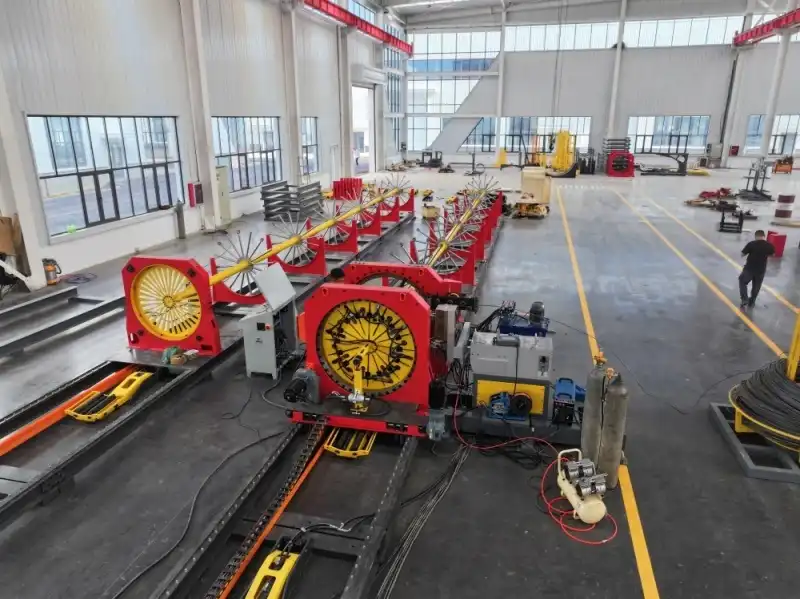
A rebar cage making machine automates the fabrication of cylindrical reinforcement cages used in pile foundations, bridge piers, and tunnels. By integrating mechanical, hydraulic, and electrical systems, it winds and welds spiral stirrups onto longitudinal bars with consistent precision — replacing slow, error-prone manual processes. On large construction projects where thousands of cages must meet strict dimensional tolerances, this equipment dramatically cuts cycle time, reduces skilled labor dependency, and ensures every cage meets structural specifications. The result is a measurable improvement in project schedule compliance, material utilization, and overall site safety.
Understanding the Role of Rebar Cage Making Machines in Construction Projects
Modern infrastructure projects like high-speed rails, highway bridges, and metro stations need reinforcing bars in sizes and shapes that can't be made by hand. For a single bored pile foundation, cages up to 12 meters long and wider than 2,000 mm may be needed. These cages are made in groups of dozens every day. Teams that do things by hand have trouble with inconsistent weld quality, spiral pitch deviation, and slow throughput. Each of these problems can be solved directly by automated cage welding tools.
How Automation Replaces Labor-Intensive Fabrication?
Fully automatic reinforced cage welding machines use a PLC control system with a touchscreen HMI to make sure that the welding tool moves in the right direction and the main bar assembly rotates. The screen is where operators set the cage length, spiral pitch, and width. The machine then does gas-shielded welding at every intersection point without any help from a person. This prevents burn-through and missed welds. A study from 2022 by the China Association of Building Material Equipment says that automated cage fabrication cuts the number of weld defects by more than 60% compared to human methods.
Machine Variants and Their Application Scope
The six basic models in Zhongji Luyuan's LYGH series cover cage widths from 500 mm to 3,000 mm. The models are named LYGH-1500 through LYGH-3000. Sizes of the main bars range from φ16 mm to φ50 mm, and the sizes of the spiral bars range from φ5 mm to φ16 mm. All models can handle cage lengths of up to 12 meters, and special project needs can lead to custom designs. Because a rebar cage making machine in this series covers so many specifications, it can be used for pile foundations, bridge engineering, and urban rail transit all at the same time.
Key Benefits of Using Rebar Cage Making Machines for Large Construction Projects
When purchasing reinforcement cage fabrication tools, teams always look for three things: better output, lower labor costs, and uniform weld quality. All three are met by the LYGH series, and the practical data backs this up.
Here are some of the best things about this line of equipment:
- High production output with verified efficiency. Under standard site conditions, the LYGH series produces approximately 8 cages per 10-hour shift. With automatic welding enabled, only 1–2 operators are required per shift, compared to 2–4 for manual welding configurations. This staffing reduction directly lowers daily labor expenditure while sustaining or increasing cage output.
- Stable, verifiable weld quality. Gas-shielded welding combined with the top-mounted automatic welding manipulator produces consistent fusion at every spiral-to-main bar joint. The system eliminates missing welds and false welds — two failure modes that compromise structural integrity and trigger costly rework on high-load foundations.
- Broad diameter adaptability. The LYGH-2500 and LYGH-3000 models handle cage diameters up to 2,500 mm and 3,000 mm, respectively, making them suitable for large-diameter bored piles on bridge and highway projects where foundation loads are extreme.
- Durable, low-maintenance construction. Each model uses a heavy-duty steel frame with a reinforced chassis. Hydraulic pressure operates at ≤16 MPa, and air supply pressure for automatic welding stays at ≤0.8 MPa — both well within conservative operating margins that extend component lifespan.
These benefits all help infrastructure companies with the problems they face most often, such as a lack of workers, tight deadlines, and the strict metal quality standards needed for bridge and rail foundation engineering. In a normal project cycle, equipment that works well in all four directions at the same time gives a good return on investment.
Comparing Types of Rebar Cage Making Machines for Optimal Procurement Decisions
Each project has different needs, and choosing the right rebar cage making machine depends on the cage diameter range, daily volume goals, budget, and available floor space. Procurement managers can make smart choices when they know how different configurations work with these factors.
Automated vs. Manual Welding Configurations
Fully automatic welding requires a lot less work from the operator and makes the weld shape more uniform. Manual welding setups are cheaper up front and can be used for cages that aren't normal forms. When there are a lot of cages to work on every day, and the specifications are always the same, like with highway pile foundations, automatic welding quickly pays for itself by saving time and labor. Manual configurations may be more flexible for smaller processing centers that get a lot of different, short-run orders.
Model Selection by Cage Diameter
| Model | Cage Diameter Range | Equipment Power | Footprint (with Auto Welding) | |
|---|---|---|---|---|
| LYGH-1500 | 500–1500 mm | 16 KW | 28 m × 8.5 m | |
| LYGH-1800 | 500–1800 mm | 18 KW | 28 m × 8.5 m | |
| LYGH-2000 | 600–2000 mm | 23 KW | 28 m × 9 m | |
| LYGH-2500 | 800–2500 mm | 25 KW | 28 m × 11.5 m | |
| LYGH-3000 | 800–3000 mm | 38 KW | 28 m × 13.5 m | |
| Model | Cage Diameter Range | Equipment Power | Footprint (with Auto Welding) | LYGH-1500: 500–1500 mm; 16 KW; 28 m × 8.5 m; LYGH-1800: 500–1800 mm; 18 KW; 28 m × 8.5 m; LYGH-2000: 600–2000 mm; 23 KW; 28 m × 9 m; LYGH-2500: 800–2500 mm; 25 KW; 28 m × 11.5 m; LYGH-3000: 800–3000 mm; 38 KW; 28 m × 13.5 m; |
Practical Guidelines for Procuring and Maintaining a Rebar Cage Making Machine
Buying a rebar cage making machine from a well-known company that has completed similar projects in the past lowers the risk of the purchase by a large amount. Along with the headline price, buyers should look at lead time, installation help, and guarantee coverage. Zhongji Luyuan was established in 2016 with a registered capital of 50 million yuan. It has provided reinforcement processing systems for projects in China Railway, China State Construction, and China Communications Construction. This is a good example of how reliable equipment can be in tough site conditions.
Maintenance Practices That Protect Uptime
By lubricating the guide rails and drive chains every day and calibrating the PLC sensors once a month, the accuracy of the measurements stays within acceptable limits. The LYGH series' modular frame design makes it easier to get to parts, which makes planned upkeep faster and easier for people who aren't skilled in that area. The after-sales team at Zhongji Luyuan helps with installation, commissioning, user training, and online diagnostic support. This makes sure that equipment downtime doesn't become a schedule risk.

Future Trends and Innovations in Rebar Cage Making Machines
Real-time production tracking and predictive maintenance are at the heart of the next big step forward in making reinforcement cages. IoT-connected PLC systems can now send data about the quality of welds and the performance of motors to site management dashboards. This lets project engineers see what the fabrication output is without having to walk the production floor. AI-assisted pitch control is becoming a way to get rid of spiral variation on long cages, where errors add up over 10–12 meter runs. Welding processes use less power per cage because of energy-efficient drive systems. This is in line with the sustainability promises that public infrastructure clients in the US and around the world are asking for more and more.
Conclusion
Automatic tools for making reinforcement cages used to be a productivity boost, but now a rebar cage making machine is a must-have for big building projects. The LYGH series can handle all kinds of projects, from 500 mm diameter pile foundations to 3,000 mm diameter bridge piers. It has a fully automatic PLC-controlled system that cuts down on labor, gets rid of weld flaws, and keeps output steady across multiple shifts. This series is a good choice for procurement teams looking at rebar cage welding equipment for energy infrastructure, bridges, highways, metro systems, or metro systems. It has a wide range of models, and the company has a history of providing good after-sales service.
FAQ
How long does installation and commissioning typically take?
Standard installation for a LYGH series machine takes between 3 and 7 days, based on how ready the site is and the size of the machine. Usually, commissioning and training the user take an extra two to three days. Zhongji Luyuan is helping with technology issues on-site during this whole process.
What routine maintenance does the equipment require?
It is best to grease the guide bars and drive chains every day. Weld positioning accuracy is maintained by calibrating the PLC sensor once a month. The flexible structure lets parts be replaced without taking the whole machine apart, which cuts down on repair downtime.
Can the machine handle different cage diameters on the same production line?
Yes. The tablet CNC interface in the LYGH line makes it easy to switch between specifications quickly. It's possible for operators to change the cage width, spiral pitch, and main bar count without having to retool mechanically. This means that processing centers can handle multiple project requirements at the same time.
What welding method does the equipment use?
An automatic welding tool does gas protected welding for the system. This method creates stable fusion at every point where the spiral and main bar meet, and the 30 KW of specialized welding power makes sure that the weld goes through evenly across the whole diameter range.
Partner with Zhongji Luyuan for Your Next Project
Zhongji Luyuan has a wide range of rebar cage making machine models that are designed to work in tough infrastructure situations. Our LYGH series gives your team the automation, accuracy, and dependability they need for projects like bridges, rail, highways, and energy. It has been used successfully on these types of projects in the past. Get in touch with our engineering team right away to talk about the details of your project and get a unique equipment quote. You can email us at sales2@shandongluyuan.com or go to shandongluyuan.com.
References
1. China Association of Building Material Equipment. Annual Report on Construction Machinery Automation Standards. 2022.
2. American Concrete Institute. ACI 318-19: Building Code Requirements for Structural Concrete. 2019.
3. Engineering News-Record. Infrastructure Automation Trends in Heavy Civil Construction. 2023.
4. International Federation for Structural Concrete (fib). fib Bulletin 72: Bond and Anchorage of Embedded Reinforcement. 2014.
5. Construction Industry Institute. Prefabrication and Modularization: Increasing Productivity in the Construction Industry. 2012.
6. ASTM International. ASTM A615/A615M: Standard Specification for Deformed and Plain Carbon-Steel Bars for Concrete Reinforcement. 2022.