What Applications Benefit from LYWQ-50 CNC Horizontal Rebar Bending Center in Infrastructure Construction?
Oct 13, 2026
The CNC Horizontal Rebar Bending Center LYWQ-50 delivers measurable value across a wide range of infrastructure construction scenarios. From high-speed railway fabrication shops to metro construction sites, bridge engineering yards, and nuclear power facilities, this machine addresses the core challenge that large-scale projects share: producing high-volume, dimensionally consistent bent metal components under tight schedules. With a 500kN nominal pressure capacity, ±0.3° bending angle accuracy, and automatic springback compensation, the LYWQ-50 gives procurement and engineering teams a reliable production platform that reduces rework, cuts labor dependency, and keeps project timelines on track.
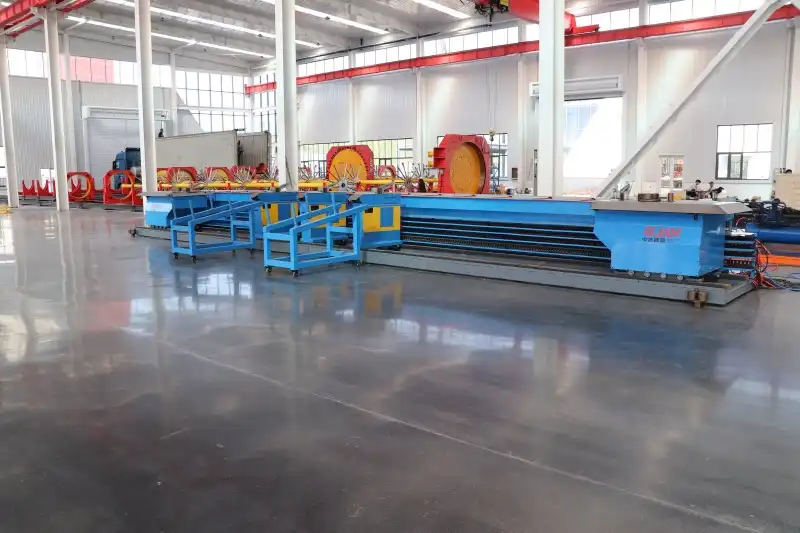
Understanding the Role of the LYWQ-50 in Infrastructure Construction
Building projects are getting bigger and need more complex technology. Modern structural engineering demands a lot of volume and tight tolerances, which can't be met by manual bending methods. That's where horizontal CNC bending comes in handy.
What Makes Horizontal Bending Different
The horizontal design of the workbench is not just for looks. On a flat, level surface, a long copper busbar or a heavy steel plate works with the machine instead of against it. Long pieces of work can sag on vertical machines, which causes angular errors that workers have to check and fix by hand. The LYWQ-50 gets rid of that variable completely, which is why it has a fixed place in manufacturing shops that work with parts that are longer than 1,000mm.
How CNC Logic Transforms the Workflow
The industrial-grade PLC control system of the machine saves and quickly recalls multi-step bending programs. When operators enter the material type and goal angle, the controller figures out the over-bend compensation needed to take springback into account. Zhongji Luyuan's own tests show that this closed-loop method keeps the bending angle error within ±0.3° for 500 rounds in a row. This directly lowers the amount of high-value metal that is scrapped.
Meeting Infrastructure-Grade Repeatability Standards
Big infrastructure builders can't afford for thousands of similar parts to have different sizes. Positioning accuracy of ±0.1mm is achieved by the LYWQ-50's servo-controlled backgauge system. This meets the strict standards needed by rail transit, bridge, and nuclear power engineering.
Core Features and Technical Advantages for Infrastructure Use
Understanding the machine's technical profile helps procurement managers connect specifications to real project outcomes.
Bending Capacity and Material Range
The CNC Horizontal Rebar Bending Center LYWQ-50 operates at a nominal pressure of 500kN (50 tons), handling copper and aluminum busbars up to 200mm wide and 15–20mm thick. Specialized heat-treated Cr12MoV alloy dies protect workpiece surface integrity and maintain wear resistance through high-duty production cycles, meeting international electrical conductivity and surface finish standards.
Intelligent Control and Programming Interface
Here are the core control features that matter on a production floor. The machine comes pre-installed with a dedicated bending CAD/CAM interface. Operators can input coordinates directly or import DXF files for complex multi-bend sequences. The high-resolution touchscreen supports multi-step program storage, so changeover between component types takes minutes rather than hours. The system also carries Modbus TCP/IP compatibility and an RJ45 Ethernet port, making integration into MES environments straightforward for contractors running digital production floors.
These control capabilities directly address the intelligent manufacturing demand that large infrastructure contractors in North America and Europe now list as a primary procurement criterion.
Maintenance Design for Continuous Operation
The hydraulic system is built for 24/7 industrial use. Zhongji Luyuan recommends a hydraulic oil filter check every six months under standard eight-hour shifts and a full oil replacement every 2,000 operating hours. The quality assurance protocol includes a 24-hour continuous hydraulic stability test and laser protractor verification of angle repeatability before shipment, all aligned with CE and ISO 9001 standards.
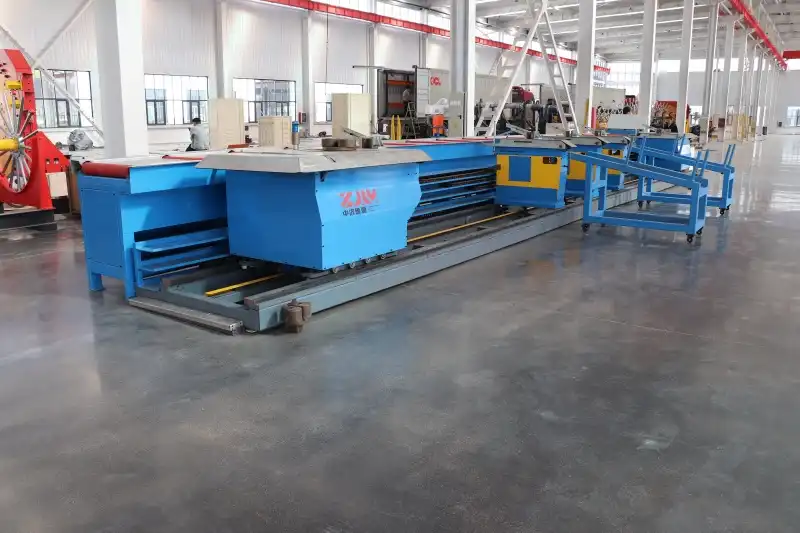
Comparative Insights: Why Choose the LYWQ-50 Over Other Bending Centers?
At this level of spending, buying choices need to be thought through side by side. Let me show you how the LYWQ-50 stacks up against other options.
LYWQ-50 vs. Vertical Bending Machines
Small manufacturing shops often use vertical machines, but they distort long pieces because of gravity, which is a known output bottleneck. The LYWQ-50's horizontal closed-loop frame structure makes the machine more rigid than C-frame designs. This means that longer busbars or structural steel sections need fewer angle adjustments and less rework.
LYWQ-50 vs. LYWQ-60
The LYWQ-60 can handle more weight and is best for handling heavy materials. But for most infrastructure fabrication jobs, like putting together switchgear, making parts for rail transit, and strengthening bridges, the CNC Horizontal Rebar Bending Center LYWQ-50's 500kN capacity is enough for all kinds of materials, and it doesn't take up as much space or use as much energy as the bigger model. It has a better cost-per-output ratio for projects with medium to high numbers.
Supplier Reliability as a Decision Factor
Zhongji Luyuan was established in 2016 with 50 million yuan in listed capital. It has long-term supply agreements with China Railroad, China State Construction, China Communications Construction, and China Nuclear Power Construction Corporation. The company sends goods to almost 100 different countries and areas, such as the US, South Korea, Malaysia, and Israel. Procurement managers in North America and Europe can use that track record as a reference before making a decision to buy capital equipment.
Practical Applications in Specific Infrastructure Scenarios
The LYWQ-50 performs across several distinct project types. The following scenarios reflect where this machine creates the most direct production value.
High-Speed Railway and Bridge Fabrication
Railway contractors processing large volumes of structural steel brackets and reinforcement components need consistent output without manual recalibration between pieces. The multi-step program storage and automatic springback compensation on the LYWQ-50 support high-throughput runs of identical parts, reducing per-unit fabrication time significantly on bridge girder and rail track bed components.
Metro and Urban Rail Transit
Metro construction timelines are tight. Fabrication delays on tunnel lining reinforcement components or station structural elements can push entire project schedules back. The LYWQ-50's servo backgauge system and CNC repeatability allow fabrication teams to run continuous production with minimal operator intervention, keeping pace with underground civil works schedules.
Nuclear Power and Energy Infrastructure
Nuclear power contractors face some of the most demanding dimensional tolerances in any construction sector. The machine's ±0.3° angular accuracy and CE/ISO 9001-aligned quality control protocol make it a fit for facilities where every component must meet documented precision standards. The electrical safety testing conducted on every unit—including insulation and grounding checks on the CNC control cabinet—specifically addresses electromagnetic interference concerns common in energy facility environments.
Procurement Considerations for North American and Global B2B Clients
When you buy capital tools across countries, you have to do more than just compare specs. At the buying stage, these things are important:
Pricing, Delivery, and Configuration
Zhongji Luyuan can set up equipment in a way that fits the needs of a specific project. Through the company's direct sales methods, you can talk about international shipping times, the availability of OEM parts, and financing choices. The business has a well-established export system that helps clients in North America and Europe with shipping, paperwork, and commissioning.
After-Sales Support Structure
Support after the sale includes help with installation, training for operators, and a quick repair service program. The testing of hydraulic stability and angle accuracy that was done before shipment cuts down on the time needed to start up the project site. For technical information, clients can email sales2@shandongluyuan.com or go to zjly2025.aixdb.cn to get in touch with the Zhongji Luyuan sales team.
Conclusion
The CNC Horizontal Rebar Bending Center LYWQ-50 is perfect for the production needs of building facilities for high-speed trains, metro transit, bridge engineering, and nuclear power. The 500kN bending strength, ±0.3° angular accuracy, automatic springback compensation, and MES-compatible control system make it a production platform that procurement and engineering teams can use for high-volume, precision-critical work. If a contractor is looking at CNC bending equipment for a future infrastructure project, this machine is a well-documented, technically sound choice that comes from a supplier with a track record of delivering goods around the world.
FAQ
1. What materials and thicknesses can the LYWQ-50 process?
The machine handles thick copper and aluminum busbars and steel plates. It maintains peak precision at up to 15mm for T2 copper and is rated for materials up to 20mm thick and 200mm wide.
2. How does the machine manage springback?
The CNC controller holds a built-in material coefficient database. When the operator enters the material type, the system automatically calculates the over-bending angle needed to compensate for springback, based on pre-programmed test data.
3. Is the LYWQ-50 compatible with digital production systems?
Yes. The machine includes an RJ45 Ethernet port and Modbus TCP/IP support, allowing integration into MES platforms and remote monitoring systems that meet Industry 4.0 operational standards.
4. What does the quality assurance process cover?
Each unit goes through a 24-hour hydraulic stability test, 500-cycle angle repeatability calibration with laser protractors, die alignment checks, and full electrical safety testing on the CNC control cabinet, all in line with CE and ISO 9001 requirements.
5. What ongoing maintenance does the hydraulic system need?
Under standard eight-hour shift operation, the hydraulic oil filter should be checked every six months. A full hydraulic oil replacement is recommended every 2,000 operating hours to maintain valve response speed and system consistency.
Request a Quote for the LYWQ-50 from Zhongji Luyuan
Zhongji Luyuan has been focused on CNC reinforcement processing for almost ten years and can use all kinds of equipment. We are ready to help you with your next buying cycle as a verified CNC Horizontal Rebar Bending Center LYWQ-50 maker that is trusted by large state-owned engineering groups in almost 100 countries. You can email our team at sales2@shandongluyuan.com to get cost information, specs, or a plan for a custom configuration.
References
1. Construction Mechanization — 2022
2. Journal of Construction Engineering and Management (ASCE) — 2021
3. Automation in Construction (Elsevier) — 2023
4. International Journal of Advanced Manufacturing Technology (Springer) — 2022
5. Engineering Procurement Construction Journal — 2021
6. Steel Construction (Ernst & Sohn) — 2023